 Sudden Valley Siding
 Why Decks in Sunnyland Wear Out Faster Than People Expect
A deck in Sunnyland doesn't fail the way a deck in a dry climate fails. Out here, the problem is almost never sun damage — it's water that never quite gets a chance to leave. Driving rain off the Sound blows in sideways more often than it falls straight down, which means it finds its way into every horizontal gap, screw hole, and board seam on a deck's surface. Add a moss season that can run from early fall through late spring, and you've got a structure that stays damp for months at a stretch instead of drying out between storms the way decks do in most of the country.
The result is predictable if you've worked on homes in Whatcom County long enough: rot that starts from the inside of a board or the underside of a ledger connection, long before it's visible from the top. By the time a homeowner notices soft decking or a wobbly rail, the damage underneath is usually further along than it looks. That's the pattern we plan around for every deck repair we take on in this area — not just patching what's visible, but checking the spots where moisture actually does its damage.
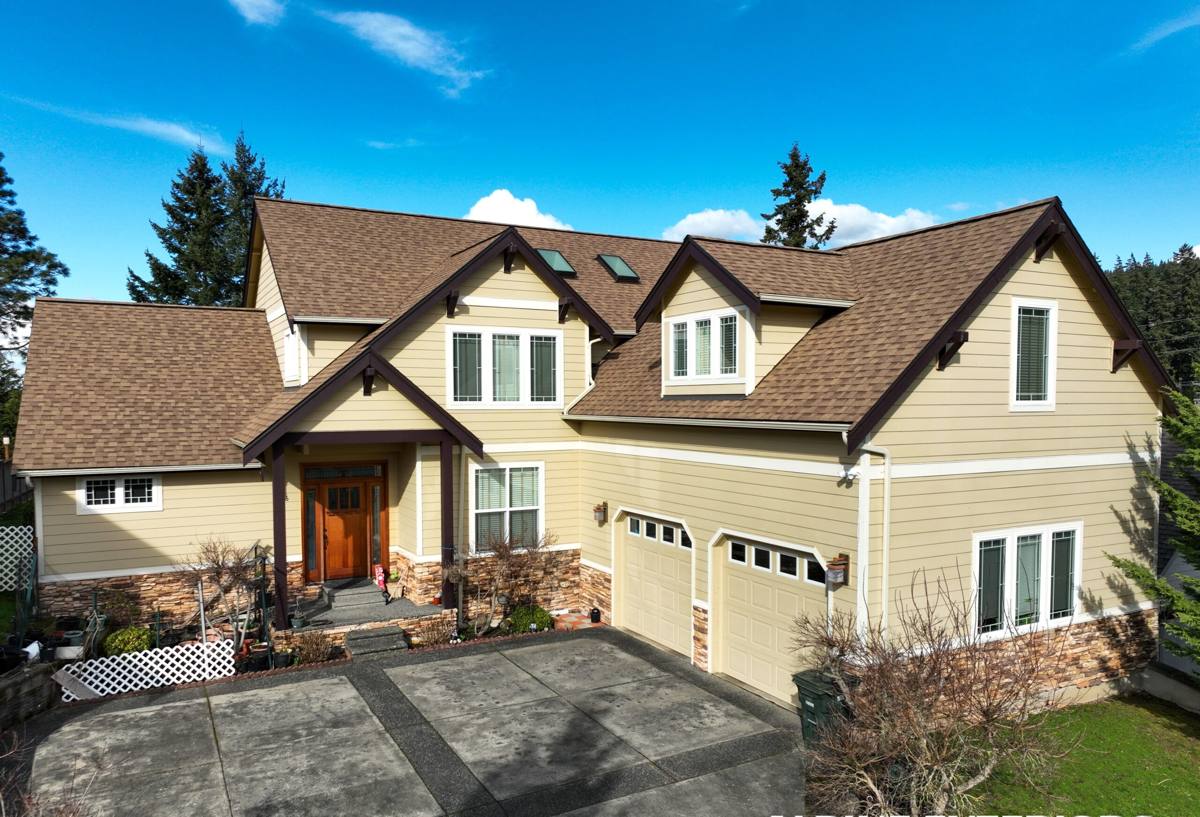
Signs a Sunnyland Deck Needs Repair
Most deck problems announce themselves in small ways long before anything becomes unsafe. Here's what we ask homeowners to watch for between now and their next inspection:
- Boards that feel spongy, springy, or noticeably softer underfoot in one area than the rest of the deck
- Gaps opening up where the deck's ledger board meets the house — a sign water may be getting behind the wall
- Rust streaks running down from screws, nails, or joist hangers
- Green or black growth that keeps coming back within weeks of cleaning, especially on north-facing or shaded sections
- Railings or posts that flex or wiggle when you lean on them
- Visible sagging between joists, or a board that's cupped (curled up at the edges) or crowned (humped in the middle)
- A musty smell coming from underneath the deck, particularly after a few dry days
Any one of these on its own might be minor. Two or three together, especially near the same section of decking, usually means the framing underneath deserves a closer look before more boards are added or replaced on top of it.
What a Correct Deck Repair Actually Involves
The Ledger Board and Structural Framing
The ledger board — the piece that bolts the deck to the house — is the single most important connection on the whole structure, and it's also the one most often repaired wrong. A quick screw-in patch from the top doesn't tell you whether water has been tracking behind the house's siding and sheathing at that connection point. Because we're a siding contractor first, this is where our crews spend extra time that a deck-only outfit might skip: checking the flashing and water-resistive barrier where the ledger meets the wall, not just the wood itself. If that detail was done wrong originally, replacing decking boards without fixing it just buys a few more years before the same rot comes back.
Joists, beams, and posts get the same scrutiny. We probe suspect areas with an awl rather than guessing from appearance — painted or stained wood can look sound on the surface while being soft a quarter-inch in. Any framing member with active rot gets sistered or replaced (never just painted over), and hardware — joist hangers, bolts, post bases — gets upgraded to corrosion-resistant fasteners if what's there has started to rust.
Decking Surface and Fasteners
Individual boards are the most visible repair and often the easiest to get wrong by rushing. Proper spacing between boards matters more here than in a dry climate — too tight and the deck can't shed water or dry out between storms; too wide and debris and moisture collect in the gaps. We also match or upgrade fasteners to stainless or coated hardware rated for coastal and marine-influenced air, since standard hardware can start showing corrosion within a few seasons in this environment.
Railings and Guardrails
Railing posts rot from the bottom up, usually where the post meets the decking or a ledger connection holds moisture against the wood. A railing repair that only addresses a loose top rail while leaving a soft post base isn't a repair — it's a liability. We check post attachment and code-compliant spacing as part of any deck repair, not as a separate add-on.
Repair or Replace? How to Tell
Not every deck problem calls for a full rebuild, and not every deck is worth patching. The table below is a general guide — the actual call depends on how far the damage has spread once we're underneath looking at it.
| Factor | Repair Is Usually Enough | Replacement Is Usually Smarter |
|---|---|---|
| Ledger board condition | Solid wood, flashing intact | Soft wood or visible water intrusion behind siding |
| Framing (joists/beams) | Isolated soft spots, sound elsewhere | Rot spread across multiple joists or the main beam |
| Decking boards | A handful of boards affected | Most boards cupped, cracked, or soft |
| Posts and footings | Posts sound, footings stable | Footing has heaved, shifted, or posts are rotted at the base |
| Age of the structure | Under 15-20 years, built to code | Older deck built before current fastener and flashing standards |
When a deck falls in a mix of both columns, we'll tell you plainly which parts are worth saving and which aren't — there's no benefit to either of us in replacing framing that's still sound, and no benefit to patching a deck that's going to need the same repair again in two years.
Materials That Actually Hold Up Here
Every decking material has trade-offs in a climate like this one, and we'd rather be upfront about them than sell a product that doesn't fit the situation.
Pressure-Treated Lumber
Still the standard for framing, and a reasonable choice for decking boards on a budget. It needs regular sealing to perform well here — skip that maintenance for a few years in a row and it will show it, especially in shaded, moss-prone areas that stay damp longer.
Cedar
Naturally rot-resistant and a good look for this region, but it's not maintenance-free. Left unsealed, cedar will gray and can develop soft spots faster than people expect given its reputation, particularly at fastener holes where water sits.
Composite Decking
Higher upfront cost, but it doesn't absorb water the way wood does, which matters a lot given how long surfaces stay wet here. The trade-off is that composite still needs proper ventilation underneath and correct fastening — done wrong, moisture can still cause problems at the framing level even if the boards themselves hold up. It's also not immune to moss and algae on the surface; it just won't rot from it the way wood can.
Our Deck Repair Process
- Full inspection, top and underneath. We check the ledger connection, framing, posts, footings, and decking surface — not just what's visible from standing on the deck.
- Honest scope and estimate. You get a clear breakdown of what needs repair now, what's borderline, and what can wait — with reasoning, not just a number.
- Structural repairs first. Any framing, ledger, or post issues get fixed before new decking goes down. Cosmetic work on top of a bad frame doesn't hold.
- Decking, fasteners, and railings. Matched or upgraded materials, spaced and fastened for drainage and long-term movement.
- Finish and seal. Where the material calls for it, we finish with a sealant or stain suited to sustained moisture exposure, not just a coastal-adjacent label.
Moss, Algae, and Keeping It From Coming Back
Even a well-repaired deck in Whatcom County will get moss and algae pressure again — that's the nature of a long, wet moss season, not a sign the repair failed. What changes after a correct repair is how much damage that growth can actually cause. Proper board spacing, sound flashing at the ledger, and fasteners that resist corrosion mean moss becomes a cleaning chore instead of a structural threat. We'll walk homeowners through a simple seasonal check — clearing debris from between boards and off the surface before it holds moisture through the wet months — so the next repair, if there ever is one, is small.
Why Local Experience in Sudden Valley Matters
Deck repair advice that works in a dry inland climate doesn't automatically work here, and a lot of general contractors treat every deck the same regardless of region. A crew that's already worked on homes around Sudden Valley knows which details actually matter in this environment — where water tends to collect against a house, which fastener finishes hold up and which don't, and how a moss season this long changes the maintenance conversation. If your property falls within the Sudden Valley community association, we're also used to working within whatever guidelines apply to exterior projects, so that's one less thing you have to manage yourself.
Because we're a siding company as much as a deck repair crew, we also look at the ledger connection with the same eye we'd use on a siding water-management detail — because structurally, it is one. That's a level of scrutiny that's easy to skip if decks are the only thing a crew works on.
If your deck in Sunnyland is showing any of the signs above, or you just want an honest opinion on whether it needs repair or replacement, we're glad to take a look. The estimate is free, there's no pressure to move forward, and you'll get a straight answer either way — just fill out the form below to get started.