 Sudden Valley Siding
 Living on Lake Whatcom: A Different Kind of Exterior Climate
Homes around Lake Whatcom and throughout Sudden Valley sit in one of the more demanding exterior environments in Whatcom County. The lake itself adds humidity to the air year-round, the surrounding forest keeps many properties shaded for long stretches of the day, and the county's broader marine climate — the same weather pattern that pushes salt-tinged air inland from Bellingham Bay and the Salish Sea — mixes with that lake moisture to keep exterior surfaces damp longer than they'd stay on a drier, more open lot. None of that is unusual for this part of Washington. But it does mean the materials and installation details that work fine on a sheltered in-town property don't always hold up the same way out here.
We install siding, roofing, windows, and decks for homes throughout the Lake Whatcom and Sudden Valley area, and the standards we build to are shaped directly by what this climate does to a house over time — not by what looks good in a showroom. On siding specifically, that means one material, installed one way: James Hardie fiber cement, installed to Hardie's published specifications. We'll explain why below.
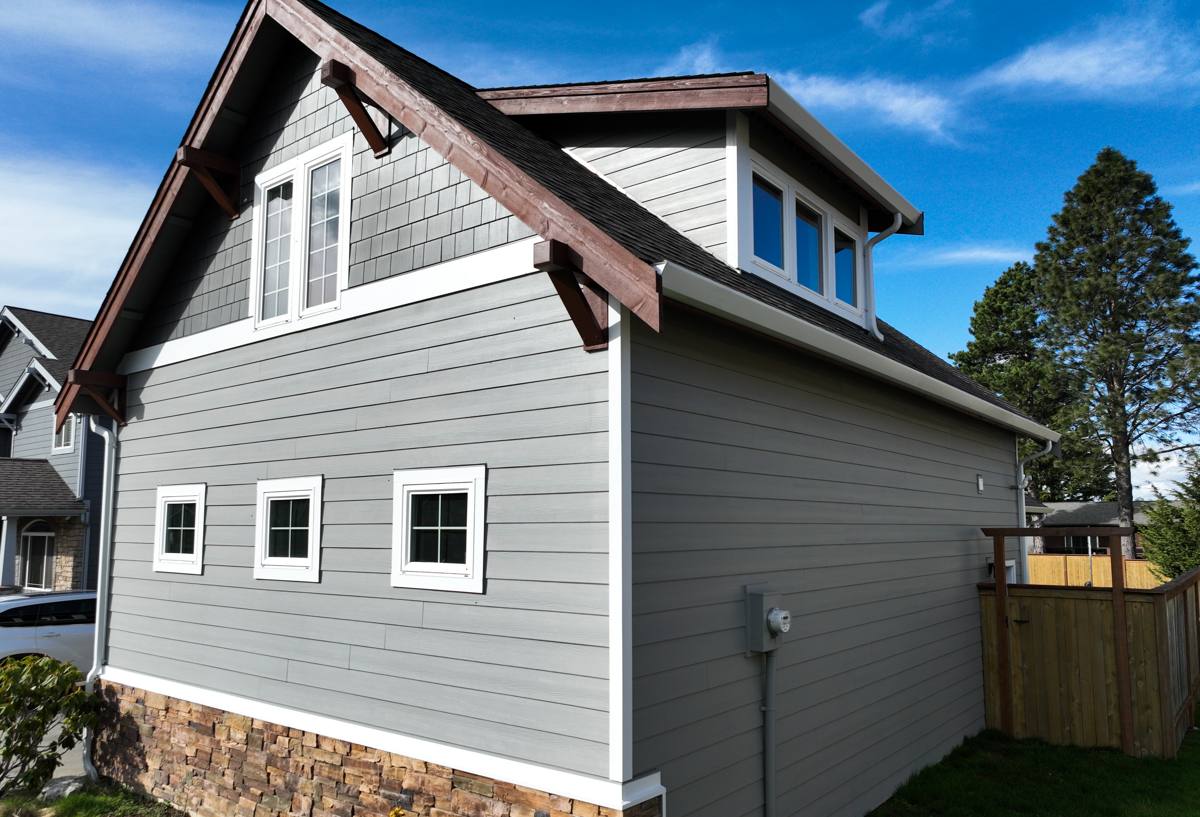
What Salt Air, Driving Rain, and a Long Moss Season Actually Do to a House
Salt-Tinged Marine Air
Whatcom County's coastal exposure means the air moving through this region carries a light salt content, even well inland. On its own that's not dramatic, but combined with constant moisture it accelerates corrosion on unprotected metal fasteners, flashing, and hardware, and it slowly breaks down finishes that weren't built to handle it. Over years, that's the kind of slow, cumulative wear that shows up as rust streaking, failed caulk joints, and finishes that fade or chalk faster than they should.
Driving Rain and Wind Exposure
Lake Whatcom sits in hilly terrain, and Sudden Valley's lots vary a lot in elevation, orientation, and exposure to wind coming across the water. That means wind-driven rain doesn't hit every wall of a house the same way — one elevation might take the brunt of a storm while another stays relatively dry. Siding, flashing, and window details all need to account for that uneven exposure rather than assuming a single, uniform level of weather protection will work across the whole house.
A Moss Season That Doesn't Really End
Shade, standing humidity, and mild temperatures are exactly what moss and mildew need to establish themselves, and around Lake Whatcom that combination is present for most of the year, not just the wettest months. Roofs are usually where it shows up first, especially on north-facing slopes and in valleys where debris collects, but it takes hold on porous or moisture-retentive siding too. Homes tucked under heavier tree cover tend to need more frequent attention simply because they never get a long enough dry stretch to fully shed that moisture.
Why We Install Only James Hardie Fiber Cement Siding
We don't offer a menu of siding brands. That's a deliberate, professional decision, not a limitation — and it came from watching what actually holds up on tear-offs and service calls in exactly this kind of climate.
- Non-combustible core: Fiber cement doesn't feed a fire the way wood-based siding can, which matters for safety and can matter for insurance underwriting in a wooded community like this one.
- Factory-applied ColorPlus finish: The color is baked on under controlled factory conditions rather than field-applied, and it resists fading, chalking, and moisture intrusion far longer than site-applied paint — a real advantage on walls that stay damp for extended periods.
- Climate-engineered HZ product lines: Hardie's HZ5 formulation is built for regions with heavy moisture exposure and cooler, wetter weather patterns, which is a good match for the Lake Whatcom area's combination of lake humidity, marine air, and shade.
- Dimensional stability: Fiber cement doesn't swell, cup, or warp the way engineered wood products can after repeated wetting cycles that never fully resolve on a shaded or lake-facing wall.
- Strong, transferable warranty: Hardie backs its products with one of the more substantial warranty structures in the industry, provided the installation follows their published specifications.
We won't install LP SmartSide, vinyl siding, Cemplank, Allura, primed spruce, or cedar. Every one of those products has a legitimate place in the market, and plenty of homeowners elsewhere are satisfied with them. But on a moisture-heavy, marine-influenced property like a typical Lake Whatcom or Sudden Valley lot, we've made the call that we'd rather stand fully behind one system than offer a cheaper option that quietly pushes long-term maintenance risk back onto the homeowner.
What Correct Installation Looks Like for This Area
Assessment and Moisture Mapping
Before any material goes up, we walk the exterior and note how sun, shade, wind, and rain exposure differ from wall to wall — something that varies more here than on a typical open, in-town lot. That assessment drives decisions about drainage detailing, fastener grade, and flashing at every penetration, rather than treating the whole house as a single uniform surface.
Drainage and Weather-Resistive Barrier Detail
Behind the siding, correct water-resistive barrier installation and, where the assembly calls for it, a drainage or rain-screen gap give any moisture that gets past the cladding a way out instead of a place to sit against the wall sheathing. In a climate that doesn't offer long dry stretches, that detail is what actually protects the structure underneath the siding.
Fastening and Finishing
Correct fastener type, spacing, and clearance from grade and roof lines matter everywhere, but they matter more where salt-tinged, moisture-heavy air is a constant factor. We follow Hardie's published fastening and clearance specifications, seal joints properly, and finish trim details so water is shed away from the wall assembly rather than channeled into it.
Roofing, Windows, and Decks for the Same Conditions
Siding is only part of the picture. Roofing takes the most direct hit from this environment — falling debris from surrounding trees, extended damp periods in shaded sections, and moss that establishes quickly on north-facing or low-slope areas all call for correct underlayment, properly lapped flashing at every transition, and ventilation that lets the roof deck actually dry between wet spells.
Windows are just as dependent on installation quality as the unit itself. A well-built window with poor flashing integration will still leak once the surrounding wall stays wet for extended periods, which is common on shaded or lake-facing elevations. We pay close attention to how new window flashing ties into the surrounding wall and siding, since that transition is one of the most common places water finds its way into a wall assembly.
Decks deal with their own version of the same problem: shade that slows drying, falling leaves and needles that trap moisture against the surface, and marine-influenced humidity that keeps wood-based materials damp longer than they'd stay on a drier lot. That combination accelerates rot in lower-grade decking and speeds corrosion in fasteners and structural connectors that aren't rated for sustained moisture exposure. We use hardware suited to this environment and walk homeowners through the real maintenance differences between wood and composite decking rather than giving a one-size-fits-all answer.
Comparing Siding Materials for Lake Whatcom Homes
| Material | Moisture Behavior | Salt/Marine Air Resistance | Typical Longevity Here |
|---|---|---|---|
| James Hardie fiber cement | Dimensionally stable, resists swelling | Good; factory finish resists fading and chalking | 30+ years with correct install |
| Vinyl siding | Can trap moisture behind panels in shaded, poorly ventilated walls | Fair; seams and fasteners more exposed to corrosion over time | Variable; shorter on damp, shaded elevations |
| LP SmartSide / engineered wood | Wood-based core is moisture-sensitive at cut edges and joints | Moderate; edge sealing matters more in constant marine humidity | Depends heavily on installation and upkeep |
| Cedar / primed wood | Absorbs and releases moisture readily | Fair; refinishing schedule shortens near the lake | Shorter without consistent maintenance |
What Exterior Work Tends to Cost — and Why It Varies
Every home is different, and we don't quote pricing without seeing the property, but a few factors consistently move the cost of siding, roofing, window, or deck work in the Lake Whatcom area more than they would on a typical in-town lot.
| Factor | Why It Matters Here |
|---|---|
| Elevation and wall exposure | Walls facing prevailing wind and rain often need extra drainage or flashing detail |
| Tree cover and access | Heavy canopy can affect scaffolding, staging, and cleanup, and shaded walls may need more prep |
| Existing moisture damage | Sheathing or framing repair found during tear-off adds scope that's hard to estimate sight unseen |
| Site and road access | Private roads and lot layout around Sudden Valley can affect material delivery and staging |
| Material and finish selection | Hardie panel profile, plank width, and ColorPlus color selection affect material cost |
Because so much of the cost depends on what an on-site look reveals — particularly any hidden moisture damage — we always start with a walk-through rather than a phone estimate.
A Homeowner's Maintenance Checklist for This Climate
Even the right materials, correctly installed, benefit from basic seasonal attention in an environment like this. A few habits go a long way:
- Rinse siding and trim once or twice a year to clear salt residue, pollen, and organic buildup before it sets in
- Clear moss from roof valleys and shaded slopes before it spreads, rather than waiting for a visible mat to form
- Keep gutters and downspouts clear of needles and leaf debris, especially on tree-lined lots
- Watch for caulk or sealant that's cracked or pulled away around windows, doors, and trim joints
- Look for rust staining at fasteners or metal flashing, which signals it's time for a closer inspection
- Check crawlspace and attic ventilation periodically — trapped moisture inside the structure causes more damage than what hits the exterior
Why Hiring a Local Crew Matters in Sudden Valley
Sudden Valley is a private community with its own road network and homeowners association, and a crew that regularly works here already understands the practical side of that — how to schedule around community access, and how much exposure changes from lot to lot even within the same neighborhood. That familiarity shows up in the details that matter: which walls need extra drainage detailing because they take the brunt of the wind, how flashing gets lapped on a steep, shaded roof plane, and which fastener grade actually holds up in this specific combination of lake humidity and marine air.
- Ask what siding material a contractor installs and why, and whether they stand behind it with a written warranty
- Confirm current Washington contractor licensing and active liability insurance
- Ask how they handle homes with heavy shade, tree cover, or lake-facing exposure, and what drainage detailing they use
- Ask about experience working within HOA or private-road communities, including access and scheduling
- Get a clear, written scope of work before signing anything
Our Process for Lake Whatcom and Sudden Valley Homes
We start with an on-site walk-through of the existing exterior, paying attention to how wind, shade, and moisture have affected different elevations over time — that variation is usually more pronounced here than on a typical open lot. From there we put together a clear, written scope and timeline before any work begins, and we treat proper flashing, drainage, and moisture management as standard practice for a property like this, not as an upgrade.
If you're weighing siding, roofing, window, or deck work on a home near Lake Whatcom or in Sudden Valley, we're glad to walk the exterior with you and give an honest read on what it actually needs. Reach out below for a free, no-pressure estimate.