 Sudden Valley Siding
 The Problem You Can't See Is the One That Costs You
By the time siding looks bad from the curb — buckling, staining, soft spots, paint that won't hold — the damage usually started months or years earlier, on the inside of the wall. Siding's real job isn't decoration. It's managing water: shedding it, venting it, and keeping it from reaching the wood sheathing, framing, and insulation underneath. When that system fails, it fails quietly at first. The visible symptoms are the last chapter of the story, not the first.
Homeowners in Sudden Valley and the rest of Whatcom County deal with a specific combination of conditions that puts extra strain on that water-management system: salt-influenced coastal air, driving rain that comes in sideways off wind-driven storms, and a long moss season where surfaces stay damp for weeks at a stretch. None of that is unique to any one house — it's just the baseline your siding has to perform against, year after year.
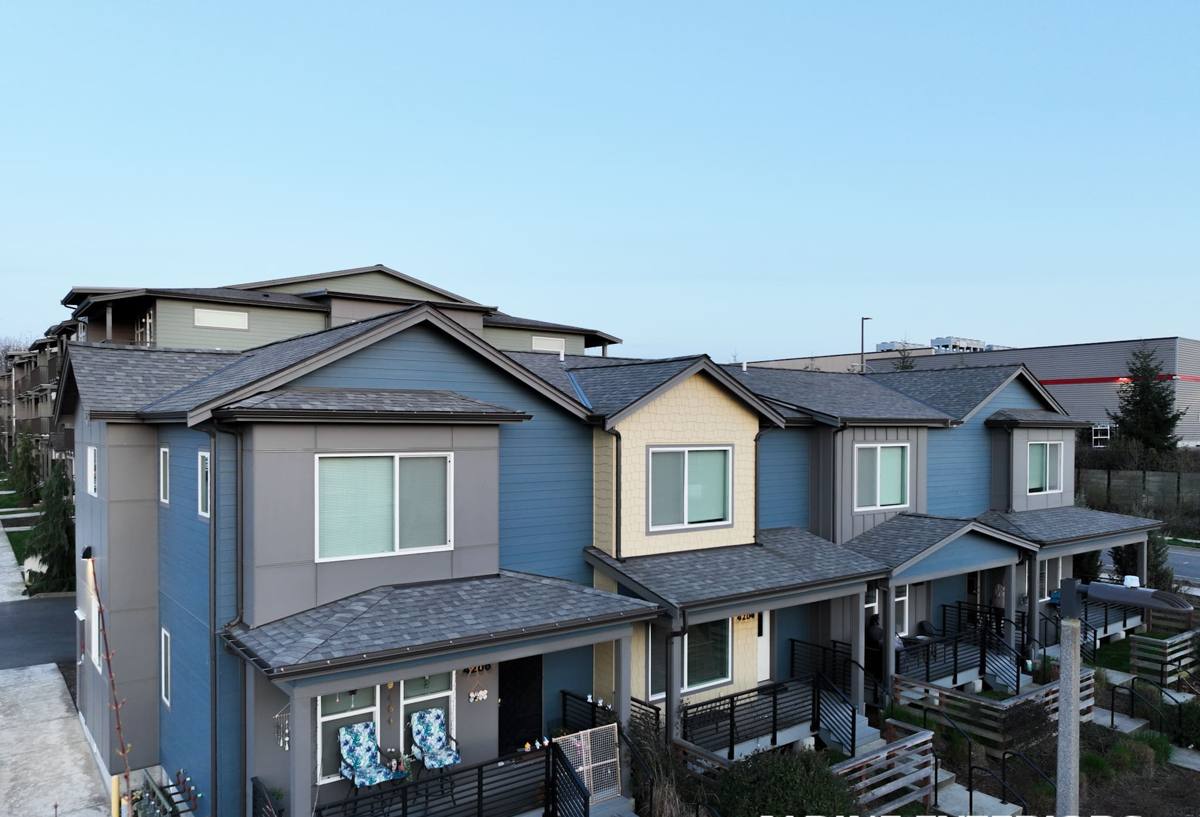
How Water Actually Gets Behind Siding
It's Rarely One Big Failure
Catastrophic leaks are rare. What actually happens is a series of small entry points that add up: a nail hole that wasn't sealed, a butt joint without proper flashing, caulking that shrank and cracked after a few Whatcom County winters, a window trim detail that relies on caulk instead of physical water-shedding. Driving rain — the kind that comes at a wall horizontally instead of falling straight down — finds every one of these gaps. Vertical rain mostly runs off. Wind-driven rain gets pushed into seams, laps, and fastener penetrations that were never designed to handle water under pressure.
Moss and Standing Moisture Make It Worse
A long moss season doesn't just look bad on a roofline — moss and algae hold moisture against a surface far longer than bare siding would otherwise stay wet. On the ground and gutter side, moss buildup in valleys and gutters causes water to back up and run down siding rather than away from it. That extended wet-dry cycle is what breaks down caulking, primer, and finish coatings faster than the manufacturer's testing usually assumes.
What Happens Once Water Gets In
Once moisture reaches the sheathing side of the wall assembly, the damage compounds:
- Sheathing rot — OSB and plywood sheathing lose structural integrity when they stay wet, sometimes crumbling before there's any visible exterior sign.
- Framing decay — untreated dimensional lumber studs and sill plates can develop rot that eventually requires structural repair, not just a siding replacement.
- Insulation breakdown — wet fiberglass or cellulose insulation loses R-value and can compress, meaning the moisture problem also becomes an energy-bill problem.
- Mold growth — wall cavities are dark, and once they're damp they're a mold environment, which can migrate to interior drywall and become an air-quality issue.
- Fastener corrosion — nails and screws holding siding in place corrode faster in salt-influenced coastal air, which loosens panels and opens new water paths.
None of this shows up on day one. It shows up as a soft spot near a window, a musty smell in a closet on an exterior wall, or a section of siding that suddenly looks like it's failing "out of nowhere" — when really it's been failing for a long time.
Reading the Warning Signs
Most homeowners don't need a moisture meter to catch this early — they need to know what to look for and take it seriously when they see it.
| What You See | What It Usually Means |
|---|---|
| Bubbling or peeling paint | Moisture is pushing out from behind the siding, breaking the paint bond |
| Soft or spongy siding when pressed | The substrate underneath has started to break down |
| Dark streaking or persistent mildew | A surface is staying wet longer than it should, often due to poor drainage or moss buildup above |
| Visible warping or buckling panels | The material has absorbed moisture and expanded or lost shape |
| Musty smell near an exterior wall inside the house | Moisture has likely reached the wall cavity, not just the siding surface |
| Siding pulling away from the wall at seams | Fasteners may be corroding or the substrate behind them is deteriorating |
Not All Siding Materials Handle Moisture the Same Way
This is the part that matters most when you're deciding what to put back on the house. Every siding material manages water differently, and the differences aren't cosmetic — they determine how long the material lasts in a wet climate and how much upkeep it demands in the meantime.
| Material | Moisture Behavior | Upkeep Demand |
|---|---|---|
| Vinyl siding | Sheds surface water well but relies entirely on the water-resistive barrier behind it; seams and J-channels can trap moisture if installed loosely | Low, but hidden problems go unnoticed longer since the material itself won't show rot |
| Cedar / primed spruce | Wood is naturally absorbent; performance depends entirely on paint/stain maintenance staying ahead of every exposed cut and joint | High — repainting and caulk maintenance on a recurring cycle |
| Engineered wood (LP SmartSide-type products) | Resin-treated to resist moisture better than raw wood, but edges and cut ends are vulnerable if field-cutting and sealing isn't done exactly to spec | Moderate — installation precision matters more than with most products |
| Fiber cement (James Hardie) | Cement-based composition doesn't absorb and swell like wood, doesn't rot, and holds a factory finish rather than relying on field-applied paint | Low — periodic cleaning and caulk inspection, no repainting cycle required |
We only install James Hardie fiber cement, and this table is a big part of why. We're not saying every other product is unusable — plenty of them perform fine under ideal installation and maintenance conditions. But "ideal conditions" is the catch. In a climate with driving rain, salt-influenced air, and long stretches of damp, mossy weather, the margin for installation error or a missed maintenance cycle is thinner than most homeowners realize. Fiber cement gives that margin back.
Installation Quality Matters as Much as the Material
No siding material — Hardie included — performs well if it's installed wrong. Most of the moisture failures we get called out to inspect trace back to one of a handful of installation shortcuts:
- Missing or incorrect flashing above windows, doors, and butt joints
- Siding installed tight to the ground or to a deck, with no clearance for drainage or drying
- Caulk used to "solve" a gap that should have been flashed instead
- Nailing patterns that don't match the manufacturer's fastening spec, leaving panels loose enough to work water in over time
- No weather-resistive barrier, or a barrier installed with unsealed seams
This is why we talk about installation to spec as much as we talk about the product itself. A correctly installed mid-tier product will usually outperform a premium product installed carelessly.
What You Can Do Now
You don't have to wait for a full inspection to start protecting your home. A simple seasonal check catches most problems while they're still cheap to fix:
- Walk the exterior after a heavy wind-driven rain and look for dark streaking or new staining
- Press gently on siding near ground level and around window sills to check for soft spots
- Clear moss and debris from gutters and roof valleys before it channels extra water onto walls
- Check caulk lines around windows, doors, and trim for cracking or gaps once a year
- Note any musty smell along exterior walls, especially in closets or corners that don't get much airflow
- Keep an eye on any spot where two different materials meet — trim to siding, siding to foundation — since transitions are where failures usually start
Why We Standardized on James Hardie
We made the decision years ago to install only James Hardie fiber cement siding, and moisture performance is the core reason. Hardie's HZ product lines are engineered specifically for climate zones like ours — built to handle sustained damp conditions without the swelling, rot, or paint failure that comes with wood-based products. The ColorPlus factory finish means the color and protective coating are baked on under controlled conditions, not applied on a ladder in variable weather, which is one less point of failure in a region where a painting window can be short. And the warranty is transferable and backed by a company with decades of fiber cement manufacturing behind it — not a marketing add-on.
We're not going to tell you every other product is a bad choice for every home. But we stopped installing the alternatives because we were tired of watching good work get undone by moisture two, five, or ten years later — and Hardie, installed correctly, gives homeowners in Sudden Valley and the rest of Whatcom County the best odds against the conditions this climate actually produces.
If you're seeing any of the warning signs above, or you just want an honest read on how your current siding is holding up, we're happy to take a look. There's no pressure and no cost to get a straight answer — fill out the form below to schedule a free estimate.