 Sudden Valley Siding
 A Product We're Not Guessing About
Homeowners in Sudden Valley ask us fairly often why we'll bid a re-side in James Hardie fiber cement but won't offer LP SmartSide as an option, even though it's a well-known, nationally distributed product with its own manufacturer warranty. It's a fair question, and it deserves a straight answer rather than a brush-off. We're not telling you SmartSide is a bad product in general terms. We're telling you why, after years of installing and servicing siding around Lake Whatcom, we decided it isn't the product we're willing to put our name behind on this specific stretch of Whatcom County.
That distinction matters more than it sounds like it should. A siding product can be legitimate, code-compliant, and backed by a real company, and still be a poor long-term match for a heavily shaded lakeside lot with a long wet season. This page walks through what LP SmartSide actually is, what we saw on real jobs, and why our standard on every siding project is James Hardie fiber cement — nothing else.
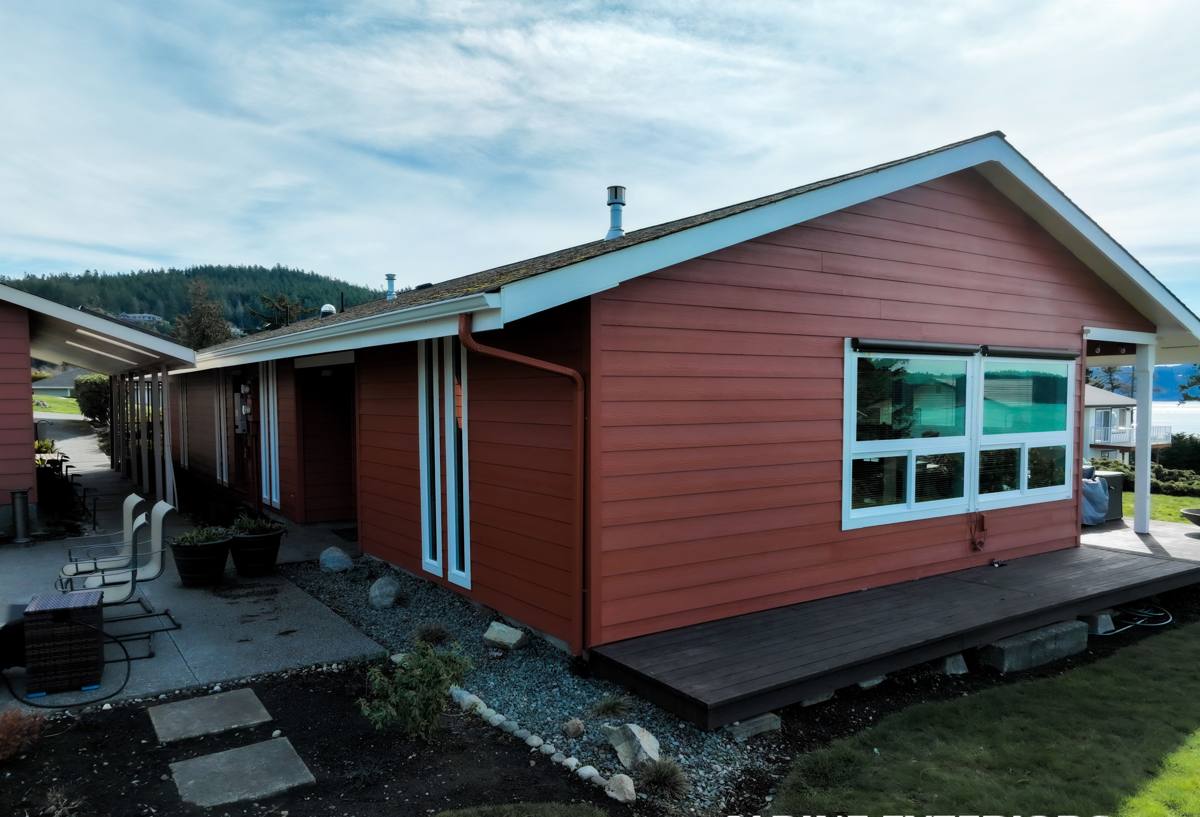
What LP SmartSide Actually Is
LP SmartSide is engineered wood siding: strand-based wood fiber, resins, and wax pressed into panels under heat, then treated with a zinc-borate process designed to resist moisture and insect damage better than raw lumber. It ships pre-primed or pre-finished in lap, panel, and trim profiles. It's noticeably lighter than fiber cement, quicker to cut with standard tools, and a crew can frame a house with it faster than with a heavier product. Those are real, legitimate advantages, and they're the reason it holds a solid share of the national siding market.
The part that matters here is what's under that treated surface: it's still wood fiber. The zinc-borate treatment and the factory coating do the work of keeping moisture out. As long as that protective layer stays fully intact for the life of the siding, the product performs close to what the marketing promises. Where we ran into trouble, repeatedly, was everywhere that protective layer gets interrupted — and on a real job, there are a lot of those spots.
Where the Protection Gets Broken
- Every field cut made on site exposes raw, untreated wood fiber, and a typical re-side involves dozens of cuts around windows, corners, and trim.
- Every fastener penetration is a small breach in the factory coating that has to be sealed correctly and stay sealed for decades.
- Every lap joint and butt seam depends on caulk, which is a maintenance item with a service life measured in years, not decades.
- Any nick or scuff in the finish from shipping or handling becomes an entry point if it isn't caught and touched up before the panel goes up.
What We Actually Saw on Service Calls
The problems we ran into weren't dramatic, whole-wall failures. They were slower and more localized: soft spots and swelling starting at cut edges near window and door trim, finish bubbling or lifting along horizontal lap joints where caulk had started to fail, and darker, spongier panel edges on shaded, north-facing walls where moisture never fully dried out between storms. On a job installed exactly to spec and maintained on schedule, we generally didn't see this. On jobs where a detail got rushed, or where a homeowner didn't stay on top of recaulking and repainting five or eight years in, the wood-based core did exactly what wood fiber does under sustained moisture exposure: it absorbed water and it didn't fully bounce back.
That's the honest version, not a scare story. LP SmartSide didn't fail on delivery. Its long-term performance depended on two things staying perfect for decades: our installation detail work, and the homeowner's ongoing maintenance schedule. In a drier inland climate, a small lapse in either one might not matter much. Around Lake Whatcom, where wet weather is the default rather than the exception, we didn't like how little margin for error that left us and our customers.
Why Sudden Valley's Climate Is a Harder Test
A Long, Damp Season Under Heavy Tree Cover
Sudden Valley sits on the south shore of Lake Whatcom under some of the heaviest second-growth tree canopy in the Bellingham area. Many homes here have at least one wall face that gets very little direct sun for most of the year, which means siding stays damp longer after every rain than it would on an open lot. Materials that need sun exposure to dry out between storms simply don't get that chance on a shaded, tree-lined property — and that's exactly the environment where a moisture-sensitive product starts showing problems years earlier than it would elsewhere.
Driving Rain and Salt Air Working Together
Whatcom County's weather doesn't arrive gently. Wind pushes rain sideways into lap joints, under trim, and into any gap in the water management system, which is a tougher test for caulked seams than an annual rainfall number suggests. Add in the salt-laden air that reaches inland from the Sound on top of the lake's own humidity, and you get a combination that accelerates the breakdown of exterior finishes and speeds up corrosion on exposed fasteners. A factory coating that holds up fine in a drier, inland region doesn't necessarily get the same service life here.
A Moss Season That Doesn't Really End
Shade, humidity, and mild temperatures are the exact recipe for moss and mildew growth, and Sudden Valley's dense canopy keeps that recipe active for most of the year. Roofs show it first, especially on north-facing slopes, but porous or moisture-holding siding materials pick it up too. Homes tucked back under heavier tree cover need more frequent attention than lots with open sky exposure, simply because the surfaces never fully dry out between wet spells.
How LP SmartSide and James Hardie Actually Compare
None of this means SmartSide is worthless everywhere. It means the trade-offs land differently depending on climate and maintenance commitment. Here's the honest comparison we walk homeowners through:
| Factor | LP SmartSide | James Hardie Fiber Cement |
|---|---|---|
| Core material | Engineered wood fiber, resin, zinc-borate treatment | Cement, sand, and cellulose fiber — non-combustible |
| Moisture behavior at cut edges | Exposed wood fiber unless every edge is sealed and stays sealed | Doesn't swell, rot, or absorb water the way wood fiber does |
| Weight and installation speed | Lighter, faster to cut and hang | Heavier, more installer skill required for correct fastening |
| Factory finish | Primed or pre-finished, quality varies by line | ColorPlus baked-on finish, engineered for UV and moisture |
| Fire resistance | Combustible wood-based product | Non-combustible, a real factor in Whatcom County's dry-season wildfire risk |
| Long-term maintenance | Depends on caulk and repaint schedule staying current for decades | Lower maintenance burden once installed correctly |
| Upfront material cost | Generally lower | Generally higher, offset by lower lifetime maintenance cost |
Why We Standardized on James Hardie
James Hardie fiber cement is made from cement, sand, and cellulose fiber. There's no wood fiber core to protect, so the failure mode we kept seeing with SmartSide — moisture creeping in at cut edges and joints — simply isn't a concern in the same way. Hardie also builds specific product lines engineered for different climate zones, and the HZ5 line is formulated for regions like ours that see sustained wet weather and freeze-thaw cycling rather than a mild, dry climate. That's an engineering decision baked into the product, not a marketing label.
The ColorPlus factory finish is baked on under controlled conditions rather than field-applied, which gives it more consistent coverage than primed products that need a full field coat after installation. It also comes with a longer finish warranty than what we could offer on a field-painted product. And because fiber cement is non-combustible, it adds a real layer of protection during Whatcom County's dry summer stretches, when wildfire smoke and elevated fire risk are a genuine seasonal concern even on the wetter west side of the state.
None of that means Hardie is maintenance-free or installer-proof. It's a heavier product that has to be fastened, gapped, and flashed correctly, and a sloppy installation of fiber cement will cause its own problems. That's exactly why installation quality is the other half of this decision — the best material on the market still needs to go on the wall correctly.
What to Ask Any Contractor Bidding Your Siding
Whether you're getting bids from us or anyone else, these are the questions that separate a real answer from a sales pitch:
- What siding products do you actually install, and why did you settle on that list?
- Have you personally gone back to service or repair jobs you installed five or more years ago, and what did you find?
- How do you detail cut edges, fastener penetrations, and lap joints on this specific product?
- What does the manufacturer's warranty actually cover, and what voids it?
- How does your installation approach change for a shaded, high-moisture lot like ones around Lake Whatcom compared to a drier, more open site?
If You Already Have LP SmartSide on Your Home
This isn't a page telling every SmartSide homeowner to panic. If it was installed correctly and you've kept up with caulk and paint maintenance, it may still have real service life left. A few things worth checking yourself before calling anyone out:
- Look closely at horizontal lap joints and any spot where caulk has cracked, shrunk, or gone missing.
- Check panel edges around windows, doors, and corners for soft spots or a slightly spongy feel when pressed.
- Look for darker discoloration or bubbling finish, especially on shaded or north-facing walls under heavy tree cover.
- Note when the siding was last repainted or recaulked, since problems tend to surface once that maintenance falls behind.
- If you find soft spots, don't wait on them. Moisture damage in wood-based siding tends to spread along the panel once it gets past the treated surface.
Get a Free, No-Pressure Estimate
Whether you're dealing with aging LP SmartSide on a Sudden Valley home or just comparing siding options before committing to anything, we're glad to walk the property and give you a straight, specific answer about what we're seeing and what we'd recommend. Reach out using the form below to schedule a free estimate — no pressure and no upsell script.