 Sudden Valley Siding
 Every siding problem eventually raises the same question: is this a patch job, or is the whole wall telling you something bigger is wrong? In Sudden Valley, where homes sit close to Lake Whatcom and take a steady diet of driving rain, salt-tinged air moving up from the Sound, and months of shaded moss growth every winter, that question comes up more often than homeowners expect. Getting the answer right matters, because repairing siding that's actually failing as a system just delays a more expensive fix, while replacing siding that only needed a repair wastes money you didn't need to spend.
This guide walks through how to tell the difference, what Whatcom County's climate does to that decision, and how the siding material itself changes the math.
Signs You're Looking at a Repair, Not a Replacement
Most siding problems start small and stay small if they're caught early. These are the situations where a targeted repair is usually the right call:
Isolated, single-cause damage
A cracked board from a fallen branch, a dented panel from a ladder mishap, or a section damaged by a one-time event (a storm, a lawn equipment accident) is almost always a repair. If the rest of the wall is sound and the damage has a clear, one-time cause, there's no reason to touch anything beyond that section.
Caulking, trim, and flashing failures
Gapped caulk joints, pulling trim boards, and failed flashing around windows and doors are extremely common in this climate and rarely mean the siding itself has failed. These are maintenance items. Left alone they can let water in, but caught in time they're a half-day fix, not a re-side.
Minor, surface-level moisture or mildew
Moss and mildew on the surface of siding, especially on north-facing or shaded walls, is a cleaning and maintenance issue in most cases — not proof the siding is compromised. It becomes a bigger concern only when it's accompanied by soft spots, staining that keeps returning after cleaning, or damage that shows up on the same wall repeatedly.
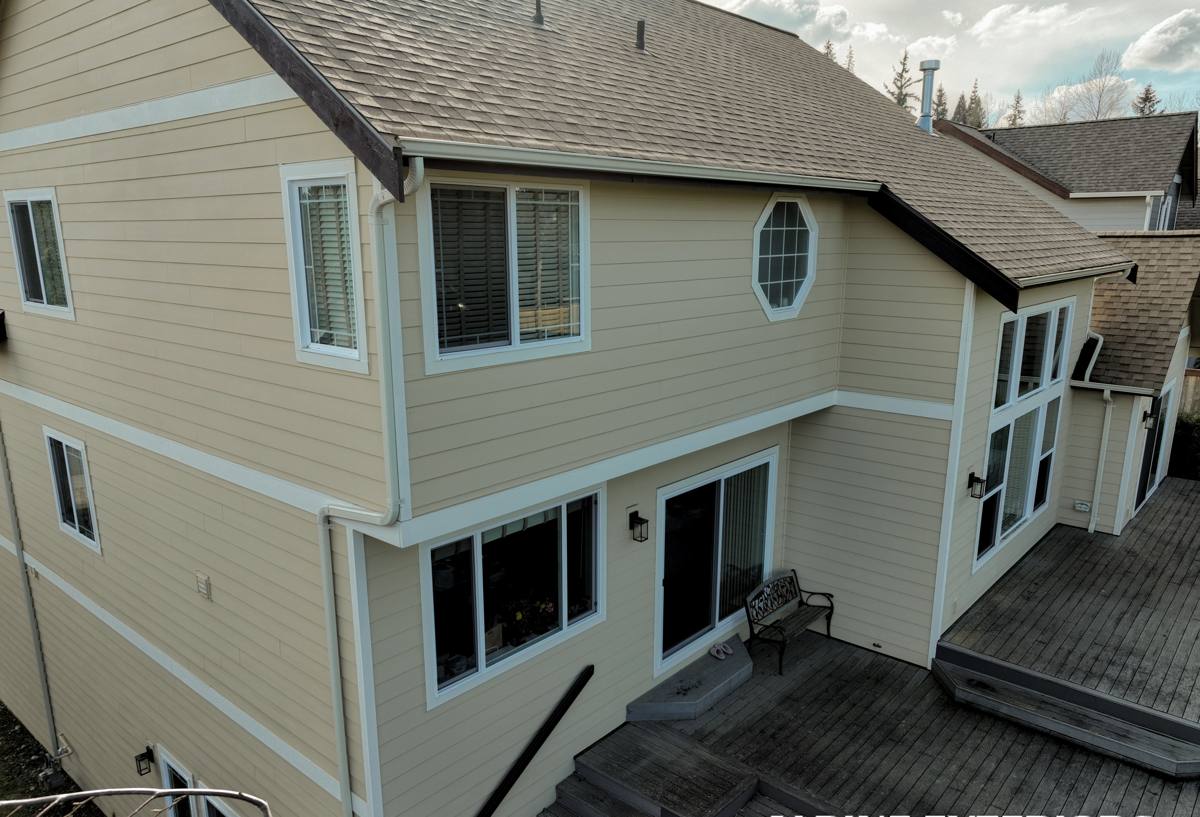
Signs That Point to Full Replacement
The picture changes when damage stops being a single event and starts being a pattern. These are the signals that a repair will just be a temporary patch on a failing system:
- Soft, spongy, or crumbling siding in multiple locations, not just one board
- Siding that's buckling, warping, or separating from the wall across a broad area
- Repeated repairs to the same general area within a few years
- Visible rot or staining on the sheathing behind siding once a section is pulled
- Siding that's simply reached the end of its expected service life for its material
- Paint or finish that won't hold anymore no matter how it's prepped
Age matters here as much as visible damage. A material nearing the end of its realistic lifespan often looks fine from the curb while quietly failing underneath — which is why a hands-on inspection matters more than a drive-by look.
Why Sudden Valley's Climate Complicates the Call
Whatcom County doesn't give siding an easy life. Driving rain off the water pushes moisture into every seam and joint that isn't perfectly sealed. Salt-carrying air accelerates corrosion on fasteners and trim hardware, especially closer to the water. And the long, shaded moss season here — often running from fall through spring — keeps north- and west-facing walls damp for weeks at a stretch, which is exactly the environment moss, mildew, and slow rot need to take hold.
The practical effect is that siding problems in Sudden Valley tend to be moisture problems first and cosmetic problems second. A wall that looks merely dirty or discolored from the street can be hiding damp sheathing behind it. That's why any repair-versus-replace decision here should include a look at what's happening behind the siding, not just what's visible on the surface.
Material Matters: How Your Siding Type Changes the Repair Math
Not all siding fails the same way, and not all siding is equally repairable. The material you have on your house right now changes both how likely you are to see problems in this climate and how practical it is to patch versus replace.
| Material | How It Typically Fails Here | Repairability |
|---|---|---|
| Vinyl | Cracks in cold snaps, fades unevenly, warps near heat sources; doesn't rot but doesn't stop water either | Individual panels can be swapped, but color-matching older, faded vinyl is often impossible |
| Cedar / primed spruce | Absorbs moisture, checks and cups, rots from the back where it can't be seen, needs repainting on a short cycle | Repairable in isolated spots, but repeated repairs are common and repainting is a recurring cost |
| Engineered wood (e.g. LP SmartSide) | Edge and end-cut swelling where moisture gets into the substrate, especially at butt joints and lower courses | Damaged boards can be replaced, but the underlying moisture path that caused the failure often isn't fixed by a swap alone |
| Fiber cement (James Hardie) | Very stable in moisture; issues are almost always installation-related (caulk, flashing, fastener placement) rather than the material itself | Individual planks can be replaced cleanly; ColorPlus factory finish holds color so patches blend in over time |
This is the core reason our crews stopped installing vinyl, LP SmartSide, primed spruce, and cedar years ago. It's not that any of those products are unusable — plenty of homes around Whatcom County have them and get by. It's that in a climate built on driving rain, salt air, and long wet seasons, we were doing repeat repair calls on the same walls, and we didn't want to keep selling homeowners a product we knew would bring them back. Fiber cement, and James Hardie's HZ5 product line specifically, is engineered for exactly this kind of climate exposure, and it's what we've standardized on for every job we do.
The Hidden Cost of "Just Patching" a Failing System
The temptation to patch instead of replace is understandable — it's cheaper up front and less disruptive. But when the underlying siding system has failed rather than just one section of it, patching has real hidden costs:
Moisture keeps finding the same path
If water got behind the siding once because of a systemic issue — bad flashing details, an underlying material that absorbs moisture, or a house wrap that's failed — a cosmetic patch doesn't fix that path. Water will find it again.
Sheathing and framing damage compounds
The longer moisture sits behind failing siding, the more likely it starts affecting the wood sheathing and framing underneath. That's a materially bigger repair than siding alone, and it's the scenario every homeowner wants to catch before it happens, not after.
Mismatched patches age visibly
Especially with faded vinyl or weathered wood siding, a patched section rarely matches for long. You end up with a wall that looks repaired rather than maintained, which affects curb appeal and resale.
A Practical Decision Checklist
Before deciding which way to go, walk your exterior and ask:
- Is the damage confined to one clear cause and one area, or does it show up in multiple places?
- When you press on a suspect area, does it feel solid or soft?
- Have you repaired this same general area more than once in the last few years?
- Is the siding approaching or past its material's typical service life?
- Does the finish or paint fail to hold no matter how well it's prepped?
- Is there any visible staining, gapping, or bulging near seams, corners, or trim?
- If you pulled one damaged board, would you expect to find dry sheathing behind it — or are you not sure?
If most answers point to "isolated" and "confined," a repair is a reasonable, honest recommendation. If you're circling "multiple," "again," or "not sure what's behind it," it's worth getting a full inspection before spending money on a patch.
What a Professional Inspection Should Actually Look At
A siding inspection that only looks at the surface isn't giving you the full picture. A useful inspection includes probing suspect areas for softness, checking moisture readings where damage is visible, examining flashing and caulk at every penetration (windows, doors, hose bibs, light fixtures), and — where damage is found — actually pulling a section to look at the sheathing behind it. That last step is the one homeowners skip most often, and it's usually the one that changes the recommendation from "repair" to "replace."
Why We Rebuild with James Hardie When Replacement Is the Right Call
When an inspection points to full replacement, the material you choose next matters as much as the workmanship. We install James Hardie fiber cement exclusively — not vinyl, not LP SmartSide, not Cemplank, not Allura, not primed spruce, not cedar — because it's non-combustible, holds up to the moisture load this climate throws at it, and carries a ColorPlus factory finish that doesn't chalk or fade the way field-applied paint does. Hardie's HZ product lines are engineered specifically for climate zones like ours, and the warranty backing it is transferable, which matters if you ever sell the house. When we replace siding in Sudden Valley, that's what goes back on the wall, because it's the product we're confident won't have us back for the same repair call in three years.
Getting a Straight Answer for Your Home
Every house and every wall is a little different, and the honest answer to "repair or replace" depends on what's actually happening behind your siding, not just what it looks like from the driveway. If you're weighing that decision on your own home in Sudden Valley or elsewhere in Whatcom County, we're happy to take a look and give you a straight, no-pressure read on where things stand — request a free estimate using the form below.