 Sudden Valley Siding
 Geneva and the Lake Whatcom Microclimate
Geneva sits in the cluster of lakeside communities around Lake Whatcom, just outside Sudden Valley in Whatcom County. It's a wooded, hilly part of the county, and that setting shapes what happens to a house's exterior over time. Homes here sit under a lot of tree cover, close to water, and in a part of Washington that sees a long, wet stretch of the year with short windows of hard sun in between. That combination is tougher on siding, trim, and roofing than most homeowners realize until they're dealing with the results.
Whatcom County as a whole gets a steady flow of marine air moving in off the Sound and the Strait of Georgia, carrying a faint salt component even well inland, along with driving rain that comes at buildings sideways during winter storms rather than straight down. Add in the tree canopy and lake-effect humidity around Geneva specifically, and you get long stretches where exterior surfaces simply don't fully dry out between rain events. That's the recipe for moss, mildew, and slow moisture damage — not a dramatic failure, but a gradual one that shows up as soft trim, discolored siding, and paint that won't hold.
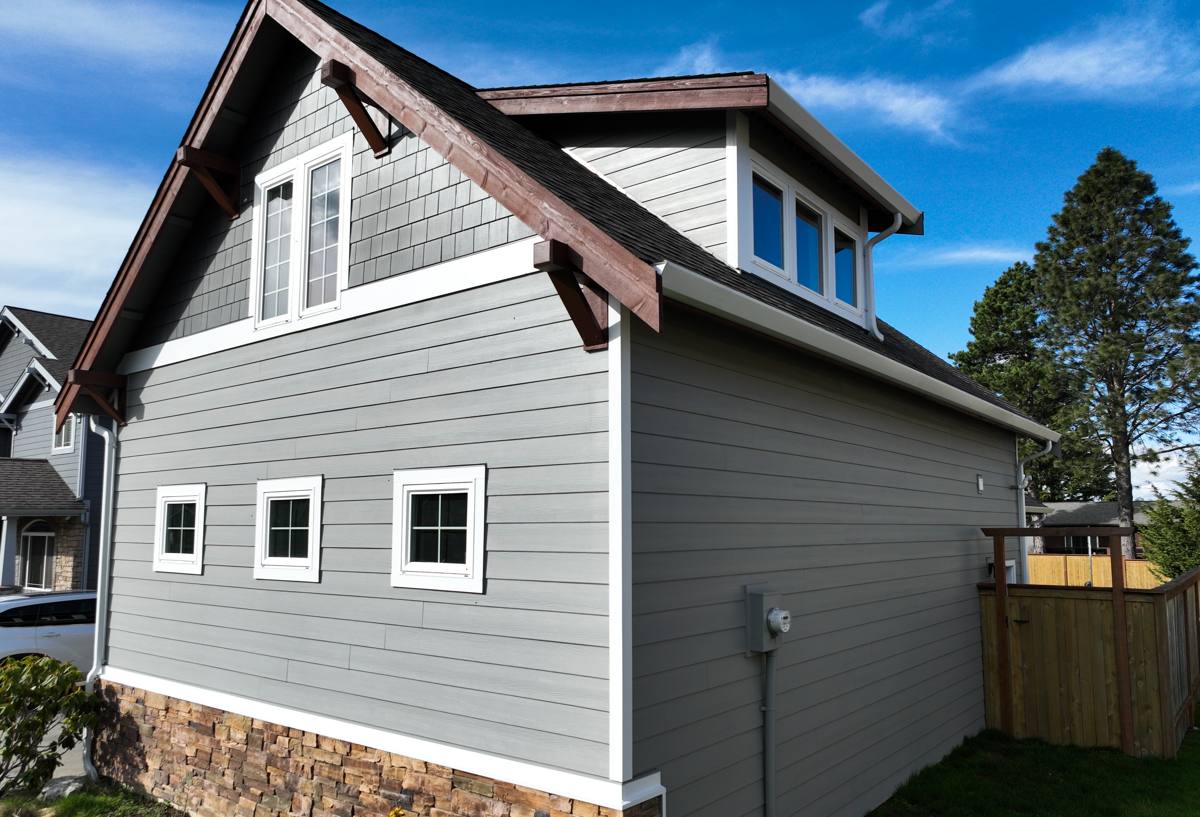
What This Climate Does to a House Over Time
Moss and Organic Growth
Shaded, moisture-prone lots around Geneva are ideal moss habitat. Moss holds water against a surface far longer than open air would, which matters more for some siding materials than others. Untreated wood and OSB-based products absorb that trapped moisture; factory-finished fiber cement sheds it far better because the substrate itself doesn't wick water the way wood fiber does.
Driving Rain and Wind-Driven Moisture
Winter storms here don't just fall on a roof — they push rain sideways into wall assemblies, lap joints, and anywhere flashing is thin or missing. Over years, that's where poorly installed siding fails first: not because the material itself is bad, but because water found a way behind it and nobody could see it happening until trim started going soft or paint started bubbling.
UV and Temperature Cycling
Sun exposure in this part of Washington is inconsistent — long grey stretches followed by intense, direct summer sun reflecting off the lake. That cycle of swelling, drying, and UV exposure is hard on paint film and on any siding material that depends on a field-applied finish to protect it.
Why We Only Install James Hardie Fiber Cement
We get asked regularly why we don't offer vinyl, LP SmartSide, or cedar alongside Hardie. It's not that those products have no place anywhere — it's that after years of doing exterior work in exactly this climate, we don't think they hold up the way homeowners expect them to, and we'd rather stand behind one system we trust than sell several we have reservations about.
| Material | How it handles this climate | Long-term concern |
|---|---|---|
| James Hardie fiber cement | Non-combustible, dimensionally stable, factory ColorPlus finish resists moisture and UV | Higher upfront cost than vinyl |
| Vinyl siding | Water-resistant surface but relies on gaps and laps that can let moisture behind it | Warps/fades with UV and temperature swings; hides trapped moisture |
| LP SmartSide | Engineered wood strand product, treated for moisture resistance | Wood-based substrate is still moisture-sensitive at cut edges and damage points |
| Cedar / primed spruce | Traditional look, breathes naturally | Needs ongoing refinishing; prone to rot and moss in shaded, damp lots |
Fiber cement's core advantage in a place like Geneva is that it isn't a food source for moss and doesn't swell or rot the way wood-based products can once moisture gets past the surface. James Hardie's HZ5 product line is engineered specifically for wetter, cooler climates like the Pacific Northwest, and the ColorPlus factory finish means the color coat is baked on under controlled conditions rather than applied on-site where weather and temperature can affect how well it cures and adheres.
How a Correct Hardie Installation Actually Works
Fiber cement is only as good as its installation. A huge share of the siding failures we see on older homes trace back to installation shortcuts, not the material itself. On every job, that means:
- Proper weather-resistive barrier and flashing behind every seam, window, and door opening — this is what actually keeps wind-driven rain out, not the siding surface itself
- Correct fastener type, spacing, and depth per the manufacturer's install guide, not generic nailing patterns
- Minimum clearance between siding and grade, decks, roof lines, and hardscaping so the bottom edge isn't sitting in standing moisture
- Caulked and sealed joints only where Hardie's specifications call for it — over-caulking can trap moisture just as badly as under-caulking
- Field-cut edges sealed to protect the fiber cement core where it's been trimmed on site
None of this is visible once the job is finished, which is exactly why it matters who does the work. Two houses can look identical from the street with completely different odds of a moisture problem five or ten years down the road.
Roofing, Windows, and Decks: Why the Whole Envelope Matters
Siding doesn't work in isolation. On a Geneva-area home, the roof, windows, and siding all share the job of keeping wind-driven rain out of the wall assembly. A roof with failing flashing at a wall intersection will feed water straight down behind good siding. Windows without proper flashing and integration into the siding plane are one of the most common sources of hidden leaks we find on older homes in this area. Decks attached to the house create another intersection point where flashing has to be right, or water tracks straight into the band board and wall framing behind it.
Because we handle siding, roofing, windows, and decks, we can look at a home's exterior as one connected system rather than patching one component and leaving the others as-is. That matters more in a wet, shaded lake community than almost anywhere else in the county.
What a Project Timeline Looks Like
Most full siding replacements on a typical Geneva-area home run a few weeks from start to finish, weather permitting — Whatcom County's wet season can add delays, which is part of why scheduling around dry stretches matters here more than in drier parts of the state. A general sequence:
- On-site assessment of existing siding, trim, and any moisture or rot found during removal
- Repair or replacement of any damaged sheathing and installation of a proper weather-resistive barrier
- Flashing installation at every window, door, and penetration
- Hardie panel or lap installation per manufacturer spec
- Trim, caulking, and touch-up paint at cut edges
- Final walkthrough
Cost Factors Homeowners Should Understand
Every home is different, but the same handful of factors drive most of the cost variation we see on jobs in this area:
| Factor | Why it matters |
|---|---|
| Extent of existing damage | Hidden rot or moisture found during tear-off adds sheathing repair before new siding goes on |
| Home size and complexity | More corners, gables, and trim detail means more labor and material cutting |
| Siding profile chosen | Lap, panel, and shingle-style Hardie products vary in material and labor cost |
| Access and site conditions | Steep or wooded lots, common around Lake Whatcom, can slow staging and scaffolding |
| Paired work | Bundling roofing, window, or deck work into the same project can reduce overall disruption and sometimes overall cost |
We don't quote broad numbers without seeing the home — too many variables affect it — but we're upfront about what's driving the cost on your specific project rather than handing over a number with no explanation behind it.
Choosing a Contractor for This Area
Not every exterior contractor working in Whatcom County has real experience with the specific problems a lake-adjacent, tree-shaded lot like Geneva creates. Before hiring anyone, it's worth asking:
- Do you carry Washington state contractor licensing and insurance, and can you provide proof?
- Have you worked on homes specifically around Lake Whatcom or Sudden Valley, and do you understand the moss and moisture issues common here?
- What's your flashing and weather-barrier detail at windows, doors, and roof intersections?
- Are you a manufacturer-certified installer for the siding product you're proposing?
- What does your warranty cover — material, labor, or both — and for how long?
A local crew that's replaced siding on other homes in this exact microclimate will catch things a crew unfamiliar with the area might miss — where moss tends to establish, which sides of a house take the worst wind-driven rain, how much clearance a lot actually needs given the tree cover.
Maintenance: What Homeowners Can Do Between Visits
Even the best siding system benefits from basic upkeep, especially in a moss-prone environment like Geneva. Rinsing siding periodically to discourage moss and organic buildup, keeping gutters clear so water isn't overflowing onto walls, trimming back vegetation that keeps siding shaded and damp, and having caulking and trim checked every few years all extend the life of the exterior. None of this requires special products — mainly just consistency, which is easy to let slip on a wooded lot where problems aren't always visible from the ground.
If you're weighing a siding, roofing, window, or deck project for a home in Geneva or elsewhere around Sudden Valley, we're happy to take a look and talk through what we're seeing — no pressure, no obligation. A free estimate is a good way to find out where your home actually stands.