 Sudden Valley Siding
 Edgemoor's Waterfront Climate Is Hard on Exteriors
Homes in Edgemoor sit close enough to the water that salt air is a daily fact of life, not an occasional nuisance. Combine that with the driving, wind-blown rain that rolls in off Bellingham Bay through the fall and winter, plus a moss season that can stretch for months in the shaded, tree-lined lots common to this part of Whatcom County, and you have a climate that quietly punishes weak exterior materials year after year. Paint fades faster near salt spray. Untreated wood trim softens. Seams and laps that weren't detailed correctly become the first place water finds its way in. None of this happens overnight — it happens in the gap between what a product looks like on install day and how it actually performs after five, ten, or twenty winters in a marine environment.
That gap is exactly what we pay attention to. We're a Whatcom County exterior contractor, and Edgemoor is squarely in our service area. We've seen what holds up out here and what doesn't, and we build our recommendations around that experience rather than around whatever is cheapest to install.
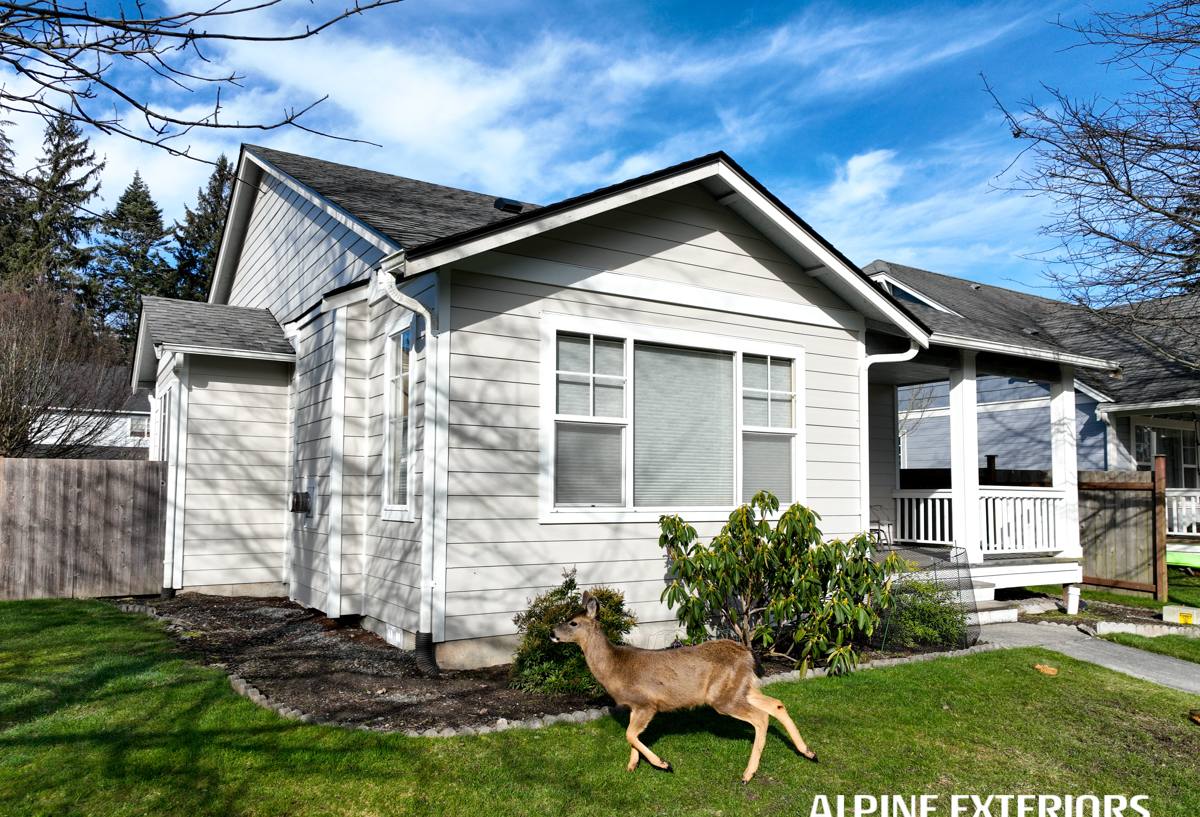
Why We Install Only James Hardie Fiber Cement Siding
We don't install vinyl, LP SmartSide, Cemplank, Allura, primed spruce, or cedar. That's a deliberate standard, not a lack of options. Every one of those products can be installed correctly and can look good on day one — the question we care about is how a siding system behaves after years of the specific weather Edgemoor gets: salt-laden air, repeated wet-dry cycling, and near-constant shade-driven moisture on north- and water-facing walls.
Non-Combustible, Dimensionally Stable
James Hardie's fiber cement core doesn't expand and contract with moisture the way wood-based products do, and it won't ignite the way vinyl or wood siding can. In a marine climate where boards are cycling through wet mornings and drier afternoons for most of the year, that dimensional stability is what keeps seams tight and paint lines crisp instead of gapping and cracking.
ColorPlus Factory Finish
Hardie's ColorPlus finish is baked on at the factory under controlled conditions, which gives it better fade and chip resistance than field-applied paint — a meaningful advantage anywhere salt air accelerates finish breakdown. It also means touch-ups match instead of requiring a full repaint down the road.
Engineered for This Region
Hardie makes climate-specific product lines, and the HZ5 formulation is engineered for regions with the kind of moisture exposure Western Washington deals with. That's not a marketing detail to us — it's the reason the product is on our trucks and nothing else is.
A Warranty Worth Having
Hardie backs its siding with a strong, transferable limited warranty. For a lot of Edgemoor homeowners, that transferability matters at resale — it's one less question a buyer's inspector has to raise.
We'd rather explain honestly why we passed on other products than oversell one we don't fully stand behind. If you want the longer version of that reasoning for any specific alternative, we're glad to walk through it.
It's Not Just Siding — The Whole Exterior Has to Work Together
Siding is the piece people notice first, but it's one part of a system. We also handle roofing, windows, and decks, because a house's exterior only performs as well as its weakest connection point. A new siding job installed against a roof with failing flashing, or around windows with degraded seals, just relocates the water problem instead of solving it.
Roofing
Roof-to-wall flashing details are one of the most common failure points we find on older homes near the water. Where the roofline meets siding is exactly where wind-driven rain gets pushed hardest, so that transition needs to be right.
Windows
Old window flashing and worn seals are a quiet source of moisture intrusion around openings — often discovered only when siding comes off during a re-side. Replacing windows at the same time as siding, when it makes sense, lets us integrate the flashing properly instead of working around old material.
Decks
Decks facing the water take a similar beating from salt air and rain as siding does, and ledger board connections where a deck meets the house are another spot where water tracks into the structure if they aren't detailed correctly.
Signs Your Edgemoor Home May Need Exterior Attention
Most exterior problems in this climate develop slowly, which is exactly why they're easy to miss until they're expensive. A few things worth checking:
- Persistent moss or green staining on siding, especially on shaded or water-facing walls
- Soft or spongy spots when you press on wood trim, fascia, or siding near ground level
- Paint that's peeling, bubbling, or chalking faster than it should
- Visible gaps opening up at siding seams, corner boards, or window trim
- Discoloration or staining below window sills, which often points to failing flashing rather than a surface issue
- Deck boards that feel spongy, or visible gaps/rot at the point where the deck attaches to the house
- Granule loss or curling shingles on roof slopes that face prevailing wind and rain
Any one of these on its own might be minor. Several together, or anything near a structural connection point, is worth a professional look before it turns into a repair rather than a maintenance item.
Why a Local Whatcom County Crew Matters
Exterior work in a marine climate isn't the same trade as exterior work inland. Flashing details, moisture management, and even how far apart to leave expansion gaps all need to account for Whatcom County's rain totals and the specific exposure that waterfront and near-waterfront neighborhoods like Edgemoor get. A crew that installs the same way regardless of region will eventually get caught out by weather they weren't planning for.
Being local also means we're not disappearing after the invoice is paid. If a question comes up two winters from now about how a detail is holding up, we're still in the area and still reachable — not a crew that worked its way through the region once and moved on.
What the Process Looks Like
We keep the process straightforward and don't push anyone into more scope than their home actually needs:
- A no-pressure walkthrough of the exterior — siding, roofline, windows, and deck if applicable — to identify what's actually failing versus what's cosmetic
- A written estimate that spells out material, scope, and timeline in plain language
- Proper prep, including addressing any moisture damage or rot found once old material comes off, before new siding goes on
- Installation to manufacturer specification, including the flashing and seam details that matter most in this climate
- A final walkthrough so you know exactly what was done and what maintenance, if any, to expect going forward
What Affects the Cost of a Siding Project
Every home is different, but the main variables tend to be the same. This is meant as a general guide to the factors involved, not a quote:
| Factor | Why It Matters |
|---|---|
| Home size and wall complexity | More corners, dormers, and trim detail mean more labor and cut waste |
| Condition of the substrate underneath | Rot or moisture damage found during removal adds repair scope before new siding goes on |
| Siding profile and trim selection | Lap width, shingle-style panels, and trim boards vary in material and install cost |
| Access and site conditions | Steep lots, tight waterfront setbacks, or limited staging area affect labor time |
| Scope beyond siding | Bundling roofing, window, or deck work can be more efficient than separate projects |
Maintenance in a Marine Climate
James Hardie siding is low-maintenance, not no-maintenance. In an area with Edgemoor's moss exposure and salt air, a periodic soft wash to clear moss and organic buildup, along with an annual look at caulking around windows and trim, goes a long way toward getting the full life out of the material and its finish. None of that is complicated work, but it's easy to let slide, and moss left to sit against siding or roofing longer than it should be is one of the more preventable sources of damage we see.
If your home has an older siding, roofing, window, or deck system and you're not sure whether it's due for replacement or just needs attention, we're happy to take a look and give you a straight answer either way. Reach out for a free, no-pressure estimate — there's no obligation, and you'll walk away knowing exactly where your home stands.