 Sudden Valley Siding
 Exterior Work in a Neighborhood That Sits Right on the Water
Fairhaven sits close enough to Bellingham Bay that the weather off the water shapes almost every exterior decision a homeowner makes here. Salt-laden air moves inland on a regular basis, rain comes in sideways more often than it falls straight down, and the tree cover that makes this part of Whatcom County so pleasant to live in also means shade, damp, and moss find their way onto roofs and siding faster than they do in drier, more open parts of the county. Sudden Valley Siding Companies works throughout this area, and we've built our approach around what actually happens to a house here over ten, twenty, and thirty years — not just what a product looks like on installation day.
This page covers siding, roofing, windows, and decks, because in a marine climate these systems don't fail independently. Water that gets past a roof detail often shows up as siding damage two years later. A window that isn't flashed correctly can rot the wall cavity around it long before anyone notices a problem from the outside. We treat the exterior as one connected system because that's how water treats it.
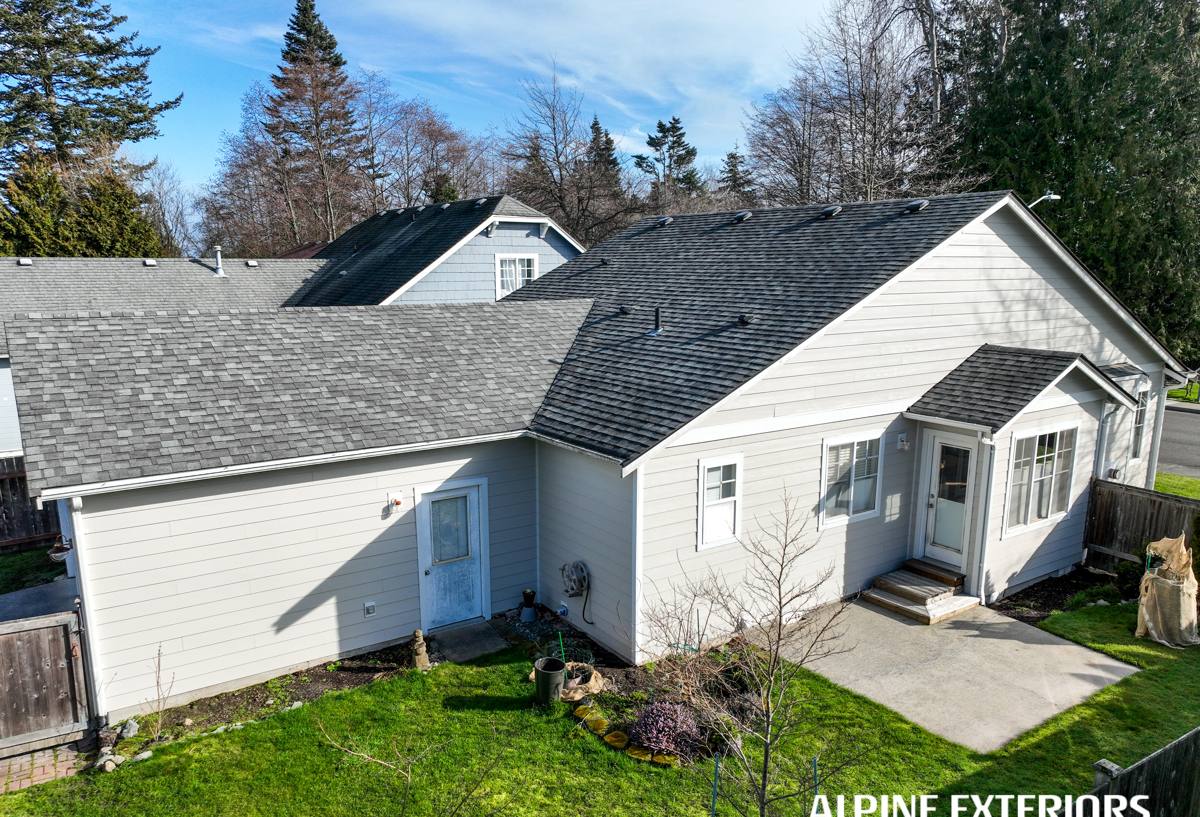
What Salt Air and Coastal Moisture Actually Do to a House
Homes near Bellingham Bay deal with a combination of stresses that inland homes in Whatcom County simply don't see to the same degree:
- Salt-laden air accelerates corrosion on exposed metal fasteners, flashing, and hardware, and it can degrade certain paint and coating systems faster than manufacturers' inland test data predicts.
- Wind-driven rain off the water pushes moisture sideways into wall assemblies, seams, and window and door openings — surfaces that a straight-down rain would never reach.
- Persistent dampness and shade from mature tree cover keep siding and roofing wet longer after every rain event, which is the single biggest driver of moss, algae, and mildew growth on exterior surfaces.
- Freeze-thaw cycling, while milder here than in the mountains, still happens enough in winter to stress any material that has already absorbed moisture it shouldn't have.
None of these forces are dramatic on their own. What causes damage in Fairhaven is the combination, repeated season after season, on a material or installation detail that wasn't specified for it.
Why Moss Season Is Longer Here Than It Looks
"Moss season" in this part of Whatcom County isn't really a season — north-facing roof slopes and shaded siding can stay damp enough to support moss and algae growth for most of the year. Moss holds moisture directly against the surface it's growing on, which is a much bigger problem than the moss itself. On a roof, that trapped moisture works into shingle granules and fasteners. On siding, it can hold water against seams, trim, and butt joints long enough to start breaking down materials that aren't built to tolerate sustained contact with moisture.
Why We Install Only James Hardie Fiber Cement Siding
Sudden Valley Siding Companies made a deliberate decision to install James Hardie fiber cement exclusively — we don't install vinyl, LP SmartSide, Cemplank, Allura, primed spruce, or cedar. That's not a marketing position; it's a standard we hold because of what we've seen these materials do, and not do, in coastal Whatcom County conditions over time.
Fiber cement is non-combustible, which matters given the wildfire smoke and dry-summer conditions the Pacific Northwest has seen in recent years. It's also dimensionally stable in a way that matters a great deal in a climate that swings between saturated winters and dry summers — it doesn't expand and contract the way wood-based or vinyl products do, which means fewer open seams for wind-driven rain to exploit. James Hardie's ColorPlus finish is baked on at the factory under controlled conditions, which gives it more consistent UV and moisture resistance than field-applied paint, and it comes with a strong, transferable limited warranty that follows the house rather than the original owner.
What We're Not Installing, and Why
| Material | What it does well | Why it's a harder fit for this climate |
|---|---|---|
| Vinyl siding | Low upfront cost, low maintenance in dry climates | Can warp or crack with temperature swings; seams and J-channels give wind-driven rain a path behind the cladding |
| LP SmartSide | Engineered wood, easier to work with than solid lumber | Still wood-based — edges and cut ends are vulnerable to moisture intrusion if sealing isn't maintained |
| Cedar siding | Natural appearance, long regional tradition | Needs regular refinishing to resist rot and moss in persistently damp, shaded conditions |
| Primed spruce | Lower material cost | Primer is a starting point, not a finish — ongoing painting and moisture vigilance required |
| James Hardie fiber cement | Non-combustible, factory-cured finish, dimensionally stable, strong warranty | Higher upfront cost than vinyl; requires correct installation to perform as designed |
Every one of the products we've stepped away from can be installed correctly and will perform reasonably well somewhere. Our judgment is that for homes exposed to salt air, driving rain, and long damp stretches near the bay, the maintenance burden and moisture risk of those alternatives outweighs their lower upfront cost. That's a standard we apply consistently, not a claim that any of these products are defective.
How We Approach a Siding Job in Fairhaven
Correct installation matters more than product choice in a marine climate — even the best fiber cement siding will underperform if it's installed without attention to water management. Our process on every job includes:
- Removing existing siding to inspect the wall sheathing and framing underneath for hidden rot or moisture damage before anything new goes on
- Installing a weather-resistive barrier and properly lapped flashing at every window, door, and penetration, since these details do more to keep water out than the siding material itself
- Following James Hardie's published fastening, clearance, and caulking specifications — gaps at grade, roof lines, and trim are sized specifically to let the material handle moisture without trapping it
- Using corrosion-resistant fasteners and hardware throughout, given how much faster standard fasteners can degrade in salt-influenced air near the bay
- Sequencing work with the roof and window scope where those are also being replaced, so flashing details tie together as one continuous water-management plan instead of separate trades working past each other
Roofing: The System That Protects Everything Below It
A roof in Fairhaven works harder than the same roof would inland, mostly because of how long shaded and north-facing sections stay wet. We look at ventilation, underlayment quality, and flashing detail as closely as we look at the shingle or roofing material itself, because a well-installed roof with poor ventilation will still trap moisture in the attic and eventually show up as problems at the eaves and in the siding below the roofline. Where moss has already established itself on an existing roof, we treat that as a sign worth investigating further — not just a cosmetic issue to wash away.
Windows: A Small Detail With Outsized Consequences
Window installation is one of the most common places water intrusion starts in coastal homes, and it's often invisible from the outside for years. Wind-driven rain off the bay pushes moisture into any gap in the flashing around a window opening, and that moisture then travels down into the wall cavity rather than draining back out. When we replace windows, we treat the flashing and integration with the surrounding siding as equally important as the window unit itself — a well-made window installed with poor flashing will still lead to rot.
Decks: Built for Damp Ground and Shaded Exposure
Decks in Fairhaven face a specific combination of challenges: proximity to moisture-holding vegetation, shaded exposure on many lots, and the same driving rain that affects siding and roofing. Ledger board attachment and flashing where a deck meets the house deserve particular attention, since that's a common point for water to work into the structure over time. We also account for drainage beneath and around the deck, since standing or slow-draining moisture accelerates decay in framing lumber regardless of the decking material chosen for the surface.
What to Ask Before Hiring an Exterior Contractor Near the Bay
Coastal exterior work has a lower margin for error than exterior work inland, so it's worth being more thorough when vetting a contractor for a Fairhaven or Sudden Valley property. A useful checklist:
- Ask specifically how they handle flashing at windows, doors, and roof-to-wall transitions — this is where most coastal water damage actually originates
- Ask what fastener and hardware materials they use, given the corrosion risk from salt-influenced air
- Ask whether they inspect sheathing and framing during a siding tear-off, and what happens if they find hidden moisture damage
- Ask for their manufacturer certification status if they're installing fiber cement, since correct installation is what activates the full manufacturer warranty
- Ask how they sequence siding, roofing, and window work together when more than one is being replaced at the same time
Why a Local Crew Matters Here
A crew that works throughout Whatcom County regularly sees how differently the same product performs on a shaded, bay-facing lot compared to a sunny, inland one. That's not something you learn from a manufacturer's installation manual — it's something you learn by doing the work in this specific climate, season after season, and going back to see how earlier jobs have held up. We bring that local experience to every estimate, and we're straightforward about what a given home actually needs versus what would just add cost.
Get a Free, No-Pressure Estimate
If you're weighing a siding, roofing, window, or deck project on a Fairhaven property, we're glad to take a look and give you an honest read on what your home's exposure actually calls for. Use the form below to request a free estimate — no pressure, no obligation.