 Sudden Valley Siding
 What Homes Near Acme Are Up Against
Acme sits in the kind of Whatcom County terrain that puts real demands on a home's exterior. Between marine-influenced moisture moving in off the water, long stretches of driving rain, and a moss season that can run most of the year under heavy tree cover, siding, roofing, and trim in this area age faster than they would in a drier climate. None of this is unusual for the region — it's just the trade-off of living somewhere green and close to the water. But it does mean the materials and workmanship on a home's exterior matter more here than they would somewhere with a milder, drier climate.
Moisture That Doesn't Let Up
Wood-based and wood-adjacent siding products absorb moisture over repeated wet-dry cycles. In a climate where the exterior of a house can stay damp for days at a stretch, that cycle repeats often enough to matter. Swelling, soft spots at butt joints, and paint failure are the usual results, and they tend to show up first at the bottom courses and around window and door trim where water lingers longest.
Driving Rain and Wind-Blown Water
Rain in this part of Washington rarely just falls straight down. Wind pushes it sideways into wall assemblies, which is exactly the condition that exposes weak flashing details, poor caulking, and siding products that aren't dimensionally stable. A wall system that looks fine in a light shower can still be taking on water during a real Pacific Northwest storm if the details underneath aren't right.
A Long Moss and Algae Season
Shade, humidity, and mild temperatures are a perfect combination for moss, algae, and mildew growth on exterior surfaces. Roofs get the most attention here, but siding, especially anything with texture or a porous surface, picks up green and black staining too. Some materials resist this better than others, and that difference becomes obvious after a few winters.
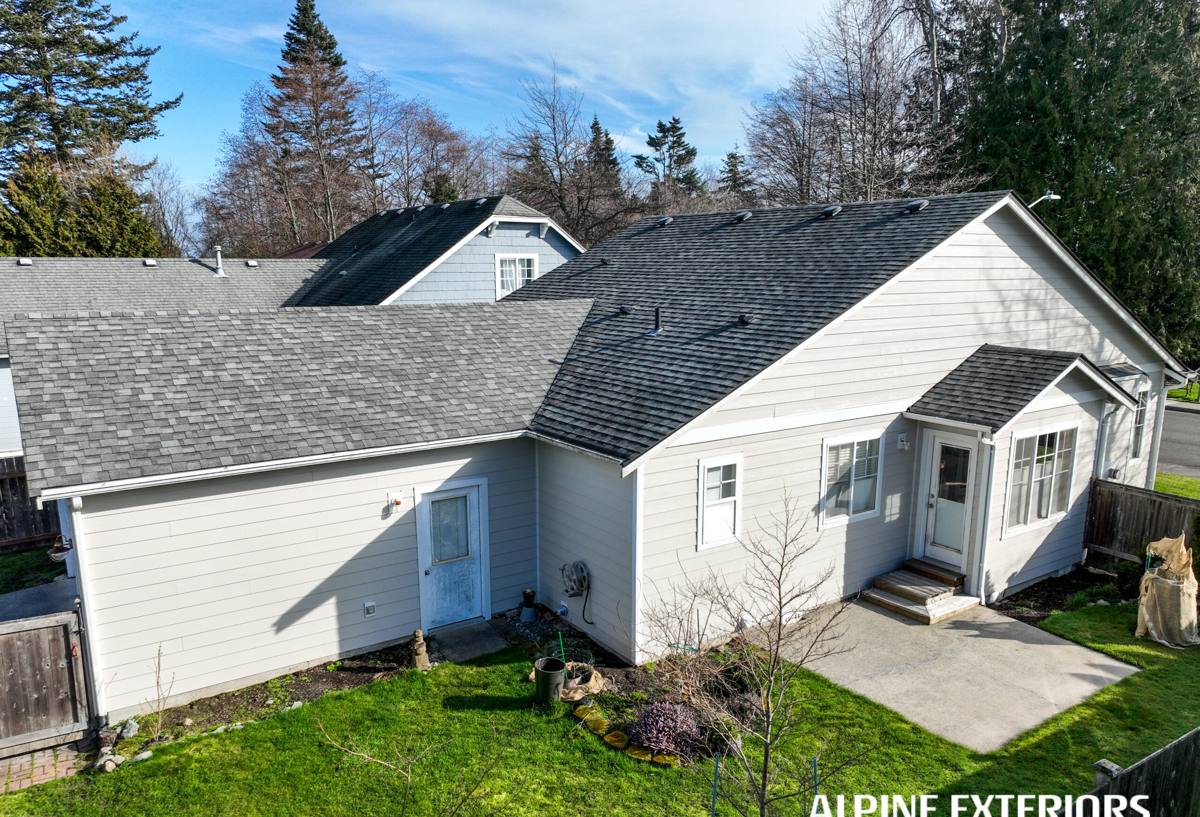
Why We Only Install James Hardie Fiber Cement Siding
We made a deliberate decision as a company to install one siding system: James Hardie fiber cement. We don't install vinyl, LP SmartSide, Cemplank, Allura, primed spruce, or cedar siding, even though all of those products have a place in the market and each has homeowners who are happy with them. Our reasoning is straightforward and it comes down to how these products hold up specifically in this climate over the long term.
What the Alternatives Get Right — and Where They Fall Short Here
Vinyl siding is inexpensive and low-maintenance in a general sense, but it's a thin, flexible material that can warp in heat, crack in cold, and it isn't fire-resistant. Engineered wood products like LP SmartSide use treated wood strand technology that resists moisture better than raw wood, but the product is still wood at its core, and any breach in the factory coating (a nail pop, a saw cut left unsealed, an impact) opens a path for water to get in. Cemplank and Allura are both fiber cement competitors to Hardie, and they're reasonable products, but we've standardized on one manufacturer so our crews install to one spec, one flashing detail, one caulking protocol, and one warranty process, rather than switching systems project to project. Primed spruce and cedar are traditional and attractive, but they're solid wood, which means they need consistent repainting or resealing, and in a climate with this much sustained moisture, that maintenance schedule is not optional — skip a cycle and the wood starts to suffer.
Why Fiber Cement Wins in This Climate
James Hardie siding is non-combustible, dimensionally stable, and manufactured with cellulose fiber and cement rather than wood or vinyl. It doesn't expand and contract the way vinyl does with temperature swings, it doesn't rot or feed insects the way wood can, and its factory-applied ColorPlus finish is baked on under controlled conditions rather than field-painted, which gives it far better resistance to fading, chipping, and moisture intrusion at the surface. For a climate defined by rain and humidity, that combination of stability and finish durability is the deciding factor.
Hardie's Climate-Engineered Product Lines
James Hardie makes region-specific formulations under its HZ5 and HZ10 engineered-for-climate system, designed around the moisture and temperature patterns of different parts of the country. For the Pacific Northwest, that means a product engineered with this exact combination of rain, humidity, and moderate temperatures in mind, rather than a one-size-fits-all formulation. That's a meaningful difference from siding products that are manufactured the same way regardless of where they'll be installed.
Hardie's plank, shingle, and panel siding options also give homeowners real design flexibility. Lap siding remains the most common choice for a traditional look, but shingle-style Hardie siding, board-and-batten panels, and trim products all come from the same ColorPlus color palette, so a home can mix textures without mismatched fading or finish differences over time.
Beyond Siding: Roofing, Windows, and Decks
Siding is only part of how a home in this climate stays protected. We also handle roofing, window replacement, and deck construction, and we look at all four together because they interact. A roof with poor drainage dumps extra water onto the siding below it. Old windows with failed seals let moisture into the wall cavity right next to new siding. A deck built without proper ledger flashing can rot the wall it's attached to, regardless of how good the siding above it is.
Roofing
In a moss-prone climate, roofing decisions around underlayment, ventilation, and material choice have a direct effect on how often moss and algae take hold, and how much long-term maintenance a roof needs. We evaluate roof condition as part of any full exterior project, not as a separate afterthought.
Windows
Window flashing and integration with the siding plane is one of the most common failure points we find on older homes. Replacing windows at the same time as siding lets us tie the flashing and water management details together properly, instead of patching around windows that were never sealed correctly against a new siding system.
Decks
Decks in this region take a beating from the same rain and moisture cycles as siding. We build and repair decks with attention to ledger board flashing, proper drainage, and materials suited to sustained wet weather, since a deck failure at the house connection point is one of the more expensive problems a homeowner can face.
What a Full Exterior Assessment Looks Like
Before we recommend any work, we look at the whole exterior system, not just the siding surface. That includes checking for soft spots or delamination in existing siding, inspecting flashing at windows, doors, and roof-to-wall transitions, looking at gutter and downspout performance, and noting any areas with heavy moss or algae buildup that point to persistent moisture. This gives us — and the homeowner — an honest picture of what's actually needed versus what can wait.
Cost Factors for an Acme-Area Siding Project
Every home is different, but the same handful of factors tend to drive cost up or down on siding projects in this area. This isn't a price list — it's a guide to what typically moves the number.
| Factor | Why It Matters |
|---|---|
| Existing siding removal | Tear-off adds labor and disposal cost, especially with layered or damaged material |
| Hidden water damage | Rotted sheathing or framing found during removal requires repair before new siding goes on |
| Home size and wall complexity | More corners, gables, and dormers mean more cutting, flashing, and labor time |
| Siding profile and texture | Lap, shingle-style, and panel products vary in material and installation cost |
| Trim and accessory work | Fascia, soffits, and trim replacement alongside siding affects total scope |
| Access and site conditions | Steep lots, tree cover, or limited equipment access can extend timelines |
Choosing a Local Contractor
Hiring for exterior work is different from most home projects because so much of the quality is hidden once the job is done — flashing, moisture barriers, and fastener patterns are all buried under the finished siding. A homeowner is largely trusting the crew's judgment and habits. A few things are worth checking before signing a contract.
- Confirm active Washington contractor licensing and insurance, and ask to see proof rather than taking it on faith
- Ask specifically how the crew handles flashing at windows, doors, and roof transitions — vague answers are a warning sign
- Find out whether the same crew installs the siding start to finish, or if labor is subcontracted out piecemeal
- Ask what manufacturer training or certification the installers have for the specific product going on your home
- Get a clear, written scope of work that separates siding, trim, flashing, and any roofing or window work
- Understand the warranty structure — both the manufacturer's product warranty and the contractor's labor warranty
Ongoing Maintenance in This Climate
No siding product is entirely maintenance-free in Whatcom County's climate, but the maintenance burden varies a lot by material. Fiber cement with a factory finish generally needs periodic washing to keep moss and algae from taking hold, and caulking checked every few years at trim and joints. That's a much lighter lift than the recurring repainting or resealing that solid wood siding demands, or the cracking and fading issues that can show up on vinyl over time.
Let's Talk About Your Home
If you're in Acme or elsewhere around Sudden Valley and want an honest look at what your siding, roof, windows, or deck actually need, we're happy to walk the property with you. There's no pressure and no obligation — just a straightforward assessment from a crew that works in this climate every day. Fill out the form below to schedule your free estimate.