 Sudden Valley Siding
 Siding, Roofing, Windows, and Decks for Ferndale Homes
Ferndale sits in a part of Whatcom County where the exterior of a house works hard year-round. Between the salt-laden air moving in off Bellingham Bay and the Strait of Georgia, the long stretch of wet months, and the shade and moisture that keep moss growing on roofs and siding for most of the year, this is not a forgiving climate for building materials that aren't suited to it. We're a local crew that handles siding, roofing, windows, and decks, and we've built our business around installing the products that actually hold up here, not just the ones that install cheapest or fastest.
This page focuses on siding, since that's the exterior surface most exposed to the elements day in and day out, but the same climate logic applies to everything we put on a Ferndale home.
What Ferndale's Climate Actually Does to a House
Salt Air and Coastal Moisture
Ferndale's proximity to the water means homes here deal with a steady dose of salt-carrying moisture in the air, especially on west- and north-facing walls that catch weather coming off the Strait. Salt air accelerates corrosion on fasteners, trim, and any metal components on a home's exterior, and it interacts with certain siding materials in ways that dry-climate products were never tested for. Coatings that hold up fine 50 miles inland can chalk, fade, or degrade faster here.
Driving Rain
Whatcom County doesn't just get rain — it gets wind-driven rain that hits siding at an angle instead of running straight down. That matters because it pushes water into seams, laps, and butt joints that a vertical-rain climate would never test. Siding systems and installation details that rely on gravity alone to shed water are more likely to let moisture behind the cladding here than in places with calmer weather patterns.
Moss and Prolonged Dampness
The long wet season in this part of Washington means north-facing walls, shaded siding, and anything under tree cover can stay damp for extended stretches. That's ideal growing conditions for moss and algae, and it's hard on any siding material that absorbs moisture rather than shedding it. Repeated wet-dry cycling over years is what eventually causes swelling, cracking, and coating failure on moisture-sensitive products.
Why We Install Only James Hardie Fiber Cement
We made a deliberate decision as a company to install James Hardie fiber cement siding exclusively. We don't install vinyl, LP SmartSide, Cemplank, Allura, primed spruce, or cedar. That's not a marketing position — it's a practical one, based on how these materials actually perform in a climate like Whatcom County's over 20 and 30 years, not just how they look on install day.
The Short Version
- Fiber cement doesn't feed moss or rot the way wood-based products can when they stay damp for long stretches.
- It's non-combustible, which matters for insurance considerations and wildfire-adjacent risk in the broader region.
- The factory-applied ColorPlus finish is baked on under controlled conditions, which holds up better against salt air and UV than field-applied paint.
- It's dimensionally stable — it doesn't expand and contract with moisture the way wood-based sidings do, which matters when you're getting driving rain and humidity swings through most of the year.
We go into more depth on our general James Hardie pages about the specific product lines, but the short version is this: Hardie's HZ5 product line is engineered for climates like ours, with freeze-thaw and moisture cycling built into the spec rather than treated as an afterthought.
What We Won't Install, and Why
Homeowners in Ferndale often ask why we won't quote vinyl or engineered wood siding when a competitor will. Here's the honest answer for each.
Vinyl Siding
Vinyl is inexpensive and easy to install, and for some climates and budgets it's a reasonable choice. But it's a thin plastic product that relies on interlocking panels rather than a fully fastened, monolithic surface, and wind-driven rain has an easier time finding its way behind vinyl than behind a properly flashed and caulked fiber cement installation. Vinyl also becomes brittle in cold snaps and can fade or warp under sustained UV and coastal salt exposure over the years.
LP SmartSide, Cemplank, and Allura
Engineered wood products like LP SmartSide use treated wood strand technology, which has improved a lot over the years, but it's still a wood-based product — it can swell at cut edges and fastener penetrations if the factory seal is compromised, and long-term performance depends heavily on maintaining caulking and paint. Cemplank and Allura are both fiber cement, technically similar to Hardie, but we've standardized on one manufacturer so we can guarantee installation consistency, warranty coverage, and color-match availability across every job, rather than juggling multiple systems.
Primed Spruce and Cedar
Solid wood siding has real aesthetic appeal, and cedar in particular has a long track record in the Pacific Northwest. But it's also the highest-maintenance option on this list — it needs regular refinishing, it's the most vulnerable to moss and rot in a damp, shaded climate, and it's combustible. For homeowners who want the maintenance commitment that comes with real wood, we respect that choice, but it isn't a system we install.
How We Approach a Ferndale Siding Job
Assessment First
Every job starts with a walk-around of the home to look at what's actually happening on each elevation — where moss and moisture are concentrated, where old caulking or flashing has failed, and what condition the sheathing and water-resistive barrier are in underneath the existing siding. That assessment drives the plan, not a generic package.
Water Management Before Siding Ever Goes Up
In a driving-rain climate, the water-resistive barrier, flashing at windows and doors, and proper lapping at penetrations matter as much as the siding itself. We treat this as the foundation of the job rather than a step to rush through. A beautiful siding job over bad flashing details will fail from behind, and you won't see it until there's already damage.
Correct Fastening and Clearances
James Hardie publishes specific installation requirements — fastener spacing, clearance from grade, clearance from roof lines and decks, and gapping at butt joints — and those specs exist because they were developed for exactly the conditions Whatcom County sees. Installing Hardie siding without following those details is how a good product gets a bad reputation. We follow manufacturer spec because it's the difference between a 30-year exterior and a 10-year one.
Finish and Color
ColorPlus finishes are factory-applied and come with their own finish warranty separate from the substrate warranty. We can also install primed Hardie board for field painting when a homeowner wants a fully custom color, though ColorPlus is the lower-maintenance route for most Ferndale homes given how much sun exposure and salt air the finish has to withstand.
Comparing Siding Options for a Whatcom County Home
| Material | Moisture/Moss Resistance | Maintenance | Combustibility | Do We Install It |
|---|---|---|---|---|
| James Hardie Fiber Cement | High — doesn't absorb and swell like wood | Low — factory finish, occasional wash | Non-combustible | Yes |
| Vinyl | Moderate — panels can trap moisture behind them | Low, but can crack/fade over time | Combustible, melts under heat | No |
| LP SmartSide / Engineered Wood | Moderate — vulnerable at cut edges/seams | Moderate — relies on intact factory seal | Combustible | No |
| Cedar / Primed Spruce | Low in shaded, damp areas without upkeep | High — regular refinishing needed | Combustible | No |
Roofing, Windows, and Decks: The Same Climate Logic
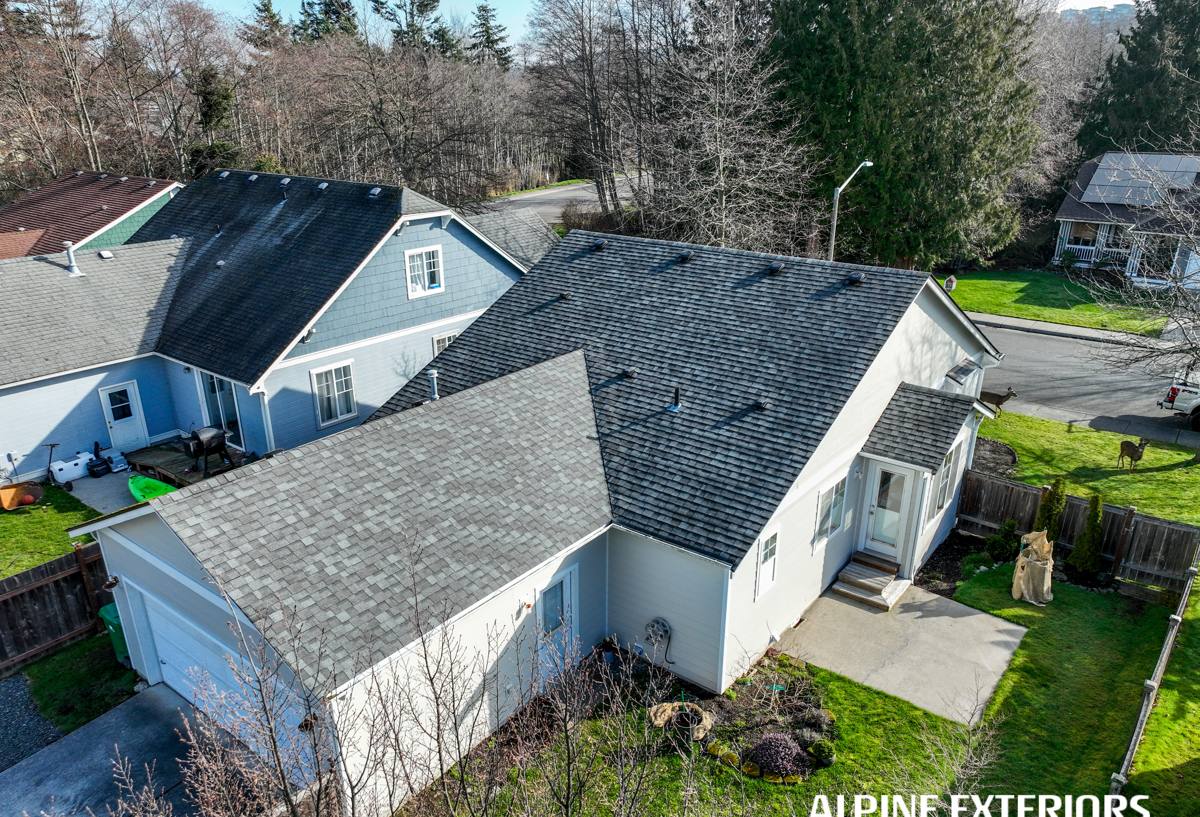
Siding doesn't work in isolation. A roof that's shedding moss and holding moisture undermines everything below it, windows that aren't properly flashed create the same behind-the-wall moisture problems as bad siding flashing, and decks in this climate need materials and fastening that account for the same wet-dry cycling. When we look at a Ferndale home, we're looking at the whole exterior envelope, because these systems interact. A homeowner replacing siding is often a good time to also address a roof nearing the end of its service life or windows that are no longer sealing well — not because we upsell for its own sake, but because tackling them together avoids redoing work.
Why a Local Crew Matters Here
Whatcom County's coastal, wet climate isn't the same as siding conditions in Eastern Washington or a drier part of the country. A crew that installs siding everywhere and anywhere doesn't necessarily know how much clearance to leave at grade in a yard that stays damp most of the winter, or how aggressively to plan for moss growth on a shaded north wall near the water. Being local means we've seen how these materials actually age in this specific climate — not just on a spec sheet, but on real homes a few miles down the road.
Planning a Siding Project: What to Expect
- An on-site assessment of your current siding condition, moisture points, and problem areas
- A written estimate that specifies product line, color, and scope — no vague allowances
- A timeline that accounts for Whatcom County's weather windows, since fiber cement installation needs reasonably dry conditions
- Attention to flashing and water-resistive barrier details, not just the visible siding
- A finished exterior installed to James Hardie's published specifications, which is what keeps the manufacturer warranty valid
Get a Straightforward Estimate
If your Ferndale home's siding is showing moss, chalking, soft spots, or failing paint, or if you're planning ahead for a replacement before it becomes an emergency, we're happy to take a look and give you an honest read on what's going on and what it would take to fix it right. Reach out for a free, no-pressure estimate — there's a form right below this page to get started.