 Sudden Valley Siding
 Siding Built for Happy Valley's Marine Climate
Happy Valley sits close enough to Bellingham Bay that the weather off the water shapes how a house ages. Homes here deal with a steady mix of salt-tinged marine air, wind-driven rain that finds its way under loose trim and lap joints, and a wet season that stretches long enough to grow moss on anything that stays shaded and damp. None of that is unusual for Whatcom County, but it does mean the siding on a Happy Valley home works harder than siding in a drier inland climate, and it needs to be chosen and installed with that in mind.
We're a local exterior contractor working throughout the Sudden Valley and greater Whatcom County area, and Happy Valley is one of the neighborhoods we're in regularly for siding, roofing, window, and deck work. This page focuses on siding, but the honest answer for most homes here is that siding rarely fails in isolation — it fails alongside flashing, trim, and roofing details that were never designed to handle this much moisture over this many years.
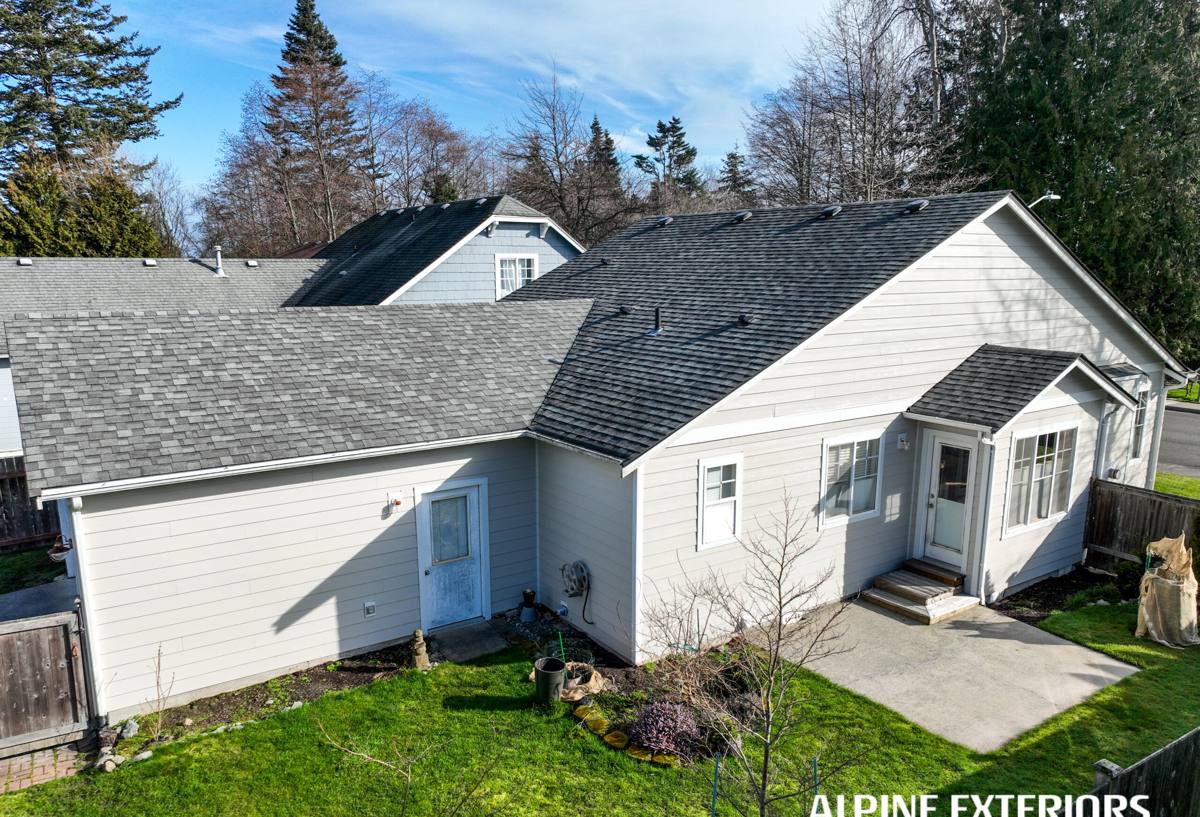
What Bellingham Bay Weather Does to Exterior Siding Over Time
Salt Air and Corrosion
Airborne salt from the bay settles on exterior surfaces and accelerates corrosion of fasteners, trim caps, and any metal flashing that isn't rated for a marine-influenced environment. On wood-based siding products, that same salt-laden moisture speeds up the breakdown of paint film and the wood fibers underneath it.
Driving Rain
Storms off the Strait of Georgia and Puget Sound don't just fall straight down — wind pushes rain sideways into lap seams, butt joints, and anywhere caulking has started to crack. Siding that isn't installed with proper overlap, flashing, and a drainage plane behind it will eventually let that water find a path to the sheathing.
A Long Moss Season
Shaded north- and west-facing walls in this part of Whatcom County can stay damp for months at a stretch. Moss and algae take hold on any siding surface with a porous or textured finish, and once established, they hold moisture against the material long after the rain has stopped — which is exactly the condition that causes rot in wood-based products and finish failure in lower-grade composites.
Why We Install Only James Hardie Fiber Cement
We made a deliberate decision as a company to install one siding system — James Hardie fiber cement — and not offer vinyl, LP SmartSide, Cemplank, Allura, or primed wood species like cedar or spruce as alternatives. That's not a marketing position; it's a standard we hold ourselves to because of what we've seen play out on homes in this climate over the long term.
Wood-based siding, even engineered products with treated strand board cores, depends on an intact factory coating to keep moisture out. In a climate with this much sustained dampness and salt exposure, any breach in that coating — a nail pop, a scuff, a cut edge left unsealed — gives water a way in, and the wood-fiber core is exactly the kind of material that swells, delaminates, or rots once that happens. Vinyl siding handles moisture differently — it doesn't rot — but it's a thin, flexible material that can warp in temperature swings, crack in cold snaps, and fade under years of UV exposure, and it isn't fire-resistant. Cedar and spruce are attractive and have a long tradition in the Pacific Northwest, but bare or site-primed wood requires a maintenance commitment — recoating, caulking, and moisture monitoring — that most homeowners underestimate until the siding is already showing damage.
James Hardie fiber cement is cement, sand, and cellulose fiber, factory-cured under pressure. It doesn't rot because there's no organic wood fiber for moisture to break down. It's non-combustible, which matters in a state that takes wildfire risk seriously even west of the mountains. And it comes from the factory with a ColorPlus finish baked on, rather than site-applied paint, which is the weak point on most other products in a marine climate.
Comparing Siding Options for a Marine Climate
| Material | Moisture Behavior | Maintenance | Fire Resistance | Typical Lifespan |
|---|---|---|---|---|
| James Hardie Fiber Cement | Does not rot; engineered for wet climates | Occasional wash; factory finish resists fading | Non-combustible | 30+ years with correct install |
| Vinyl | Sheds water but can warp/crack at seams and fasteners | Low, but color fades and can't be repainted easily | Combustible, can deform in heat | 15-25 years typical |
| LP SmartSide / Engineered Wood | Vulnerable at cut edges and coating failures | Regular inspection and caulk/paint upkeep | Combustible | 20-30 years if maintained closely |
| Cedar / Primed Spruce | Absorbs moisture; needs an intact finish at all times | High — recoating and caulking on a cycle | Combustible | Highly variable, maintenance-dependent |
These are general characteristics, not claims about any specific manufacturer's failure rate. The trade-offs above are why we standardized on one product rather than offering several — it lets us install to one spec, warranty it with confidence, and be honest with customers about what to expect.
What Correct Installation Looks Like Here
James Hardie makes several product lines engineered for different climate zones, and the Pacific Northwest falls into the HZ5 zone — meant for regions with significant moisture exposure. Choosing the right HZ product is only half the job. The installation details matter just as much:
- A drainage plane (weather-resistive barrier plus, in many cases, a rainscreen gap) behind the siding so any moisture that gets past the surface can drain and dry out rather than sit against the sheathing
- Correct fastener type and spacing — stainless or hot-dipped galvanized fasteners are worth the upgrade in a salt-air environment
- Proper flashing at every window, door, and roof-to-wall intersection, since these are the points where wind-driven rain actually gets in
- Factory-cut edges sealed per manufacturer spec, and field cuts sealed the same way
- Correct lap and clearance from grade, decks, and roof lines so water sheds away from the wall assembly instead of wicking up into it
Skipping any one of these doesn't show up as a problem in year one. It shows up in year five or eight, as moisture damage that's expensive to trace back to its source. This is where a local crew earns its keep — we know which details matter most on homes exposed to Bellingham Bay weather, because we see the failures that result when they're skipped.
Beyond Siding: The Full Exterior Envelope
Siding doesn't work in isolation. A new fiber cement siding job installed over a failing roof, worn-out flashing, or leaking windows just relocates the water problem instead of solving it. We handle roofing, windows, and decks alongside siding for exactly this reason — when we're on a Happy Valley home for a siding project, we're looking at the whole envelope, not just the wall cladding.
Roofing
Roof-to-wall transitions are one of the most common sources of hidden water intrusion. If your roof covering or flashing is due for attention, it's worth addressing at the same time as siding rather than after.
Windows
Old or poorly flashed windows are a direct path for wind-driven rain, no matter how good the siding around them is. Window replacement or re-flashing is often bundled with siding work for that reason.
Decks
Decks that attach directly to the house create another moisture-prone junction. Ledger board flashing and proper separation from siding matter just as much here as anywhere else on the exterior.
Choosing a Contractor for Siding Work in Happy Valley
A siding job is only as good as the crew installing it — the material is engineered to perform, but the installation is where most real-world problems originate. Before hiring anyone for exterior work in this area, it's worth asking a few direct questions.
- Are you licensed and insured to work in Washington State, and can you provide proof?
- Who is the manufacturer-certified installer on my job specifically, not just the company as a whole?
- What's your plan for the drainage plane and flashing details, not just the siding panels themselves?
- Will I get a written scope that specifies the exact Hardie product line and fastener type?
- What does the manufacturer's warranty cover, and what does your workmanship warranty cover separately?
- Do you have local references I can call, not just photos?
Any contractor who's confident in their work should be comfortable answering all of these without hesitation.
Maintenance and Long-Term Care
Even a low-maintenance product benefits from basic upkeep in this climate. A rinse-down once or twice a year removes the salt film and organic buildup that feeds moss before it gets established. Keeping gutters clear prevents overflow from running down the wall face. And a periodic walk-around to check caulking at trim and penetrations catches small gaps before they become entry points for water. James Hardie's factory finish means you're not repainting on a recurring cycle the way you would with wood siding, but it isn't a "never think about it again" product — nothing exposed to Whatcom County winters truly is.
Get a Free, No-Pressure Estimate
If your Happy Valley home's siding is showing its age, or you're planning ahead before the next wet season sets in, we're glad to take a look and walk you through what we're seeing — no pressure, no hard sell. Fill out the form below to schedule a free estimate for siding, roofing, windows, or deck work.