 Sudden Valley Siding
 Exterior Work Built for South Hill and Sudden Valley
South Hill sits close to the water in the Sudden Valley area of Whatcom County, and that proximity shapes everything about how a house ages here. Homes in this part of the county deal with a combination most other regions don't: salt-laden air off the water, driving rain that comes in sideways during winter storms, and a moss season that can stretch from October through April. Any one of these on its own is manageable. Together, over years, they find every weak point in a home's exterior — a nail popped slightly proud, a caulk joint that shrank, a paint film that started chalking. We've built our siding, roofing, window, and deck work around what actually happens to houses in this specific environment, not a generic Pacific Northwest playbook.
This page covers what South Hill homeowners tend to run into, how we approach siding and the rest of the exterior for this area, and why we standardized on one siding product instead of offering the usual menu of options.
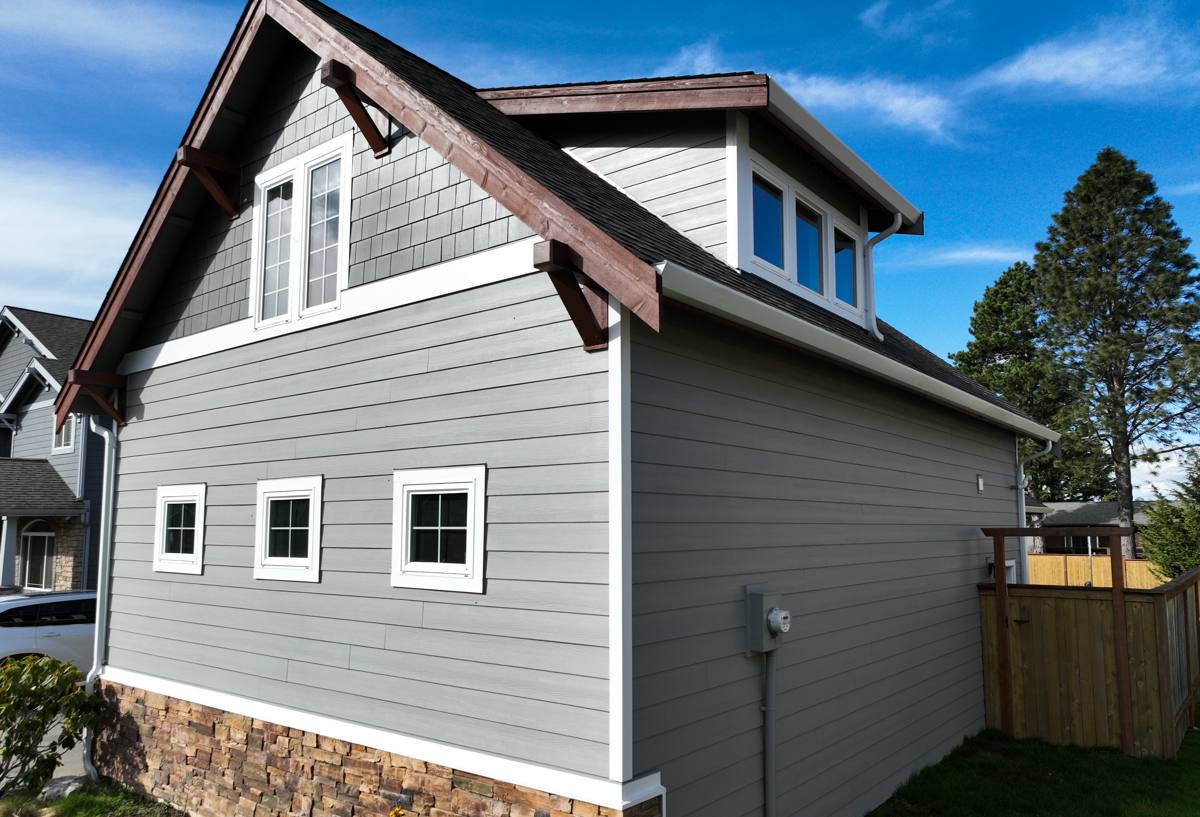
What the South Hill Climate Does to a House
Salt Air and Moisture
Being close to the water means airborne salt settles on exterior surfaces even when there's no direct spray involved. Salt is hygroscopic — it pulls moisture out of the air and holds it against whatever surface it lands on. On wood-based sidings, that means more time spent damp, which accelerates rot at seams, corners, and anywhere water can pool. On fasteners and trim hardware, it accelerates corrosion unless the materials were chosen with that exposure in mind.
Driving Rain
Rain that falls straight down is one problem. Rain that gets pushed sideways by wind off the water is a different, harder problem, because it drives into laps, joints, and any gap in the siding's water-shedding path. A siding system that relies on face-sealing (caulk and paint doing the work of keeping water out, rather than the material and installation detail itself) is more exposed in a wind-driven rain environment like this one.
Moss and Prolonged Dampness
Whatcom County's moss season is long, and North-facing or shaded walls in South Hill can stay damp for days at a stretch during the wet months. Moss and algae growth on siding isn't just cosmetic — sustained organic growth holds moisture against the surface underneath it, which matters a lot more on a material that can absorb water than on one that can't.
Why We Only Install James Hardie Fiber Cement
We used to get asked to quote a range of siding products — vinyl, LP SmartSide, Cemplank, Allura, primed spruce, cedar. We don't install any of those anymore, and it's worth explaining why rather than just stating it as a policy.
The Honest Trade-Offs We Weighed
- Vinyl is inexpensive and low-maintenance in mild climates, but it expands and contracts significantly with temperature swings, can crack in impact or extreme cold, and isn't a great match for a coastal wind-driven rain environment where panel movement and seam performance matter.
- LP SmartSide is an engineered wood product with real strengths, but it's still wood-based at its core — meaning cut edges, fastener penetrations, and any breach in the factory coating are potential entry points for moisture, which is a bigger liability in a salt-air, high-moisture area than in a dry climate.
- Cemplank and Allura are both fiber cement, and both are reasonable products in general terms. Our decision to standardize on one manufacturer isn't a claim that these are inferior — it's that consolidating on one product line lets our crews install to a single spec, order matching trim and accessories reliably, and back every job with one consistent warranty conversation.
- Primed spruce and cedar are traditional, attractive, and locally familiar — but solid wood siding demands a maintenance schedule (repainting, caulk inspection, moisture monitoring) that most homeowners underestimate, and in a moss-heavy, salt-air environment that schedule compresses.
Why Hardie Fiber Cement Fits This Environment
James Hardie fiber cement is non-combustible, dimensionally stable across temperature and moisture swings, and doesn't rot, swell, or feed insects the way wood-based products can. The ColorPlus factory-applied finish is baked on under controlled conditions, which gives more consistent, longer-lasting color performance than field-applied paint — a real advantage when a house is fighting salt exposure and UV year-round. Hardie also engineers regional HZ5 product formulations specifically for climates with sustained moisture exposure, which is directly relevant to a South Hill / Sudden Valley install. It backs the product with a strong transferable limited warranty, which matters to buyers if a South Hill home ever changes hands.
How a South Hill Siding Project Typically Goes
Assessment
We start by walking the exterior and looking specifically for the failure patterns common in this area: moisture staining near grade, soft spots at trim and window returns, moss buildup on shaded walls, and any prior repairs that may be masking a bigger issue underneath. This tells us whether we're looking at a straightforward re-side or whether there's sheathing or framing damage that needs addressing first.
Water Management Details
In a driving-rain, high-moisture area, the flashing, house wrap, and drainage plane details behind the siding matter as much as the siding itself. We pay particular attention to window and door flashing, kick-out flashing at roof-wall intersections, and proper clearance between the bottom of the siding and grade or decking — all common points where water gets in on older installs.
Installation to Manufacturer Spec
Fiber cement performs the way it's supposed to only when it's installed correctly — proper fastener type and placement, correct joint treatment, and the right clearances. We install to James Hardie's published specifications, which is also what keeps the manufacturer's warranty intact.
Beyond Siding: Roofing, Windows, and Decks in This Area
Siding rarely fails in isolation — it's usually one piece of an exterior envelope that's under the same climate stress. We also handle:
- Roofing — the first line of defense against driving rain and the source of a lot of moss growth that migrates down onto siding and trim.
- Windows — flashing integration between windows and siding is one of the most common sources of hidden water intrusion in older South Hill homes.
- Decks — exposed to the same salt air and moisture cycling, with their own maintenance and material considerations.
Addressing these together, rather than treating siding as an isolated project, is usually the more efficient way to actually solve a moisture problem rather than just relocating it.
Cost Factors for South Hill Siding Projects
| Factor | Why It Matters Here |
|---|---|
| Home size and wall complexity | More corners, gables, and trim details mean more labor and cut waste |
| Existing water damage | Salt-air and moisture exposure can hide rot behind old siding; repairs add cost but are necessary before re-siding |
| Siding profile and trim style | Lap width, board texture, and trim complexity affect material and labor cost |
| Access and site conditions | Sloped lots and limited access around Sudden Valley properties can affect scaffolding and staging |
| Tear-off vs. overlay | Full removal of old siding allows inspection of sheathing and house wrap, which matters more in this climate |
Why a Local Crew Matters
A crew that works this specific stretch of Whatcom County knows which walls take the worst of the driving rain, how fast moss reestablishes on shaded elevations, and what a salt-air corrosion pattern looks like before it becomes a structural problem. That local pattern recognition shows up in small decisions — where to add extra flashing, which fastener finish to spec, how tight to run clearances — that a crew unfamiliar with the area might not think to make.
A Simple Maintenance Checklist for South Hill Homes
- Rinse siding annually to remove salt residue and slow moss/algae buildup, especially on shaded or North-facing walls
- Inspect caulk joints at trim, windows, and doors each fall before the wet season sets in
- Keep gutters clear so overflow doesn't run down and sit against siding
- Trim back vegetation that keeps a wall shaded and damp
- Watch for soft spots, staining, or paint failure near grade — early signs of moisture intrusion
- Have flashing at roof-wall intersections checked periodically, since this is a common hidden leak point
If you're weighing a siding, roofing, window, or deck project on a South Hill or Sudden Valley home, we're happy to take a look and walk you through what we're seeing — no pressure, no obligation. The estimate form below gets you started.