 Sudden Valley Siding
 Why This Comparison Matters in Sudden Valley
If you own a home in Sudden Valley or anywhere else around Lake Whatcom, you already know the exterior of your house works harder than exteriors in drier parts of the country. Between the marine air pushing in off the Salish Sea, the long stretch of driving rain from October through April, and a moss season that seems to start earlier every year, Whatcom County siding takes a beating that siding in, say, eastern Washington never sees. That's the honest starting point for this comparison. Vinyl siding and James Hardie fiber cement siding are both legitimate, widely used products. They are not equally suited to this specific climate, and this page explains why, without exaggeration or scare tactics.
We install James Hardie fiber cement exclusively. We do not install vinyl, and we want to explain our reasoning clearly enough that you can evaluate it yourself, not just take our word for it.
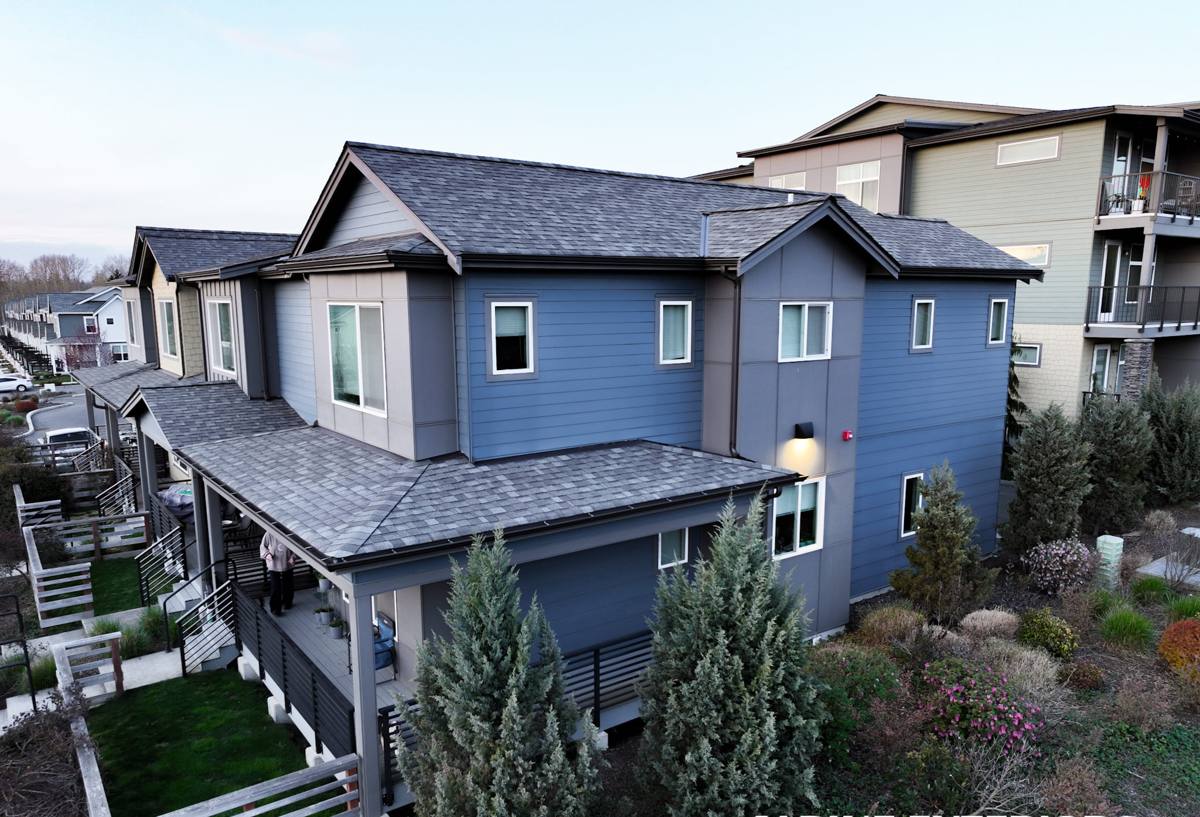
What Vinyl Siding Actually Gets Right
Vinyl deserves a fair shake before we get into trade-offs. It is inexpensive relative to almost every other cladding option. It installs quickly, which keeps labor costs down. It never needs painting, since the color runs through the material. Manufacturing has improved over the decades, and modern vinyl panels resist cracking better than older generations did. For a homeowner on a tight budget who needs a functional, low-maintenance exterior and plans to move within a decade, vinyl is not an irrational choice. We're not here to tell you it's a bad product in the abstract. We're here to tell you why it's a poor match for this specific climate and why we, as a company, chose not to install it.
Where Vinyl Struggles Locally
Vinyl is a petroleum-based plastic product, and plastic behaves predictably with temperature swings: it expands and contracts more than fiber cement does. In a climate with the kind of persistent damp cycling we get around Lake Whatcom, that expansion and contraction repeatedly stresses the seams, the nailing flanges, and the J-channel trim around windows and doors. Over years, those stressed joints are where water finds its way behind the panel. Vinyl is also installed as a "float" system, hung loosely on the wall rather than fastened tight, specifically to allow for that movement. That's fine in theory, but it also means vinyl was never designed to be a water barrier on its own — it relies entirely on the house wrap and flashing behind it doing the real work. When those layers are imperfect (and after 15-20 years, fasteners loosen and seams gap), vinyl offers very little backup.
Moss and algae are the other local reality. Vinyl's smooth, slightly textured plastic surface, combined with the shade many Sudden Valley lots get from mature evergreens, gives moss and green algae a surface to cling to on north- and west-facing walls. Vinyl doesn't rot from this, but it does stain, and that staining is difficult to fully remove without damaging the surface finish or using aggressive chemical treatments that void warranties.
What Fiber Cement Actually Is
James Hardie fiber cement siding is made from Portland cement, sand, and cellulose fiber, pressed and cured into dense, rigid planks or panels. It is not a "premium plastic" — it's a completely different material category, closer in behavior to fired masonry than to vinyl. That density is what changes the equation for this climate:
- Non-combustible — fiber cement does not burn, which matters for wildfire-adjacent insurance considerations even on the wet side of the state.
- Dimensionally stable — it expands and contracts far less than vinyl with temperature and moisture changes, so seams and fasteners stay tight for decades rather than years.
- Factory-applied ColorPlus finish — a baked-on finish, not a field-applied paint, engineered specifically to resist UV fading and moisture intrusion at the surface.
- Rigid, not floating — it's fastened directly and holds its shape, which reduces the gapping that lets moisture behind the cladding over time.
None of this makes fiber cement magic or maintenance-free. It's heavier, costs more up front, and has to be installed correctly — including caulking, flashing, and clearance details — to perform the way it's engineered to. But the underlying material is simply built for wet, temperature-cycling coastal climates in a way vinyl isn't.
Side-by-Side: The Honest Numbers
| Factor | Vinyl Siding | James Hardie Fiber Cement |
|---|---|---|
| Typical material lifespan | 20-30 years, shorter with UV/moisture stress | 30-50+ years when installed to spec |
| Moisture behavior | Relies entirely on the barrier behind it; float system allows gapping over time | Rigid, tightly fastened, less prone to seam gapping |
| Moss/algae resistance | Smooth plastic surface stains and holds moss on shaded walls | Denser surface, factory finish resists staining better, still needs periodic washing |
| Fire rating | Combustible plastic | Non-combustible |
| Upfront installed cost | Lower | Higher |
| Impact resistance | Can crack in freeze/cold or from impact | Rigid and impact-resistant, but can crack if struck hard enough |
| Repainting needed | Never (color is through-body) | Not for the ColorPlus factory finish under warranty; field-painted units eventually need repaint |
| Warranty structure | Varies widely by manufacturer, often prorated | Manufacturer's non-prorated limited warranty on ColorPlus product; ask us for current terms |
The Salt Air and Driving Rain Factor
Sudden Valley sits inland from the open ocean, but Whatcom County as a whole still gets meaningful airborne moisture and salt-tinged air moving in off the Salish Sea and Bellingham Bay, on top of the straightforward volume of driving rain we get for six-plus months a year. That combination is corrosive to fasteners and hard on any seam-dependent system. It's a big part of why we look at a home's actual wall assembly — house wrap, flashing at every window and door, kick-out flashing where roof lines meet walls — as seriously as we look at the siding material itself. A great cladding product installed over sloppy flashing details will still fail in this climate. A modest cladding product installed with meticulous flashing and drainage details will outperform expectations. The material matters, but so does the installer's attention to the water-management details underneath it, and that's true whether you go with vinyl or fiber cement.
Moss Season: What It Actually Does to Siding
Moss doesn't eat through vinyl or fiber cement the way it can degrade untreated wood, but it does two things that matter over time. First, it holds moisture against the siding surface longer than an exposed, sun-dried wall would experience, which extends the amount of time fasteners, caulk joints, and trim pieces sit wet. Second, on textured or porous surfaces it can work into surface irregularities and become genuinely difficult to remove without a pressure washer or scrub brush, both of which carry their own risk of damaging the siding finish if done incorrectly. Homes tucked under conifer canopy around Lake Whatcom — a lot of Sudden Valley lots — see this on north and west walls especially. Annual soft washing (not high-pressure) is the realistic maintenance step for either siding type, but the denser, factory-finished surface of fiber cement generally sheds this staining more easily than textured vinyl.
Installation Sensitivity: Why the Installer Matters as Much as the Product
Fiber cement is less forgiving of poor installation than vinyl in one specific way: it must be cut, fastened, and clearances (ground clearance, roof-to-wall clearance, kick-out flashing at rooflines) must be done to Hardie's published installation instructions, or the warranty is at risk and moisture problems can follow. This is exactly why we don't sub this out casually or treat it as interchangeable with vinyl installation — the crew has to understand cement board specifically. Vinyl is comparatively more tolerant of installation shortcuts, which is part of why it's cheaper to install, but that same tolerance is also why a rushed vinyl job can look fine for a few years and then fail quietly behind the panels where no one sees it until there's rot in the sheathing.
What Correct Fiber Cement Installation Includes
- Proper house wrap or weather-resistant barrier installed and lapped correctly before any siding goes up
- Flashing at every window, door, and roof-to-wall intersection, including kick-out flashing to direct water away from the wall
- Correct fastener type, spacing, and depth per Hardie's installation guide for our wind/exposure zone
- Minimum ground clearance and clearance from roofing, decks, and grade to prevent wicking moisture
- Factory-cut edges primed or sealed where field cuts expose raw material
- Caulking only at specified joints — not as a substitute for proper flashing
Why We Standardized on James Hardie
We made a business decision years ago to install one fiber cement system rather than juggle vinyl, LP SmartSide, and several fiber cement brands. James Hardie is the product we standardized on because of the combination of its HZ5 product engineering for our climate zone, the ColorPlus factory finish, and a warranty structure we felt comfortable standing behind. That's a narrower offering than a lot of contractors provide, and we understand that limits your options if you walk in wanting vinyl. But it means every crew member on your job knows this one system in depth, rather than being reasonably competent across four different products. For a climate that punishes installation shortcuts the way Whatcom County's wet season does, we think that specialization is worth more than breadth.
Cost Reality Check
We won't quote you a number here because every home is different — square footage, trim complexity, number of stories, tear-off versus new construction, and current condition of the sheathing all move the price. What we will say honestly: fiber cement costs more installed than vinyl, usually by a meaningful margin, and if your only constraint is minimizing upfront cost, vinyl will win that comparison every time. The question worth asking isn't just "what's cheaper today" but "what's the cost per year of ownership" once you weigh lifespan, moisture risk, and how the home looks and performs at year 20 versus year 40. That's a judgment call every homeowner has to make for their own budget and timeline, and we'd rather lay out the trade-offs plainly than oversell you.
If you're weighing a siding replacement in Sudden Valley or elsewhere in Whatcom County, we're happy to walk your home, look at your current siding's actual condition, and give you a straight, no-pressure estimate for what a James Hardie fiber cement replacement would involve on your specific house.