 Sudden Valley Siding
 New-construction windows are a different job than replacement windows, even though homeowners sometimes use the terms interchangeably. On a new build, there's no existing window to reference and no old flashing to work around — the window has to be integrated into a wall assembly that doesn't exist yet, coordinated with the weather-resistive barrier, the siding plan, and whatever framing tolerances the crew actually delivered. In South Hill, working alongside Sudden Valley and elsewhere in Whatcom County, that integration has to be done with a specific climate in mind: wind-driven rain that doesn't fall straight down, air with a salt edge to it working on hardware and finishes over time, and a moss season that runs long enough to punish any water management shortcut within a few wet seasons.
We install new-construction windows on homes and additions in South Hill as a routine part of our work, not a side offering. That means we're set up for the sequencing a new build actually requires — showing up at the right point in the framing schedule, coordinating with the WRB and flashing plan rather than treating the window as an isolated component, and building in the extra margin this area's weather calls for.
New Construction vs. Replacement: Why the Distinction Matters
A replacement window has to work within an existing rough opening and an existing wall assembly that's already weatherproofed, for better or worse. A new-construction window is installed into a bare opening before the wall is finished, which means the window and the surrounding wall assembly get built together as one system. That's an advantage when it's done right — the flashing, the WRB, and the window all get integrated in the correct order, with no old sealant or hidden rot to work around. It's a liability when it's rushed, because there's no forgiving layer of existing construction to fall back on if a step gets skipped.
New-construction windows typically use a nailing flange that fastens directly to the sheathing, with the WRB and flashing tape lapped over the flange in a specific shingle-style sequence. Get that sequence wrong — flashing tape running the wrong direction, WRB lapped under the flange instead of over it — and the mistake gets buried behind siding, where it won't show up as a problem for years.
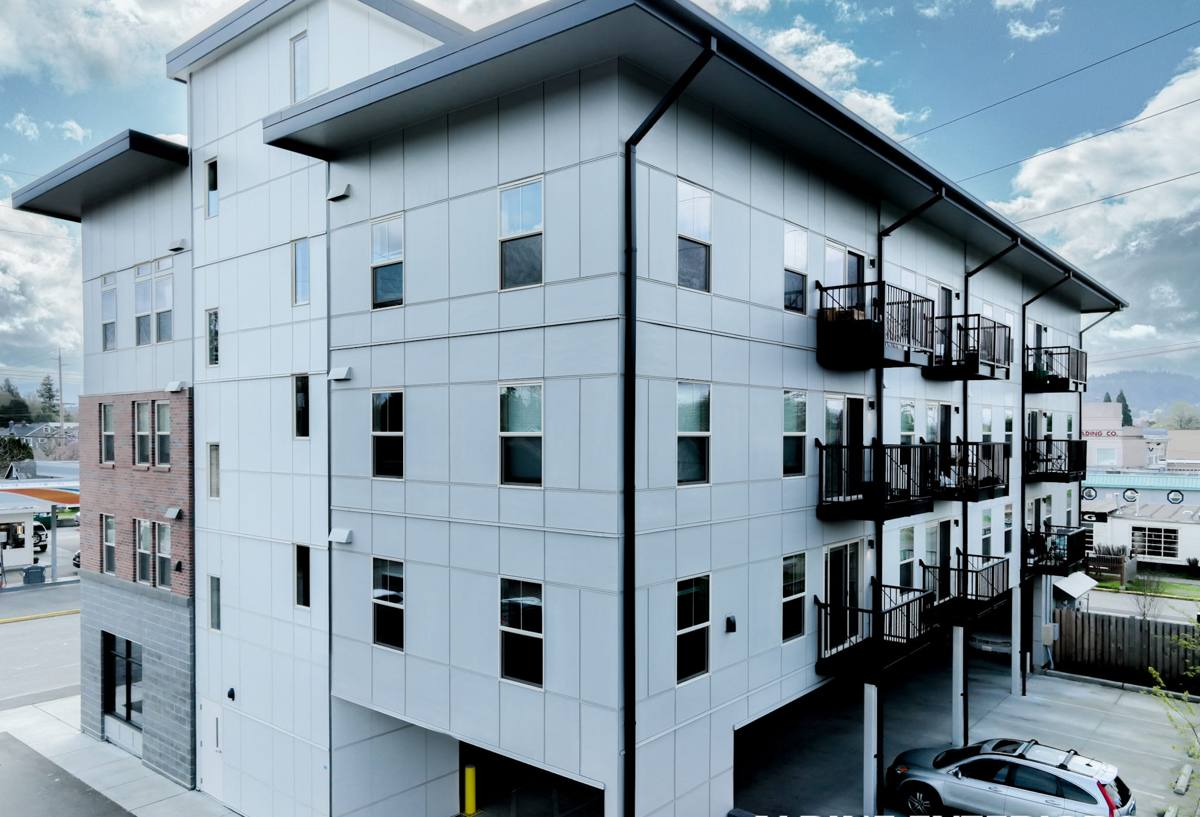
What This Climate Does to a New-Construction Window Install
Wind-Driven Rain and Flashing Sequencing
Rain in this part of Whatcom County doesn't reliably fall straight down. Storms push it sideways into wall assemblies, and South Hill's terrain and elevation relative to Sudden Valley and the surrounding hills mean different walls of the same house can take very different wind exposure. A flashing sequence that would be fine on a calm, sheltered wall isn't automatically fine on the weather-facing side of the same house. We plan flashing detail by elevation, not by a single generic spec applied to every wall.
Salt-Tinged Air and Hardware Longevity
Whatcom County's proximity to the Salish Sea means the air carries some salt influence even inland, and that shows up over time as accelerated corrosion on lower-grade fasteners, hinges, and cladding hardware. On a new build, this is a decision point rather than an afterthought — the fasteners and flashing components going into the wall now are the ones that have to hold up for decades, since none of it is easy to inspect or replace once the siding is closed in.
A Long Moss and Mildew Season
Damp, mild conditions in Whatcom County support moss and mildew growth for most of the year, and any surface that stays wet longer than it should becomes a target. For windows, that means sill pans that don't drain correctly, or a WRB lap that lets water track sideways instead of shedding down and out, will show moss and staining well before the window itself shows any real problem. Getting the drainage plane right at install is cheaper than fighting moss on a finished wall for the next twenty years.
What Correct New-Construction Window Installation Involves
Working from the Rough Opening, Not Around an Old One
We check the rough opening against the actual window dimensions before anything gets set — square, level, plumb, and correct rough opening sizing per the manufacturer's specification. Framing crews are generally good, but tolerances vary, and catching an out-of-square opening before the window goes in is far cheaper than shimming around a problem after the fact.
Sill Pan and Drainage Plane
Every new-construction window we set gets a sloped sill pan, not just a bead of sealant at the bottom of the opening. The sill pan is what gives any water that gets past the window a clear path back outside instead of into the framing. This is one of the details that separates an installation built to hold up in this climate from one built to pass a quick visual check.
WRB and Flashing Tape Integration
The window's nailing flange has to integrate with the weather-resistive barrier in the correct order — WRB below the window lapped first, jamb flashing next, head flashing last, always shingle-style so water sheds down and over each layer rather than getting trapped behind it. We coordinate this step directly with whoever is running the WRB on the rest of the house, since a window flashed correctly in isolation can still fail if the surrounding WRB isn't lapped to match.
Timing Within the Build Schedule
New-construction windows go in after the WRB is up and before siding starts, and the schedule matters more than people expect. Setting windows too early, before the wall is properly wrapped, or too late, after siding crews are already staging material, creates rework. We coordinate directly with the builder or general contractor on timing so the window install doesn't become the bottleneck — or the reason someone else's work has to be redone.
Frame Material Considerations for South Hill's Climate
Frame material matters more on new construction than people assume, because whatever goes in now is what the homeowner lives with for the life of the window. We'll walk through the honest trade-offs for a specific build rather than defaulting to one material for every project.
| Frame Material | Moisture and Salt-Air Performance | Maintenance | Typical Fit |
|---|---|---|---|
| Vinyl | Good — won't corrode, handles sustained damp exposure well | Low | Cost-conscious builds, most new-construction projects |
| Fiberglass | Very good — dimensionally stable, resists warping and corrosion | Low | Larger openings, higher-exposure walls, longer-term ownership |
| Wood-clad (exterior-clad) | Depends on clad quality — the interior wood look with a protected exterior shell | Moderate | Builds where the interior wood appearance matters |
| Aluminum | Weaker in this climate — conducts cold and can corrode without proper coating | Moderate to high | Rarely our first recommendation for weather-facing walls here |
None of this rules out a given material outright — it's about matching frame choice to which wall it's going on and how exposed that wall actually is. A sheltered interior-facing window has more flexibility than one on a weather-facing elevation in South Hill.
Our Process for New-Construction Window Installs
- Plan review and coordination — we review window schedules and rough opening sizes against the build plans before framing is even finished, and coordinate timing with the builder or GC
- Rough opening verification — every opening gets checked for square, level, and correct sizing before the window is set
- Sill pan installation — a sloped drainage path goes in at every opening, no exceptions
- Window setting and shimming — the unit is set plumb and square, shimmed correctly, and fastened per manufacturer spec
- WRB and flashing integration — jamb and head flashing lapped in the correct shingle-style order with the surrounding WRB
- Final inspection — operation check, seal check, and a visual confirmation that flashing is fully integrated before siding crews start
Mistakes We See on New Construction — and Catch Before They're Buried
- Nailing flange fastened directly over house wrap with no flashing tape lapped over it
- Missing or flat sill pan with no slope to shed water back outside
- Head flashing lapped under the WRB instead of over it, which sends water behind the barrier instead of in front of it
- Rough openings left out-of-square and shimmed excessively instead of corrected
- Windows set before the WRB is properly lapped around the opening, forcing a rushed fix later
- Fasteners or hardware not rated for this area's moisture and salt-tinged air exposure
Most of these don't show up as a visible problem for years. By then the siding is finished, the drywall is painted, and fixing it means opening up a wall that was supposed to be done.
Why a Local South Hill and Sudden Valley Crew Matters
Manufacturer installation instructions are written for average conditions in a moderate climate — they're a baseline, not a complete answer for every wall on every house. A crew that has actually set windows on new builds throughout South Hill and the wider Sudden Valley area knows which elevations in this specific terrain tend to take the harder hit from driving rain, where the moss season shows up first on a wall that's draining poorly, and which flashing details are worth the extra time even when a generic spec sheet doesn't call for it.
That local pattern recognition also matters for scheduling and coordination. New-construction window work depends on showing up at the right point in someone else's build schedule, working cleanly with whatever WRB and siding crew is already on the job, and not being the reason a framing or siding schedule slips. A crew that regularly works this area already knows the pace local builders expect and plans around it.
What to Confirm Before Hiring for a New-Construction Window Install
- Ask whether they regularly work new construction, not just replacement windows — the sequencing skills are different
- Ask how they handle sill pan and flashing integration with the WRB, specifically
- Confirm current Washington contractor licensing and insurance
- Get a clear answer on how they'll coordinate timing with your builder or general contractor
- Ask how the window unit warranty and the installation labor warranty are handled separately
If you're building or adding on in South Hill and need windows installed as part of the framing schedule, it's worth getting a local crew looking at your plans before the walls are closed in. We offer free, no-pressure estimates for new-construction window work in South Hill and the surrounding Sudden Valley area — use the form below to get a time on the schedule.