 Sudden Valley Siding
 Edgemoor Decks Face a Different Set of Problems Than Decks Inland
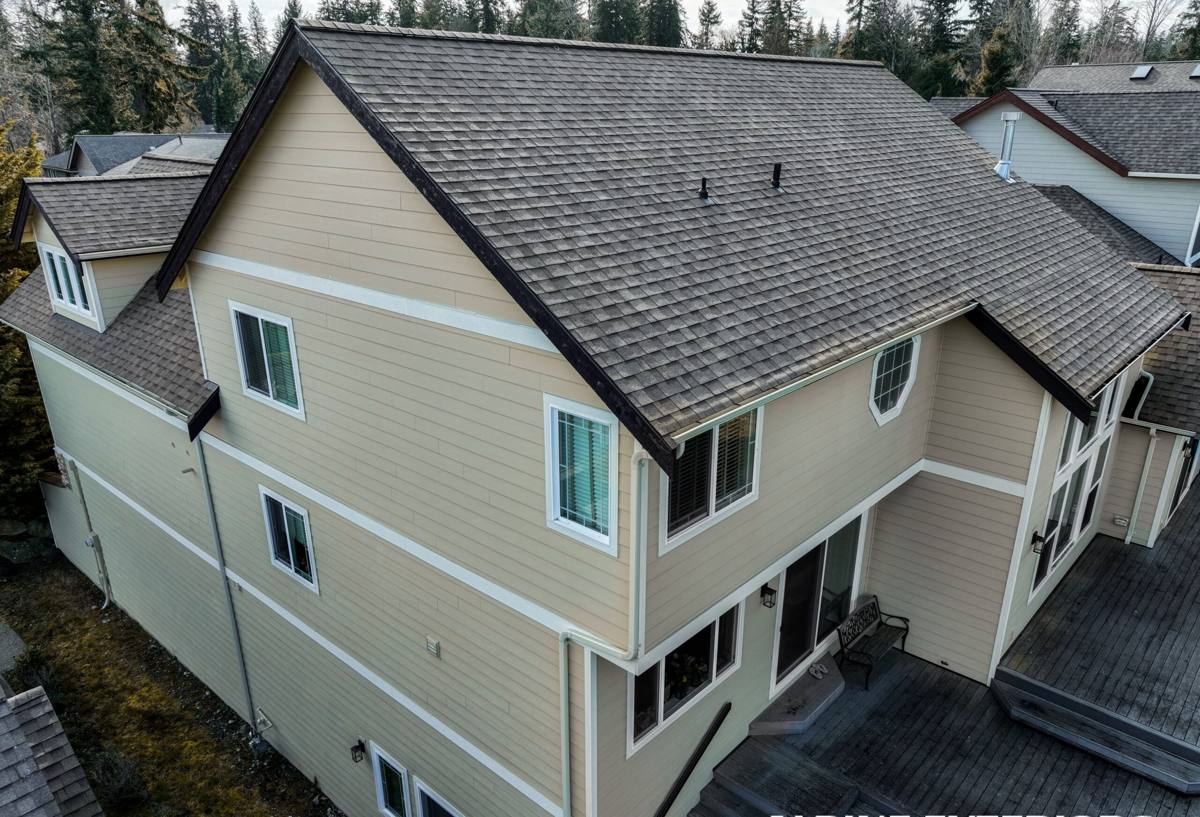
If your property sits in or near Edgemoor, close enough to Bellingham Bay and the Sudden Valley shoreline to catch the marine air, your deck lives a harder life than a deck twenty miles inland. Salt-laden moisture rides in on the wind and settles into every joint, fastener, and shaded corner. Whatcom County's driving rain doesn't just fall straight down here — it comes in sideways off the water and gets driven under rail caps, behind fascia boards, and into end grain that wasn't sealed. And because so many Edgemoor lots sit under mature conifers with limited afternoon sun, decks here run a long moss and algae season that stretches from fall through late spring.
None of that means composite decking is a bad choice for this neighborhood. It means the installation has to account for those conditions from the start — not as an afterthought once the boards start looking green or the fasteners start weeping rust. This page covers what that actually looks like.
Why Composite Makes Sense Here — With Honest Caveats
Composite decking (a blend of wood fiber and plastic, usually with a protective cap layer) resists moisture absorption far better than raw lumber, which matters when a board is going to be damp more often than dry for half the year. It won't splinter, doesn't need annual staining, and holds up to the freeze-thaw cycles Whatcom County gets in winter without the surface checking that cedar and untreated pine eventually show.
It isn't maintenance-free, and we don't sell it that way. Composite still needs periodic cleaning to stay ahead of moss and mildew, the color can fade slightly over years of UV and salt exposure, and the substructure underneath it — the part nobody sees — still has to be built to shed water, because composite boards don't dry out the way wood does once trapped moisture gets underneath them.
Capped Composite vs. Uncapped
Most composite sold today is "capped" — a solid polymer shell wrapped around the wood-plastic core on some or all sides. In a climate like Edgemoor's, that cap layer is what actually keeps moisture and algae from working into the board itself. Uncapped or partially capped boards (usually the lower-cost end of a manufacturer's line) absorb more moisture at cut ends and exposed faces, and in a shaded, damp lot that shows up as premature graying and mildew staining years before a fully capped board would. We'll tell you plainly which tier a product falls into before you buy it.
What a Correct Composite Deck Build Involves
The decking boards get most of the attention, but in this climate the substructure and detailing decide whether the deck looks good in year eight or needs boards replaced by year four. A correct install includes:
- Joist tape or a flashing membrane over every joist top, so fastener penetrations don't become water entry points into the framing
- Proper joist spacing for the specific composite product — many composites require tighter spacing than dimensional lumber decking, especially on angled or picture-frame layouts
- Ledger board flashing that actually sheds water away from the house rim joist, critical anywhere driving rain is a factor
- Hidden fastener systems where the board profile allows it, which reduces the exposed metal that corrodes fastest in salt air
- Gapping between boards set for the manufacturer's spec and adjusted slightly for our wet-season swelling, not just eyeballed
- Ventilation underneath the deck so airflow can carry moisture out from below instead of letting it sit and feed mold growth on the joists
- Stainless or coated fasteners rated for coastal/marine exposure, not standard exterior-grade hardware that will streak and weaken faster here
Skip any one of these and the boards themselves — even a premium capped composite — won't perform the way the warranty assumes they will.
Edgemoor's Specific Conditions We Build Around
Proximity to the Water
Salt air accelerates corrosion on anything metal and speeds up UV breakdown on unprotected surfaces. It's a bigger factor for fastener choice and railing hardware than it is for the decking boards themselves, since quality composite is largely inert to salt.
Tree Cover and Shade
Many lots in this part of Whatcom County keep significant tree canopy for privacy and windbreak. That's good for the house, but it means less direct sun reaching the deck surface — which is exactly what moss, algae, and lichen need to establish. Board placement, gap width, and even which composite color and texture you choose can make a real difference in how fast growth shows up on a shaded deck versus an open one.
Drainage Off the Lot
Sloped Sudden Valley terrain means deck framing sometimes sits closer to grade on the downhill side than plans intended. We check actual site drainage during the estimate, not just the framing plan, because a deck built to spec on paper can still trap water if the ground around the footings doesn't drain the way it's supposed to.
Our Process for an Edgemoor Composite Deck
- Site visit and assessment — we look at sun exposure, tree cover, existing structure condition (if replacing an old deck), and how water currently moves across the lot.
- Product selection — we walk you through capped vs. better-capped tiers, board profiles, and color/texture options that actually resist algae staining in shaded spots, rather than just what looks best in a showroom.
- Framing and flashing — this is where most of the long-term performance gets decided, and it's the part we don't rush or skip line items on to hit a lower bid.
- Installation — boards, hidden fasteners where applicable, railing, stairs, and any picture-framing or accent detailing you've chosen.
- Final walkthrough — we go over the specific maintenance this deck will need given its exposure, not a generic care sheet.
Composite Tiers: What Actually Changes Between Them
| Factor | Entry-Level Composite | Mid-Tier Capped | Premium Capped |
|---|---|---|---|
| Moisture resistance | Moderate — uncapped or single-side cap | Good — fully capped | Best — fully capped, denser core |
| Algae/mold resistance in shade | Lower, shows staining sooner | Solid | Best, often with added surface treatment |
| Fade resistance over years | Noticeable fading | Moderate fade | Minimal fade |
| Typical warranty length | Shorter, prorated | Longer, often 25 years | Longest, sometimes limited lifetime |
| Rough installed cost per sq ft | Lower end of range | Mid range | Higher end of range |
As a broad range, homeowners in this area are typically looking at roughly $40 to $70+ per square foot installed depending on tier, board profile, railing choice, and how much framing work the existing structure needs. We'll give you a firm number for your specific deck after the site visit — we don't quote sight-unseen for structures where drainage and framing condition matter this much.
Maintenance That Actually Fits This Climate
Composite is lower-maintenance than wood, not maintenance-free, and Edgemoor's moss season means a slightly more active care schedule than a composite deck would need in a drier part of the state.
- Rinse and soft-wash the surface at least twice a year — before and after the wettest months — to keep moss and algae from establishing
- Keep gutters and downspouts near the deck clear so runoff isn't dumping directly onto boards or railing posts
- Sweep fallen needles and leaf debris off regularly in fall; trapped organic matter holds moisture against the board surface and feeds staining
- Check fastener and hardware condition annually, especially anything closer to the water side of the property
- Avoid pressure washing at close range or high PSI directly into the cap layer — it can etch or dull the surface finish over time
Why a Crew That Already Works Sudden Valley and Edgemoor Matters
A lot of the decisions above — joist spacing for a given composite profile, how much ventilation a shaded deck actually needs, which fastener coating holds up this close to the water — aren't things you learn from a spec sheet. They're things a crew learns from building and later servicing decks in this specific stretch of Whatcom County, season after season. We've built and repaired decks throughout Sudden Valley and the surrounding Edgemoor area, and we bring that site-specific judgment to every estimate, not just a generic install checklist.
If you're weighing composite decking for a home in Edgemoor, we're glad to come out, look at your lot's specific sun and drainage situation, and give you a straight answer on what it'll take to build it right — no pressure, no inflated scope. Reach out for a free estimate using the form below.