 Sudden Valley Siding
 Building Decks for Life on Lake Whatcom
A deck on Lake Whatcom isn't just an outdoor room — it's usually the main way a home connects to the water, the trees, and the slope the property sits on. Sudden Valley homes are often built into hillsides with a view down toward the lake, which means the deck has to do real structural work, not just sit flat on a slab. At the same time, it has to survive a climate that stays damp for months at a stretch. Those two things together — sloped terrain and sustained moisture — are what make a Lake Whatcom deck a different project than a deck built on a flat, open lot in town.
We build and repair decks throughout Whatcom County, and the Lake Whatcom shoreline communities, including Sudden Valley, are some of the trickiest sites we work because of how tree cover, elevation, and lake humidity combine. This page covers what we've learned building decks specifically in this setting.
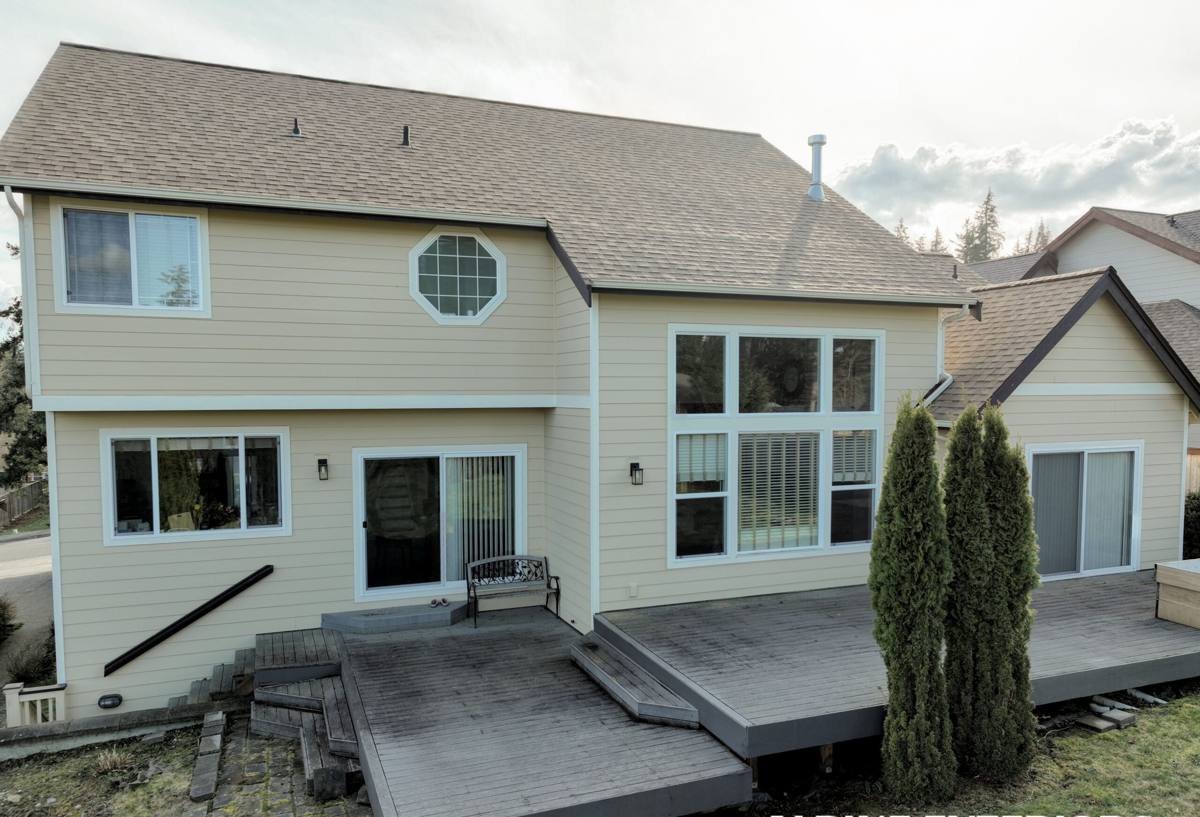
What the Lake Whatcom Climate Actually Does to a Deck
Whatcom County gets a long, wet fall-through-spring stretch, and lakefront and lake-view lots around Sudden Valley tend to hold onto that moisture longer than open ground. A few things stack up here:
- Shade from mature evergreens. Many Sudden Valley lots have significant tree cover, which is part of the appeal, but it also means large sections of decking rarely get direct sun to dry out between rain events.
- Driving rain off the lake. Wind funneling across open water can drive rain sideways into a deck's ledger connection, stair stringers, and any spot where the deck meets the house — areas that are easy to under-flash if a crew isn't paying attention.
- A long moss and algae season. Shaded, damp decking grows moss and algae for a big part of the year in this area, not just a few weeks. That growth holds moisture against the board surface and, on wood decking, becomes slick and slowly breaks down the wood fibers underneath.
- Regional marine air. Whatcom County sits close enough to the Salish Sea that damp, salt-tinged air is part of the broader regional climate, and it's one more reason fasteners and hardware matter as much as the decking itself.
None of this means a deck can't hold up well here — it means the material choices and detailing need to account for shade and standing moisture as the default condition, not the exception.
Decking Material Choices for a Shaded, Damp Lake Lot
There's no single "best" decking material for every Sudden Valley property — the right call depends on how much sun the deck gets, how the lot slopes, and what kind of upkeep the homeowner actually wants to do. Here's how the common options compare in this specific climate.
| Material | How it handles shade & moss | Maintenance in this climate | Typical trade-off |
|---|---|---|---|
| Pressure-treated wood | Absorbs moisture, needs airflow and regular cleaning to resist moss buildup | Annual cleaning and refinishing recommended in shaded areas | Lowest material cost, highest upkeep |
| Cedar | Naturally moisture-resistant but still needs cleaning where shaded | Periodic cleaning and sealing to hold its color and resist graying | Good look, mid-range upkeep, softer wood |
| Composite decking | Doesn't absorb water into the board core, but moss/algae can still grow on the surface film in shade | Occasional washing; no sealing or staining | Higher upfront cost, low long-term labor |
| PVC / capped polymer | Fully sealed surface resists moisture absorption best of the group | Simple washing; most resistant to surface staining | Highest material cost, longest expected service life |
For decks that sit under heavy tree canopy — common on the wooded side of Sudden Valley — we lean toward composite or capped polymer more often than we would on an open, sunny lot, simply because it removes the wood-rot variable from the equation. That said, plenty of homeowners want the real-wood look and are willing to keep up with cleaning; we'll build a solid wood deck too, we just make sure the framing and fastening underneath is done to handle the extra moisture exposure.
Structural Considerations for Sloped Lake-View Lots
Because so many Sudden Valley homes step down toward the lake, a deck here often isn't a simple ground-level platform. A few things we account for on sloped, elevated builds:
Footings and support on uneven ground
Sloped lots usually mean post heights vary across the same deck, sometimes significantly. Footings need to be sized and set to local frost depth and soil conditions, and on a steep site that can mean engineered post-to-beam connections rather than a standard prescriptive layout.
Ledger attachment and flashing
Where a deck ties into the house is the single most common failure point we see on older decks in this area — usually water that got behind the ledger board over years of driving rain and slowly rotted the rim joist. Correct flashing at that connection matters more here than in a drier climate.
Railing height and guard code on elevated decks
A deck that's several feet off the ground on the downhill side needs code-compliant guardrail height and baluster spacing, which is a different conversation than a low deck a foot off the grass. We size railings to the actual elevation drop, not a generic default.
Permits and Shoreline-Adjacent Considerations
Whatcom County requires permits for most new deck construction and significant deck rebuilds, and elevation, footing design, and guardrails all get reviewed. If a property is close enough to the Lake Whatcom shoreline, additional shoreline-related review can come into play — this varies by exact lot location and setback, so it's worth confirming early rather than assuming. Many homes in Sudden Valley are also part of the Sudden Valley Community Association, which can mean an architectural review step on top of the county permit. We factor both into the schedule up front so there are no surprises mid-project.
How We Approach a Lake Whatcom Deck Project
- On-site assessment. We look at slope, existing structure (if any), tree shade patterns, and how water moves across the lot during rain.
- Design and material conversation. We walk through the material comparison above against your actual sun/shade exposure and how much upkeep you want to take on.
- Permitting. We handle the county permit process and flag any HOA architectural review needed for Sudden Valley properties.
- Framing and structural work. Footings, posts, beams, and ledger flashing get built to handle both the slope and the moisture load, not just the minimum code pass.
- Decking, railing, and finish work. Final surface installed, railings set to code for the actual drop height, and any finishing (staining/sealing on wood) completed.
- Walkthrough. We go over basic care — especially moss prevention — before we call the job done.
Keeping a Lake Whatcom Deck in Good Shape Year-Round
A deck built correctly for this climate still needs some seasonal attention. A simple checklist we give homeowners:
- Sweep leaves and needles off the surface regularly in fall — trapped organic debris is what feeds moss growth in shaded spots.
- Wash the deck surface at least once or twice a year, more often in heavily shaded areas, to keep moss and algae from taking hold.
- Check the ledger board area and any spot where the deck meets the house for discoloration or soft wood, which can signal a flashing issue starting.
- Keep gutters and downspouts near the deck clear so runoff isn't dumping extra water directly onto or under the structure.
- Re-stain or reseal wood decking on the schedule your material calls for — don't wait until it's visibly gray and dry.
- Trim back overhanging branches where practical to let more light and air reach shaded sections of the deck.
Why a Crew That Already Works This Lake Matters
Sudden Valley's mix of steep lots, tree cover, and lake-driven weather isn't something you get a feel for on paper — it's something you learn by building decks here, season after season. A crew that already knows how water moves on these hillsides, how much shade a given exposure actually gets through the year, and what the county and the Sudden Valley Community Association will expect on permitting isn't guessing on any of that. It shows up in fewer surprises during the build and in a deck that's detailed correctly for this specific lake, not for a generic Pacific Northwest lot.
Get a Straightforward Estimate
If you're planning a new deck, a rebuild, or you're not sure whether your current deck is holding up the way it should, we're happy to take a look. Fill out the form below for a free, no-pressure estimate — we'll walk your property, talk through the material and structural options that make sense for your specific lot, and give you an honest read on what the project involves.