 Sudden Valley Siding
 Why Barkley Homes Take a Different Kind of Weather Beating
Homes in the Barkley area sit close enough to open water and the hills around Whatcom County that they take on a combination few siding products handle well over the long run: salt-laced air drifting in off the water, driving rain that comes in sideways during fall and winter storms, and a wet season that stretches long enough to grow a healthy crop of moss and algae on anything that stays damp. None of these factors is dramatic on its own. Together, over ten or fifteen years, they're what separates siding that still looks sharp from siding that's cupping, staining, and letting water into the wall behind it.
Salt air is corrosive to exposed fasteners and trim, and it breaks down paint films faster than inland exposure does. Driving rain doesn't just wet the face of the siding — wind-driven moisture finds every gap in flashing, every under-caulked seam, and every spot where the original installation cut a corner. Moss doesn't just look bad, either: it holds moisture against the siding surface for weeks at a time, which is exactly the condition that rots wood-based products and stains any painted finish that isn't holding up.
We work in this climate every week, not occasionally, and that's the lens we bring to every Barkley siding replacement: what will actually survive this specific combination of exposure, not just what looks good the day it goes up.
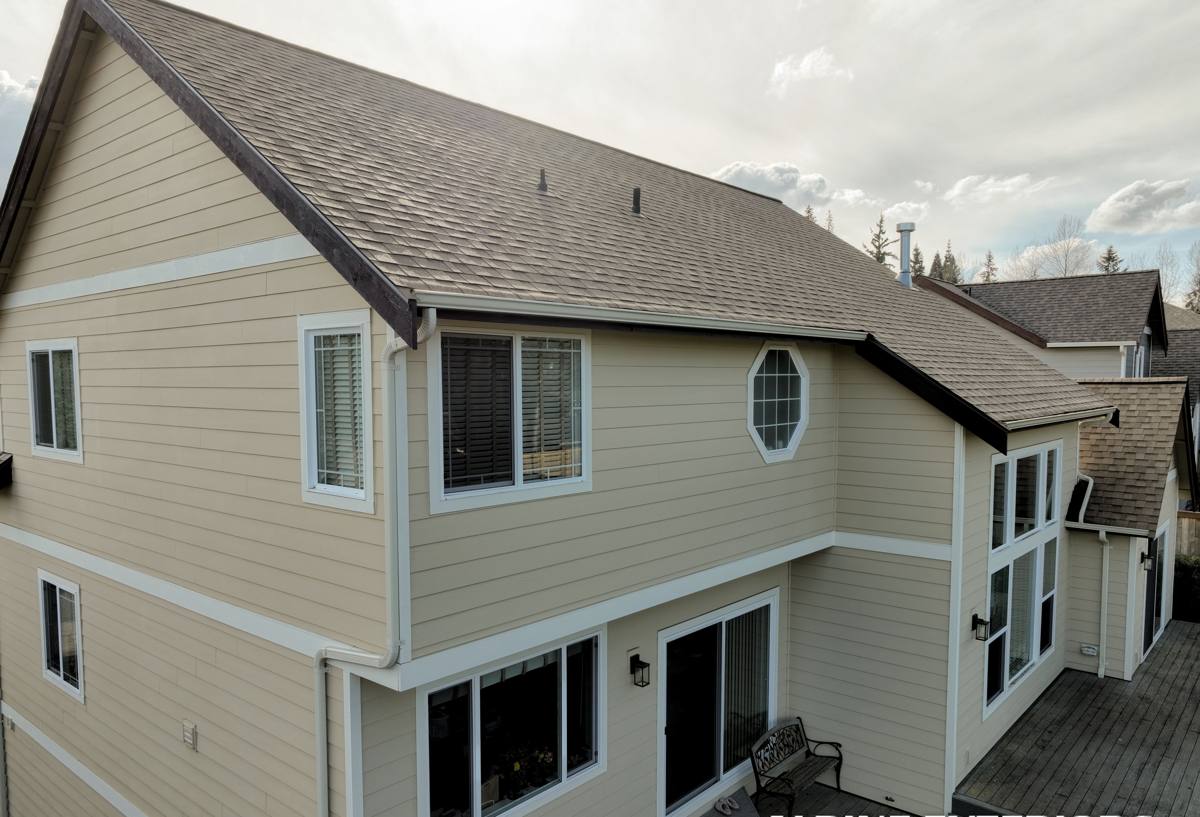
Signs Your Barkley Home's Siding Has Reached the End of Its Life
Some of these are obvious from the driveway. Others take a closer look, especially near grade, under eaves, and around windows and doors where water concentrates.
- Boards that are cupping, bowing, or visibly separating from the wall
- Soft or spongy spots when you press on the siding, especially near the bottom courses
- Paint that's peeling, chalking heavily, or won't hold a fresh coat anymore
- Persistent moss or dark streaking that returns within a season of cleaning
- Visible gaps at seams, corners, or trim where caulking has failed
- Rising heating bills alongside drafts near exterior walls
- Original siding on a home built more than 20-25 years ago
One or two of these on their own might mean a repair. Several at once, especially paired with an older original install, usually means the weather barrier and fastening underneath have been compromised long enough that patching won't hold.
What a Correct Siding Replacement Actually Involves
Tear-Off and a Real Look at What's Underneath
Replacement starts with full removal of the old siding, not siding-over-siding. That's the only way to actually see the sheathing, framing, and any water damage that's been hiding behind the old material. In a climate that drives rain sideways, we routinely find soft sheathing or rot around window openings and at the bottom plate that wouldn't show up in a surface inspection. Any of that gets cut out and replaced before anything new goes up — covering it over just seals the problem inside the wall.
The Weather-Resistive Barrier and Flashing Details
This layer is what actually keeps water out of the wall assembly; the siding itself is the first line of defense, not the last. We install a continuous weather-resistive barrier, lapped shingle-style so water sheds down and out, with flashing integrated at every window, door, deck ledger, and roof-to-wall intersection. This is the step that's easiest to rush, and the one that causes the most expensive failures down the road when it's skipped — most of the rot we find behind old siding traces back to a flashing detail that was missing or reversed.
Installing the New Siding to Manufacturer Spec
Correct fastener type, spacing, and placement; proper clearance at grade and at horizontal surfaces like decks and roofs; caulking only where the manufacturer calls for it, never as a substitute for good flashing. These details determine whether the warranty is actually valid and whether the product performs the way it's engineered to for the next several decades.
Why We Install Only James Hardie Fiber Cement
We get asked why we don't offer vinyl, LP SmartSide, or a cheaper fiber cement alternative alongside Hardie. The honest answer is that we standardized on one product because we got tired of doing warranty and repair calls on the others in exactly this kind of climate.
Vinyl is inexpensive and low-maintenance in mild conditions, but it's a material that expands and contracts noticeably with temperature swings, can crack in impact-prone spots, and its color is molded in rather than baked on at the factory, so it fades unevenly over time — not the product to lean on where wind-driven rain is a regular event. Engineered wood siding uses a wood-strand core that, however well it's treated, is still wood; keep it wet at seams or cut edges long enough and it can swell and deteriorate, which is a real risk in a wet season that runs half the year here. Cedar and primed spruce are genuinely attractive but need ongoing paint and caulk upkeep to keep water out, and moss favors their surface texture.
James Hardie's fiber cement is non-combustible, dimensionally stable across temperature and moisture swings, and comes with a factory-applied ColorPlus finish that's baked on and warrantied against fading and peeling — a real advantage where salt air chews through field-applied paint faster than it does inland. Hardie also engineers specific formulations, including HZ5 product lines built around wetter, more variable climates, which matters more here than in a dry region.
| Factor | Vinyl | Engineered Wood | James Hardie Fiber Cement |
|---|---|---|---|
| Moisture behavior | Doesn't rot, but seams can let water track behind it | Wood-based core; vulnerable if cut edges or seams stay wet | Cement-based; doesn't absorb and swell like wood |
| Finish durability | Molded-in color, fades unevenly | Factory-primed or coated, still needs repainting | Factory-baked ColorPlus finish, warrantied against fading |
| Fire resistance | Melts or deforms under heat | Combustible | Non-combustible |
| Wind-driven rain performance | Seams are a weak point | Moderate, install-sensitive | Strong when installed to spec |
| Typical lifespan when correctly installed | 20-30 years | 15-25 years | 30-50+ years |
Our Siding Replacement Process, Start to Finish
- On-site assessment: We walk the exterior, check for hidden moisture damage, and measure for materials.
- Written estimate: A clear scope and price, including any sheathing repair allowance, before any work starts.
- Full tear-off: Old siding and trim removed down to the sheathing.
- Repair and prep: Any damaged sheathing or framing replaced; new weather-resistive barrier installed.
- Flashing installation: Windows, doors, and penetrations properly flashed and tied into the barrier.
- Hardie installation: Panels or lap siding installed to manufacturer fastening and clearance specs.
- Trim, caulking, and final details: Finished to a clean, weathertight standard.
- Final walkthrough: We review the completed job with you before calling it done.
What Siding Replacement Costs Depend On
Every Barkley home is a little different, but the price of a job comes down to a handful of factors we walk through at the estimate:
| Factor | Why It Matters |
|---|---|
| Home size and wall complexity | More square footage and more corners, gables, and dormers mean more material and labor |
| Condition of the sheathing underneath | Hidden rot found during tear-off adds repair scope not visible at the estimate |
| Siding profile chosen | Lap, panel, and shingle-style Hardie products carry different material and labor costs |
| Trim and accessory work | Fascia, soffits, and trim boards replaced at the same time add scope but avoid a mismatched result |
| Access and site conditions | Slopes, tight lot lines, and multi-story walls affect staging and labor time |
We'd rather walk your home in person and give you real numbers than throw out a broad range that doesn't mean much until we've seen the walls.
Why Hiring a Crew That Already Works Barkley Matters
A crew that's already replacing siding on homes in this specific area knows the exposure patterns before they ever get on a ladder — which walls take the worst of the wind-driven rain, where moss builds up fastest, and what builders in homes of a certain era tended to skip on flashing. That's the difference between a crew learning your home's problems for the first time and one that's already seen the same failure points on the house down the street.
It also means someone local is standing behind the work. Warranty service, a question a year after installation, or a follow-up on a trim detail — all of that is easier when the crew that did the work is still working in Whatcom County, not three counties away chasing the next job.
Caring for Your New Siding After Installation
Hardie siding installed to spec is genuinely low-maintenance, but "low-maintenance" isn't "no-maintenance" in this climate:
- Rinse off moss and algae buildup once or twice a year, especially on north-facing and shaded walls
- Keep gutters clear so overflow doesn't run down the siding face repeatedly
- Re-caulk any gaps that open up at trim joints before they become water paths
- Keep sprinklers and landscaping from spraying the lower courses directly
- Walk the exterior once a year and look for anything that's changed since last season
None of this is heavy lifting, but a few minutes twice a year is what keeps a correctly installed Hardie exterior looking and performing the way it's supposed to for decades.
If your Barkley home's siding is showing its age, or you just want an honest read on where it stands, we're glad to come take a look. The estimate is free, there's no pressure attached to it, and you'll get a straight answer about what your home actually needs.