 Sudden Valley Siding
 Building a Deck That Actually Holds Up in Alger
A deck in Alger has a harder job than a deck almost anywhere inland. It sits outside year-round in a climate that combines long stretches of driving rain, salt-laden air moving in off the water, and shaded, moisture-holding conditions that keep surfaces damp for weeks at a stretch. None of that is exotic or rare for this part of Whatcom County — it's just the normal weather pattern here — but it does mean a deck built with generic, one-size-fits-all methods will show problems faster than the same deck would somewhere drier. Fastener corrosion, soft or rotted ledger connections, slick moss growth on the walking surface, and footings that heave or settle in saturated soil are the issues we see most often when we're called out to fix somebody else's work.
We build decks in Alger and the surrounding Sudden Valley area as a local siding and exterior crew, not a deck-only specialty shop that shows up once and disappears. That matters more than it sounds like it should, and we'll explain why later in this page. First, let's walk through what a deck actually needs to hold up here, and what a correct build looks like from the ground up.
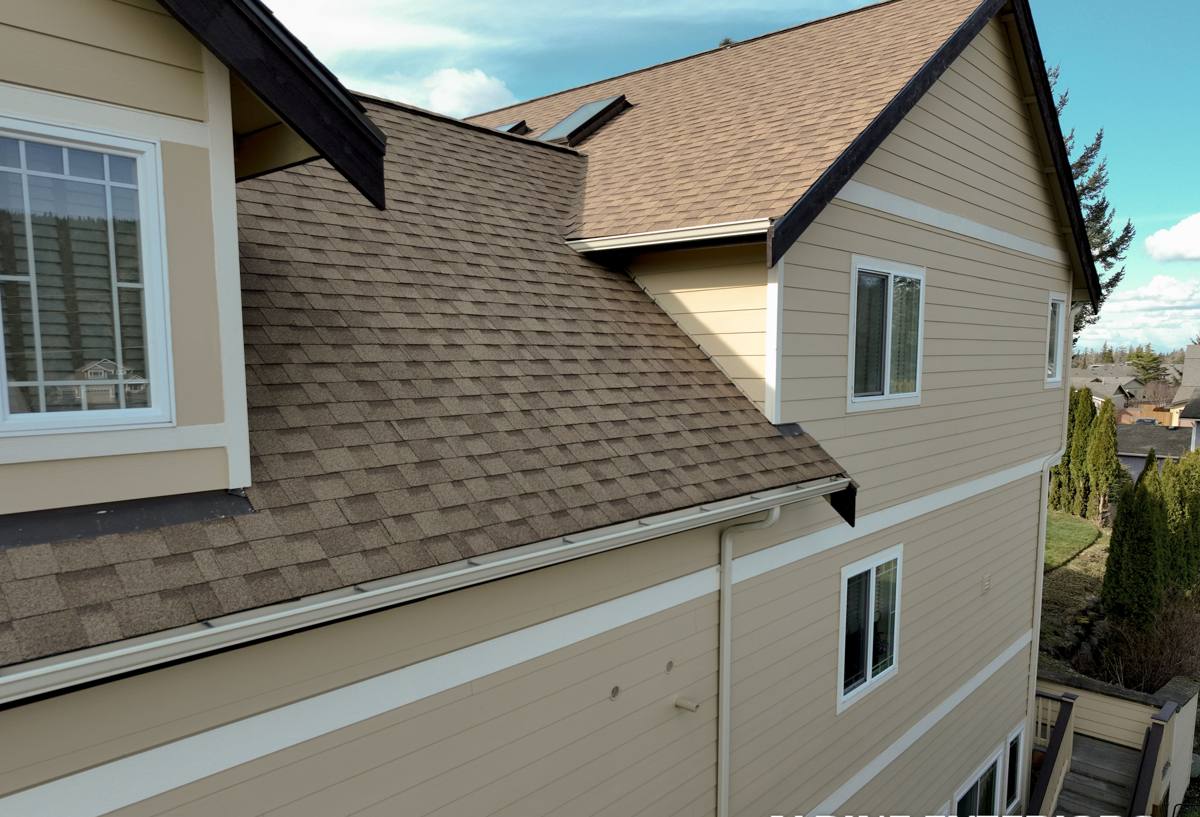
The Ledger Connection: Where Deck Building Meets Siding
The single most important — and most commonly botched — part of any attached deck is the ledger board: the horizontal framing member that bolts the deck directly to the house. This is also the point where deck building and siding work overlap directly, and it's a big part of why a siding contractor is a natural fit to build your deck rather than a crew that only frames decks and never touches wall assemblies.
Why the Ledger Is the Highest-Risk Point
Every ledger board penetrates your home's water-resistive barrier and siding. If that penetration isn't flashed correctly — with the right layering of flashing tape, metal flashing, and a proper air gap or drainage path behind the ledger — water works its way behind the siding and into the wall framing. In a climate with as much sustained rain as we get here, a poorly flashed ledger doesn't take years to cause damage. It can take one wet season.
What a Correct Ledger Detail Includes
- Removing siding at the ledger location rather than fastening through it or butting against it
- Installing self-adhering flashing membrane that laps correctly with the existing water-resistive barrier
- A code-compliant structural connection — lag screws or through-bolts sized and spaced to the load, never just deck screws or nails
- A ledger flashing cap that directs water outward and away from the wall, not toward it
- Maintaining a small gap or spacer between the ledger and the wall sheathing in some assemblies, so water that does reach that zone can drain and dry instead of sitting against wood
Because we work on siding and water-resistive barriers all the time, this detail isn't a step we're guessing at — it's the same discipline we apply to every wall penetration on a house, whether it's a deck ledger, a vent, or a light fixture.
Framing and Footings for Wet, Uneven Ground
Soil around Alger and Sudden Valley tends to hold moisture, and lots here are often sloped or partially wooded, which changes how a deck's substructure needs to be engineered compared to a flat, well-drained yard.
Footings
Footings need to be sized and set to local frost depth and soil-bearing requirements, not eyeballed. On damp or clay-heavy ground, we pay close attention to drainage around each footing — standing water against a footing over multiple wet seasons is one of the more common causes of deck settling and post lean we're asked to correct on older decks.
Framing Material and Fasteners
All structural framing should be pressure-treated lumber rated for ground contact where it's near or in soil, with joist hangers, screws, and structural connectors in a corrosion-rated coating or stainless steel. This isn't optional upgrading — it's the baseline standard for any deck that has to survive both constant moisture and the salt content that shows up in coastal Whatcom County air. Mixing untreated hardware with treated lumber, or using standard zinc-coated fasteners where a coastal-rated or stainless fastener is called for, is one of the fastest ways to get premature corrosion and staining.
Choosing a Decking Material for This Climate
There's no universally "best" decking material — every option is a trade-off between upfront cost, appearance, and how much upkeep you're willing to do in a climate that stays wet for a large part of the year. Here's how the common choices actually compare for a deck in this area:
| Material | Moisture Behavior | Moss/Algae Resistance | Maintenance | Typical Lifespan |
|---|---|---|---|---|
| Pressure-treated wood | Absorbs and releases moisture; needs sealing | Low — moss and algae take hold quickly if not cleaned | Annual cleaning and re-sealing/staining | 15–20 years with upkeep |
| Cedar | Naturally moisture-resistant, still needs finish | Moderate — better than treated pine but still needs cleaning | Periodic cleaning and refinishing | 20+ years with upkeep |
| Composite decking | Doesn't absorb water into the board core | Moderate to good, varies by product and surface texture | Occasional washing, no staining/sealing | 25–30 years, manufacturer-dependent |
| PVC/capped polymer | Fully moisture-sealed surface | Good — smoother capped surfaces shed algae more easily | Simple washing | 25–30+ years, manufacturer-dependent |
Wood costs less up front but asks for real annual maintenance to keep moss and algae from taking over — something that's harder to stay ahead of in a climate with a long wet season than it would be somewhere drier. Composite and PVC products cost more initially but shift the ongoing burden from sealing and staining to occasional washing. We'll walk you through the honest maintenance commitment of whichever material you're considering rather than just pointing you to the option with the best margin.
Railings, Hardware, and Corrosion Protection
Railings and hardware take a beating from the same conditions that stress the rest of the structure — driving rain and salt-bearing air accelerate corrosion on any fastener or bracket that isn't rated for it.
What We Standardize On
- Stainless steel or coastal-rated coated fasteners for all structural connections
- Structural post-to-beam connectors rated for outdoor, high-moisture exposure
- Railing systems with drainage detailing at post bases so water doesn't pool and sit against wood or metal
- Code-compliant railing height and baluster spacing, checked against current Whatcom County building code at permitting
We've seen decks where the framing itself was sound but the fasteners had corroded to the point of failure years ahead of schedule, simply because they weren't rated for this environment. Getting hardware right the first time is far cheaper than replacing it once it's failed under a finished deck surface.
Moss, Algae, and the Long Wet Season
Whatcom County's wet season runs long, and shaded or tree-covered lots — common around Alger and Sudden Valley — stay damp even longer than open ones. That combination is exactly what moss and algae need to establish on a deck surface, and once established, they make boards slick and, over time, hold moisture against the wood or decking surface itself.
Design Choices That Reduce the Problem
- Board spacing and orientation that lets water drain and air move underneath
- Decking with a lower-texture or capped surface where moss has a harder time gripping
- Keeping the deck surface out from directly under heavy tree canopy where practical
- Under-deck drainage systems on multi-level builds so the lower level isn't constantly wet from runoff above
No design choice eliminates the need for occasional cleaning in this climate — that's just realistic. But the right layout and material choice can turn "scrub it every few weeks" into "hose it down once or twice a season," which is the more honest goal.
Permitting and Code in Whatcom County
Most attached decks require a building permit, and inspections typically check footing depth, ledger attachment, framing connections, and railing/guard compliance before the deck is signed off. We handle the permit process as part of the job rather than leaving it to the homeowner, and we build to pass inspection the first time — not to squeak by. If you've had a deck built or added onto without a permit in the past, we can also help evaluate whether it meets current structural and safety standards.
Our Process, Start to Finish
- On-site assessment — we look at your home's siding and wall assembly at the proposed ledger location, the soil and drainage on your lot, and how the deck will be used, before we talk materials
- Design and material selection — honest comparison of wood, composite, and PVC options based on your budget and how much maintenance you actually want to take on
- Permitting — we prepare and submit what's required and coordinate inspections
- Ledger and framing — proper flashing at the wall connection, treated framing, corrosion-rated hardware throughout
- Decking, railings, and finish work — installed to the manufacturer's specifications so material warranties stay intact
- Final walkthrough — we go over basic maintenance for whatever material you chose, including how to stay ahead of moss in the wetter months
Why a Crew That Already Works Alger Matters
Deck building isn't a one-time transaction — it's a structure that has to perform through repeated wet seasons, and the details that matter most (ledger flashing, footing drainage, fastener corrosion resistance) are exactly the things that only show their weaknesses years later. A crew that's already doing exterior work throughout Alger and Sudden Valley has a practical advantage: we're not driving in from out of the area for a single job and disappearing. If a warranty question comes up, or you want a maintenance check before a wet winter, we're already working in the neighborhood.
We also see the long-term results of our own ledger and framing details on other homes in the area — siding calls often bring us back to houses where we or a similar local crew built the deck years earlier, which keeps us honest about what actually holds up here versus what only looks good on installation day.
A Quick Checklist Before You Hire Anyone for a Deck Build
- Do they pull a permit and expect an inspection, or suggest skipping it?
- Will they show you the ledger flashing detail before it's covered by decking?
- Do they specify stainless or coastal-rated fasteners in writing, not just "quality hardware"?
- Can they explain the real maintenance difference between wood, composite, and PVC for this climate?
- Do they have experience working on homes in Alger, Sudden Valley, or elsewhere in Whatcom County specifically?
If you're planning a new deck or replacing one that's showing its age, we're happy to take a look and give you a straightforward, no-pressure estimate — including an honest read on your ledger connection, footings, and which decking material actually fits how you'll use the space. Use the form below to get started.