 Sudden Valley Siding
 Why Bellingham Siding Wears Differently Than Siding Inland
Bellingham sits close enough to the water and gets enough wind-driven rain that siding here ages on a different timeline than siding fifty miles inland. Three things do most of the damage: salt-laden air off Bellingham Bay that accelerates corrosion on fasteners and trim, driving rain that gets pushed sideways into wall assemblies during winter storms, and a moss and algae season that runs long because the Pacific Northwest simply doesn't dry out for months at a stretch. None of these are dramatic events. They're slow, steady pressure that shows up as paint failure, soft trim boards, and streaked or fuzzy-looking siding a few years before a homeowner expects to be thinking about replacement.
Whatcom County's building stock includes a lot of homes from eras when siding materials and water-management details weren't built for this kind of exposure. That's not a knock on the original builders — it's just that siding technology and installation standards have moved a long way since a lot of these houses went up. When we talk about siding replacement in this area, we're not just talking about swapping old boards for new ones. We're talking about correcting whatever let moisture and salt air win in the first place.
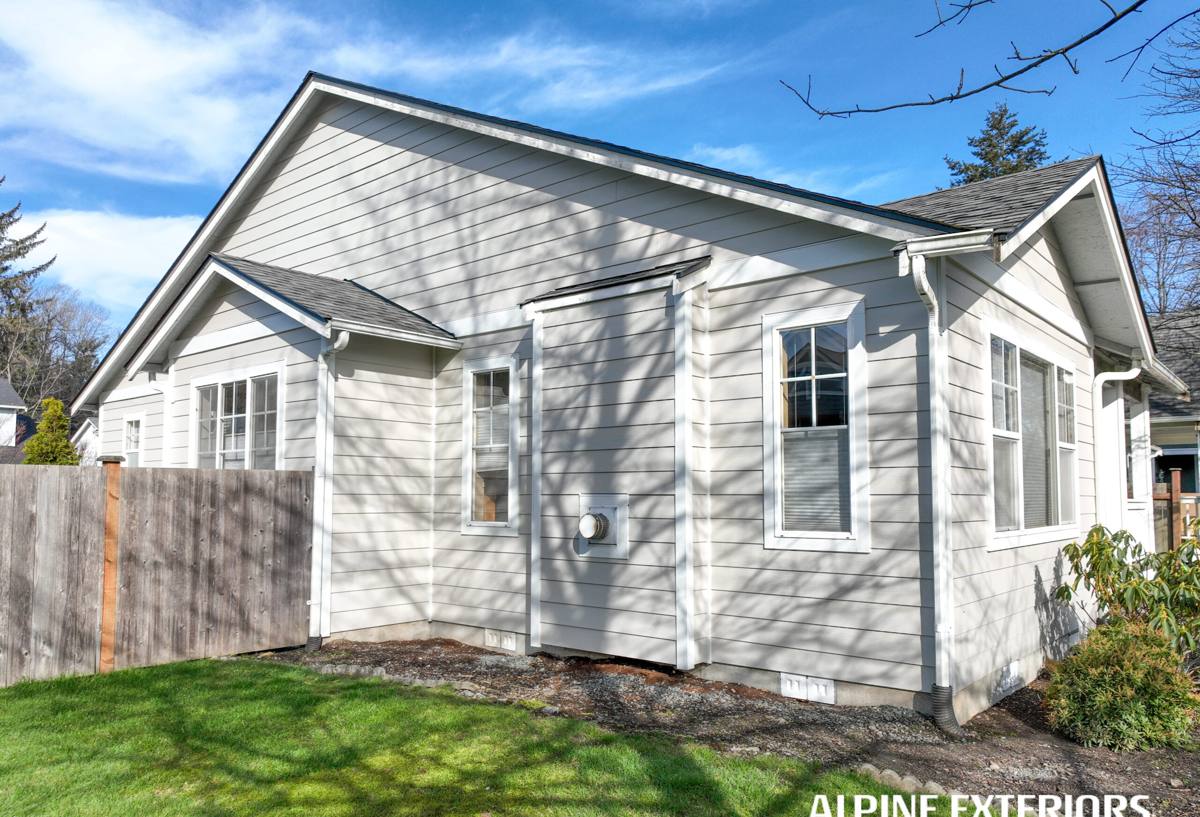
What "Siding Replacement" Actually Means (Not Just New Boards)
A siding replacement that's done right is a water-management project first and a cosmetic project second. The visible siding is the last layer installed, not the first thing that matters. Here's what a correct job involves, in order:
Tear-Off and Inspection
Old siding comes off down to the sheathing so we can actually see the wall, not guess at its condition from the outside. This is where hidden rot, failed flashing, or old moisture damage gets found — and it needs to get found before anything new goes up, not discovered five years later when a homeowner notices a soft spot.
Sheathing Repair
Any sheathing that's soft, delaminated, or water-stained gets cut out and replaced. Covering damaged sheathing with new siding just hides a problem that keeps getting worse underneath.
Weather-Resistive Barrier
A new water-resistive barrier goes on correctly lapped, shingle-style, so water sheds down and out rather than working its way behind the barrier at every seam. In a climate that sees this much driving rain, this layer is doing a lot of the real work.
Flashing at Every Penetration
Windows, doors, hose bibs, vents, light fixtures — anywhere something penetrates the wall is a place water can get in if it's not flashed correctly. This is one of the most common places we find shortcuts on older installs, and it's one of the least visible once the siding is back on.
Proper Fastening and Clearances
James Hardie has specific nailing patterns, fastener types, and clearance requirements — from grade, from roof lines, from decks — that exist because the manufacturer has tested what actually holds up. Skipping these doesn't show up as a problem on day one. It shows up in year eight or ten.
Signs a Bellingham Home Needs Replacement, Not Just Repair
| What You See | What It Usually Means |
|---|---|
| Paint that keeps failing within a couple years of repainting | Moisture is moving through the siding from behind — a surface fix won't hold |
| Soft or spongy spots when pressed | Water has reached the substrate; localized repair may not be enough |
| Persistent moss or dark streaking that returns after cleaning | Normal for this climate on some materials, but heavy return growth can mean the surface is holding moisture longer than it should |
| Visible cupping, warping, or separated seams | The material itself is failing, not just the finish |
| Siding that's original to a home built decades ago | Even well-maintained siding has a service life; older wood or composite products are often past theirs |
A lot of homeowners try to solve early warning signs with a fresh coat of paint or a pressure wash. That can buy a little time, but if the underlying issue is moisture getting behind the siding, repainting the outside doesn't fix it — it just resets the clock on how long it takes to show up again.
Why We Install Only James Hardie Fiber Cement
We don't install vinyl, LP SmartSide, primed spruce, cedar, or other fiber cement brands. That's a deliberate standard, not a lack of options. In a climate with this much sustained moisture exposure and salt air, the trade-offs on those other products are ones we're not willing to put on a customer's home:
- Vinyl can warp or become brittle over time, and its seams and J-channels give wind-driven rain more opportunities to find a way in.
- Wood products (cedar, primed spruce) look great initially but require real ongoing maintenance — repainting, caulking, moisture checks — to keep ahead of a climate that doesn't give wood much of a chance to dry out.
- LP SmartSide and other engineered wood products perform reasonably well when installation and maintenance are perfect, but the margin for error is thin, and moisture intrusion at a cut edge or fastener point can compromise the product from the inside out.
James Hardie fiber cement is non-combustible, doesn't rot, and holds its factory-applied ColorPlus finish far longer than field-applied paint on wood or composite siding. Hardie also engineers specific product lines (HardiePlank HZ10, for example) for exactly the kind of wet, temperate climate Whatcom County sits in. It's not the cheapest option on day one, but it's the option we're comfortable standing behind on a home that's going to face fifteen or twenty more winters of Pacific Northwest weather.
Our Bellingham Siding Replacement Process
- On-site assessment — We look at the existing siding, trim, and any visible trouble spots, and talk through what we expect to find once tear-off starts.
- Written estimate — Scope, product line, color, and price, in plain terms, before any work begins.
- Tear-off and inspection — Old siding comes off, sheathing gets inspected, and we flag anything that needs repair before moving forward.
- Water management install — New barrier, flashing at every penetration, correct laps and overlaps.
- Hardie installation — Installed to manufacturer specification for fastening, clearances, and joint treatment.
- Trim, caulking, and final detail work — The finish details that separate a clean-looking job from one that's actually weathertight.
- Walkthrough — We go over the finished work with the homeowner before calling the job done.
What Drives Cost on a Bellingham Siding Job
| Factor | Why It Matters |
|---|---|
| Home size and wall complexity | More corners, gables, and dormers mean more cutting, flashing, and labor |
| Condition of existing sheathing | Rot or water damage found during tear-off adds repair scope that can't always be known until the old siding is off |
| Hardie product line and profile | Lap siding, shingle-style panels, and board-and-batten all price differently |
| Trim and detail scope | Window and door trim, fascia, and soffit work add labor beyond the flat wall areas |
| Access and site conditions | Steep lots, limited staging area, or multi-story walls affect labor time |
We won't quote a firm number without seeing the home, and we won't pretend to know what's under the old siding until it's off. What we can promise is a written estimate before work starts and a clear conversation if tear-off reveals something that changes scope.
Choosing a Contractor Who Actually Works This Area
Siding installation is detail work, and the details that matter most in Whatcom County — how much overlap a water-resistive barrier needs, how aggressive the flashing has to be around windows, how much clearance to leave near grade given how wet the ground stays — are the kind of thing a crew learns by working this specific climate over and over, not by reading a manufacturer manual once. A contractor who mostly works drier regions can do competent work and still miss the margin that matters here.
A few things worth asking any siding contractor before you hire one:
- Are you a certified or factory-trained installer for the product you're proposing?
- Will you show me the water-resistive barrier and flashing before it's covered up, or document it with photos?
- What's your plan if you find rotted sheathing during tear-off?
- What warranty covers the material, and what warranty covers your labor — and are those the same document or two different ones?
- Can I see the manufacturer's installation instructions you're following for fastening and clearances?
A contractor who answers these plainly and without hesitation is one who does this work often enough that it's routine.
After Installation: Keeping Hardie Siding Performing
James Hardie fiber cement is low-maintenance compared to wood or composite siding, but "low-maintenance" isn't "no-maintenance," especially with the moss and algae pressure this region sees. A periodic gentle wash to keep organic growth from building up, a visual check of caulking at trim and penetrations every year or two, and prompt attention to any impact damage go a long way toward getting the full service life out of the material and keeping the warranty intact.
If you're weighing siding replacement for a home in the Bellingham area, we're glad to come take a look, walk the exterior with you, and give you an honest read on what your siding actually needs — whether that's a full replacement now or a few more years of life left in what's there. The estimate is free, and there's no pressure attached to it.