 Sudden Valley Siding
 Why Lake Whatcom Homes Need a Different Siding Standard
Lake Whatcom sits in a pocket of Whatcom County that gets more of everything: more rain off the Puget Sound weather systems, more humidity trapped by the surrounding hills and tree cover, and more of the low-angle winter sun that never quite dries out a north-facing wall. Add the lake itself, which keeps ambient moisture higher along the shoreline than you'd find a few miles inland, and you've got a climate that is genuinely harder on exterior siding than most of the country deals with. Homes here don't fail because owners neglected them. They fail because the siding material wasn't built for this specific combination of driving rain, salt-tinged marine air moving up from the Sound, and a moss season that can run eight or nine months out of the year.
We install James Hardie fiber cement siding exclusively, and Lake Whatcom is exactly the kind of area that explains why. This page covers what a correct Hardie installation looks like for homes in this community, what the local climate actually does to siding over time, and how our process is built around the realities of this specific lake and this specific county.
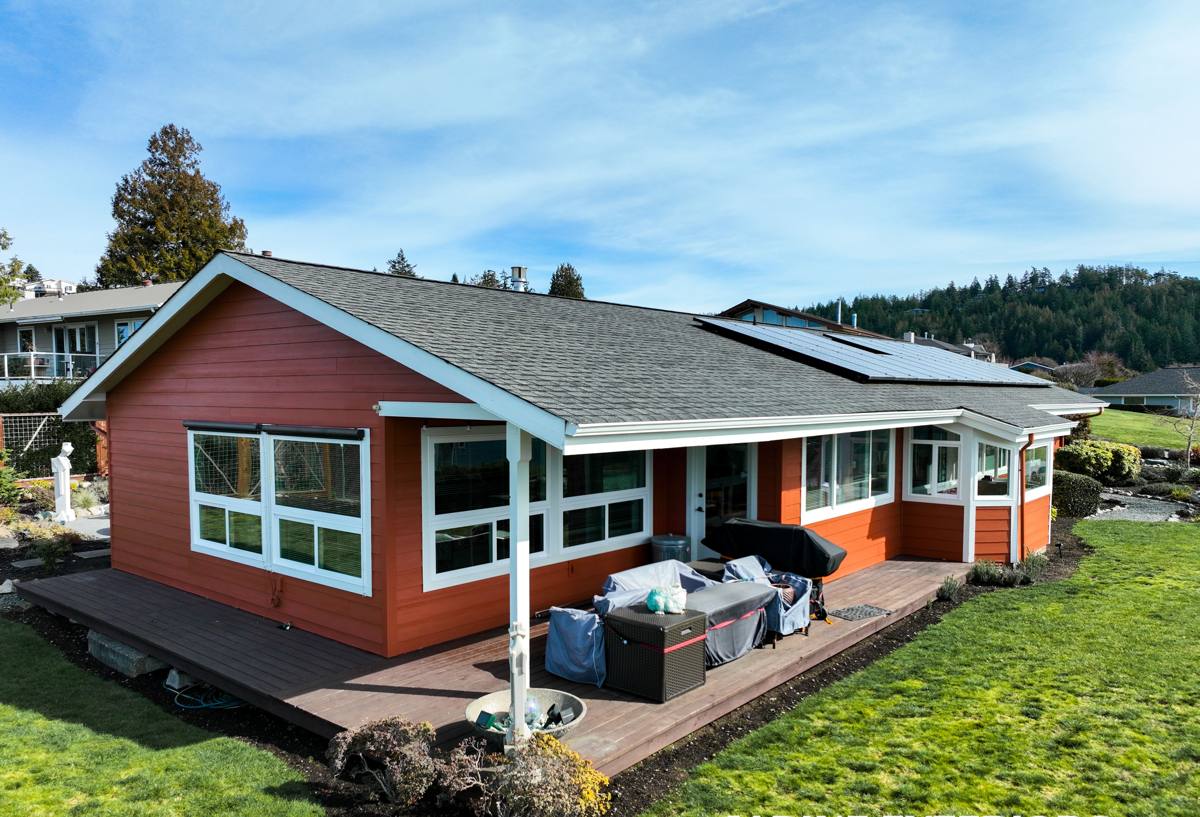
What Salt Air, Driving Rain, and Moss Season Do to Siding
Salt-Influenced Marine Air
Whatcom County isn't oceanfront, but the marine air that moves inland off the Sound still carries enough salt and moisture to accelerate corrosion on fasteners, staining on porous materials, and finish breakdown on anything not engineered to resist it. Over years, that steady low-grade exposure adds up faster than most homeowners expect.
Driving Rain
Rain in this part of Washington doesn't just fall straight down — wind off the lake and through the surrounding terrain pushes it sideways into wall assemblies, working it into laps, seams, and any gap in the water-resistive barrier. Siding that isn't dimensionally stable, or that was installed without proper flashing and clearances, lets that water in behind the cladding, where it does the real damage.
Moss and Sustained Dampness
Shade from mature trees around the lake, combined with long stretches of overcast, damp weather, creates ideal conditions for moss and algae to colonize siding surfaces — especially on north- and east-facing walls that don't get much direct sun to dry them out. Moss holds moisture against the surface far longer than open air would, which is a problem for any material that absorbs water or swells when wet.
Put those three factors together and you get a climate that punishes materials prone to swelling, delaminating, or holding moisture. It rewards materials that stay dimensionally stable wet or dry and that carry a factory finish resistant to both fading and biological growth.
Why James Hardie Is the Right Material for This Climate
James Hardie fiber cement is engineered from cement, sand, and cellulose fibers — a composition that doesn't absorb and swell the way wood-based products can, and won't combust, warp, or rot the way some alternatives do over a long wet season. For a property near Lake Whatcom, that translates into a few concrete advantages:
- Dimensionally stable when saturated, so repeated wet-dry cycles through fall and winter don't cause the board itself to swell, cup, or push fasteners loose over time.
- A factory-applied ColorPlus finish that's baked on under controlled conditions, giving far better resistance to the fading and chalking that constant damp, low-light exposure causes on field-painted surfaces.
- Non-combustible core, which matters for wildfire-adjacent insurance considerations even in a wetter county, since carriers increasingly ask about exterior material class.
- HZ5 and HZ10 product engineering specifically built for wetter, more humid climate zones — the Pacific Northwest is exactly the region these product lines were developed for.
We don't install LP SmartSide, vinyl, Cemplank, Allura, primed spruce, or cedar. Each of those has legitimate uses somewhere, but none of them holds up as consistently as Hardie does under Lake Whatcom's specific combination of moisture load, shade, and marine-influenced air — and we'd rather stand behind one system we trust completely than offer several we have reservations about.
What a Correct Installation Involves
Fiber cement siding is only as good as its installation. Hardie's own warranty is conditional on installation meeting their published specifications, and in a climate like this, the details that get skipped on a rushed job are exactly the ones that cause problems three or five years later.
Water Management Comes First
Before a single piece of siding goes up, the wall needs a correctly lapped weather-resistive barrier, properly integrated flashing at every window, door, and penetration, and a drainage plane that lets any water that does get behind the cladding find its way back out. This is the step most likely to get shortchanged on a fast job, and it's the step that matters most in a climate that sees this much driving rain.
Clearances and Gaps
Hardie specifies minimum clearances from grade, roofing, decks, and other transitions, along with defined gaps at butt joints and trim. In a high-moss, high-moisture environment, skipping these clearances is how you end up with siding sitting in standing water or trapped organic debris — exactly the conditions moss and rot need.
Fastening
Corrosion-resistant fasteners, correctly spaced and set to the right depth, matter more here than in a dry climate because marine-influenced air accelerates corrosion on anything undersized or improperly coated. Overdriven or underdriven nails compromise both the water seal and the board's ability to move slightly with temperature changes.
Caulking and Sealant Strategy
Hardie's system actually calls for less reliance on caulk than most homeowners assume — proper flashing and lapping do the real work, with sealant used only where specified. Over-caulking creates maintenance points that fail and trap water rather than shedding it.
Our Process for Lake Whatcom Homes
| Step | What Happens | Why It Matters Here |
|---|---|---|
| Site assessment | We walk the property, checking exposure, tree cover, drainage, and current siding condition wall by wall | Shaded and lake-facing walls often need different attention than sun-exposed sides |
| Moisture check | We look for existing water intrusion, soft sheathing, or trapped moisture behind current siding before quoting | Catching hidden damage early avoids surprises once tear-off starts |
| WRB and flashing plan | We detail the water-resistive barrier and flashing approach for every window, door, and penetration | This is the layer that actually keeps driving rain out, not the siding itself |
| HZ product selection | We spec the Hardie HZ line and profile suited to the home's exposure and style | Not every wall needs the same product, especially with varying shade and moisture exposure around a lake lot |
| Installation to spec | Clearances, fastening, and lapping done to Hardie's published requirements | Keeps the manufacturer warranty valid and the wall system performing as designed |
| Final walkthrough | We review the finished work with the homeowner before calling the job done | You should understand what was done and why before we leave |
Why a Crew That Already Works Lake Whatcom Matters
Siding installation isn't uniform across Whatcom County. A crew that mostly works drier, more open sites elsewhere doesn't always think about the shade patterns around a lake lot, or how much longer a north wall under fir trees stays damp compared to open siding thirty minutes away. Working this community regularly means recognizing which walls need extra attention to drainage and clearance before problems show up, not after.
It also means understanding the practical side of working here — narrower access on some lake-adjacent lots, seasonal weather windows that are shorter than they'd be inland, and the value of scheduling exterior work around the wetter months rather than fighting through them. None of that is exotic knowledge, but it's the difference between a crew executing a generic spec and one applying it correctly to this specific site.
Signs Your Current Siding Isn't Keeping Up
- Persistent moss or algae growth that returns within a season or two of cleaning, especially on shaded walls
- Visible swelling, delamination, or soft spots at board edges and seams
- Paint that's chalking, peeling, or fading unevenly, particularly on walls facing the lake or prevailing wind
- Staining or discoloration streaking down from seams or trim after rain
- Fasteners backing out or visible gaps opening at butt joints
- A musty smell or soft drywall on interior walls that back up to exterior siding
Any one of these on its own might just mean routine maintenance. Several together, especially on a home that's had the same siding for fifteen-plus years, usually means the material itself is reaching the end of what it can handle in this climate.
What to Expect Cost-Wise
Every Hardie project is priced around the specific home — square footage, number of stories, trim complexity, current siding removal, and any sheathing repair needed once old material comes off. Homes near Lake Whatcom with significant tree cover or older siding sometimes carry extra cost for moisture remediation discovered during tear-off, which is why we check for that during the initial assessment rather than after signing a contract. We're happy to walk through actual numbers for your home once we've seen it — broad national averages don't account for the site-specific factors that actually drive a Lake Whatcom quote.
Get a Straight Answer for Your Home
If your siding is showing its age, or you're planning ahead of the wetter months, we're glad to come take a look and give you an honest read on what your home actually needs — no pressure, no inflated urgency. Reach out through the form below for a free estimate.