 Sudden Valley Siding
 Why Lake Whatcom Homes Take a Different Kind of Beating
Homes around Lake Whatcom don't weather the same way a house in downtown Bellingham does, and they definitely don't weather the same way a house east of the Cascades does. Sit at lake level in Sudden Valley and you're dealing with three things stacked on top of each other: marine air moving in off the Salish Sea and settling into the Whatcom County lowlands, driving rain that comes sideways off the water during fall and winter storms, and heavy tree cover that keeps north- and lake-facing walls shaded and damp for months at a stretch. That combination adds up to one of the longer moss and algae seasons in the county, and it's brutal on siding that isn't built to shed water fast and dry out between soakings.
This page is about one job specifically: installing fiber cement siding correctly on a Lake Whatcom-area home. Not a general siding overview — the actual product, the actual installation details, and the actual reasoning that matters when your walls sit in a lake basin with limited sun exposure and near-constant humidity for half the year.
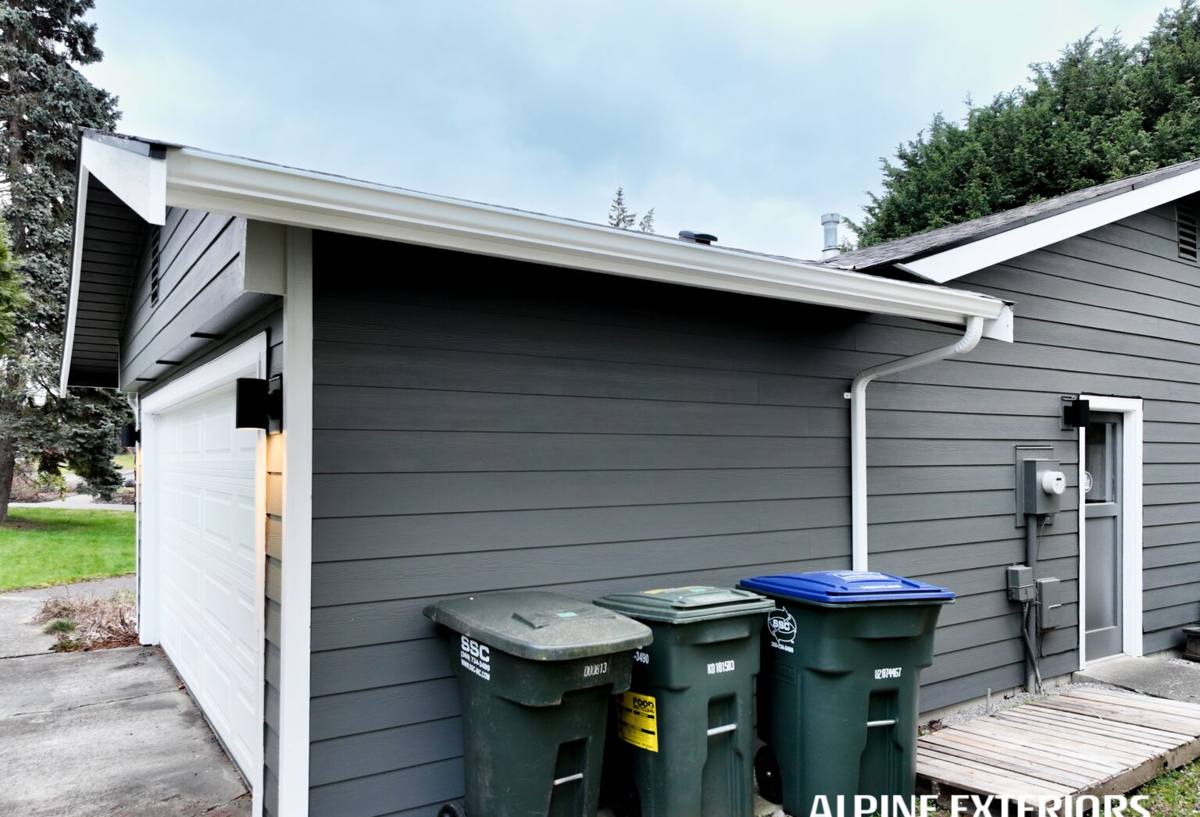
What Damp, Shaded Siding Actually Has to Survive Here
Most siding failures we see around the lake aren't dramatic. They're slow. A wall that never fully dries starts growing moss in the caulk lines and butt joints first, then along any horizontal surface where water sits. Wood-based products swell and shrink with every wet-dry cycle, which eventually opens seams and lets water behind the panel — and once water gets behind siding in a shaded, humid spot, it doesn't evaporate quickly. That's how you get soft trim, peeling paint, and eventually sheathing damage that costs far more to fix than the siding itself.
Three conditions specific to this area drive that failure pattern:
- Prolonged shade: tree cover around much of the lake keeps walls wet longer after rain than an open, sun-exposed lot would.
- Driving, wind-pushed rain: storms off the lake push water sideways into laps, corners, and trim joints, not just straight down.
- High ambient humidity: even on dry days, the air near the lake stays moist enough that moss and algae spores have what they need to take hold on porous or absorbent surfaces.
None of that is unusual for Whatcom County. It's just more concentrated at lake level than it is up on a drier, sun-exposed slope.
Why We Install Only James Hardie Fiber Cement
We get asked why we don't offer vinyl, LP SmartSide, cedar, or primed spruce as options. The honest answer: we standardized on James Hardie fiber cement because it's the product that holds up best to exactly the conditions described above, and we'd rather turn down jobs than install something we know will need premature repair in this climate.
Fiber cement is cement, sand, and cellulose fiber — it doesn't absorb and swell the way wood-based products do, and it's non-combustible, which matters more every wildfire season. James Hardie also engineers separate product lines for different climate zones (their HZ5 and HZ10 systems), which means the panels going on a Lake Whatcom home are formulated for the Pacific Northwest's wet cycle specifically, not a generic national spec. That's not marketing — it's a real difference in how the product handles repeated moisture exposure over decades.
We're not going to tell you every other product is worthless. Vinyl is inexpensive and low-maintenance in dry climates. Cedar looks great and plenty of people love the look. LP SmartSide is a legitimate engineered wood product. But each of them has a real trade-off — moisture sensitivity, repainting cycles, seam and caulk maintenance, or all three — that we think is a bad bet in a shaded, humid lake environment. Hardie is the one product where we're comfortable standing behind the install for the long haul.
What "Climate-Engineered" Actually Means
James Hardie's HZ5 line (the standard for our region) is formulated with a moisture-resistant composition and comes with a factory-applied ColorPlus finish — baked-on color and a protective coat applied under controlled conditions, not brushed on in the field where humidity and temperature swings affect cure quality. That factory finish is one of the bigger reasons Hardie holds color and resists cracking longer than field-painted alternatives, especially on walls that don't get much direct sun to help paint cure and dry.
What a Correct Fiber Cement Installation Involves
Fiber cement is only as good as the install behind it. A rushed or generic install — the kind that ignores the specific water-management needs of a shaded, lake-adjacent lot — will fail regardless of the product. Here's what we treat as non-negotiable on every Lake Whatcom project:
Water Management Comes First
- House wrap or weather-resistive barrier installed and lapped correctly, with all seams taped
- Flashing at every window, door, and horizontal trim transition — this is where driving rain finds its way in if it's skipped
- Proper starter strip and clearance at the foundation so panels don't wick moisture from grade or splash-back
- Rainscreen or drainage gap where wall conditions call for it, giving trapped moisture somewhere to drain and air to circulate behind the panel
Fastening and Fit
Hardie panels have to be fastened per the manufacturer's specification — correct fastener type, spacing, and depth — because over- or under-driven nails compromise the water-shedding lap and can void the warranty. Panel joints get factory-cut or precision-scored, not hacked to fit, and any cut edge that exposes raw fiber cement gets sealed before it's closed in. That last step is one contractors skip constantly, and it's exactly the kind of detail that determines whether a wall holds up through fifteen wet seasons or starts absorbing moisture at every joint within a few years.
Caulking and Sealant
We use sealants rated for the actual movement and moisture exposure the joint will see, not whatever's cheapest at the yard. In a high-humidity environment, the wrong sealant either fails early or becomes the first place moss takes hold.
Comparing Options for a Lake Whatcom Property
| Factor | James Hardie Fiber Cement (HZ5) | Vinyl | Wood-Based (Cedar / LP SmartSide) |
|---|---|---|---|
| Moisture absorption | Minimal — cement-based, doesn't swell | None, but seams can trap water behind panel | Moderate to high — swells and can rot if finish fails |
| Moss/algae resistance | Good with factory finish; cleans easily | Fair; moss can gain a foothold in grooves | Poor in shade — porous surface holds moisture |
| Repainting cycle | Factory ColorPlus finish, decades before repaint needed | Never repainted, but fades and can't be restored easily | Every 3-7 years depending on exposure |
| Fire resistance | Non-combustible | Melts/deforms under heat | Combustible |
| Upfront cost | Mid-to-higher | Lower | Mid-range, varies by species/grade |
| Long-term cost of ownership | Lower — less maintenance, longer service life | Low-moderate — occasional panel replacement | Higher — recurring maintenance and finish upkeep |
None of these numbers are guarantees — actual cost and lifespan depend on your home's exposure, existing wall condition, and how well the install is done. But the pattern holds across the lake: products that resist moisture and hold their finish without constant upkeep come out ahead over a 20-30 year ownership window.
How Our Process Works
- On-site assessment: we look at your home's specific exposure — tree cover, prevailing wind direction off the lake, existing moisture damage, and current siding condition — before recommending anything.
- Tear-off and sheathing check: old siding comes off and we inspect the sheathing underneath for rot or damage that needs addressing before new siding goes on. Covering up a problem is how small issues become expensive ones.
- Water-resistive barrier and flashing: installed to spec at every penetration, corner, and horizontal transition.
- Panel installation: Hardie panels installed per manufacturer fastening and clearance requirements, with cut edges sealed.
- Trim, caulking, and detail work: the finish details — corner boards, trim, sealant lines — that determine how the wall actually performs in wind-driven rain.
- Walkthrough and cleanup: we go over the finished work with you and clear the site.
Living With Fiber Cement Around the Lake: What Upkeep Actually Looks Like
Fiber cement isn't zero-maintenance, but it's low-maintenance compared to what most lake-area homes are currently wearing. A realistic annual routine:
- Rinse siding once or twice a year, more often on shaded, north-facing walls where moss and algae collect fastest
- Keep gutters clear so overflow isn't running down the wall face
- Trim back vegetation that's shading walls or holding moisture against the siding
- Check caulk lines annually, especially around windows and trim, and re-caulk any joint that's cracked or pulled away
- Watch for any soft spots at the base of walls near grade — a sign water is sitting somewhere it shouldn't
Compare that to a wood-based product needing a fresh coat of stain or paint every few years on shaded elevations, and the maintenance gap becomes obvious fast.
Why Hiring a Crew That Already Works This Lake Matters
A contractor who mostly works drier, more open lots in other parts of Whatcom County can install fiber cement competently and still miss the details that matter specifically at lake level — the extra attention to flashing on shaded walls, the drainage planning for a lot that barely dries out between November and April, the awareness that a wall facing the water takes a different beating than one tucked behind a hill. Crews that work Sudden Valley and the broader Lake Whatcom basin regularly know which walls on which exposures need the extra rainscreen detail and which don't, because they've already seen how houses here actually age.
That local pattern recognition is worth more than it sounds like. It's the difference between a siding job that looks right on installation day and one that's still performing correctly a decade in.
If you're weighing a siding replacement or new construction siding for a home in Sudden Valley or elsewhere around Lake Whatcom, we're happy to take a look and give you a straightforward, no-pressure estimate — including an honest read on what your specific lot and exposure actually need. There's a form below to get started.