 Sudden Valley Siding
 Why South Hill Homes Need Windows Built for This Climate
South Hill sits inside the larger Sudden Valley community in Whatcom County, and like the rest of the area it deals with a wet season that runs long and a shoulder season that never really dries out. Homes here don't fail because of one dramatic storm — they fail slowly, from months of driving rain hitting the same wall, salt-tinged air working on hardware and finishes, and moss finding every shaded, damp surface it can hold onto. Windows sit right at the center of that exposure. They're penetrations in the building envelope, and every seam, sash, and sill is a place where water and air can get in if the unit or the installation isn't right for the conditions.
An energy-efficient window isn't just about a lower heating bill, though that matters here too. In this climate, the glass package and the frame material also decide how well the window resists moisture intrusion, how much condensation builds up on cold mornings, and how long the finish holds up before it needs attention. We treat efficiency and durability as the same conversation for South Hill homes, because in this climate they are.
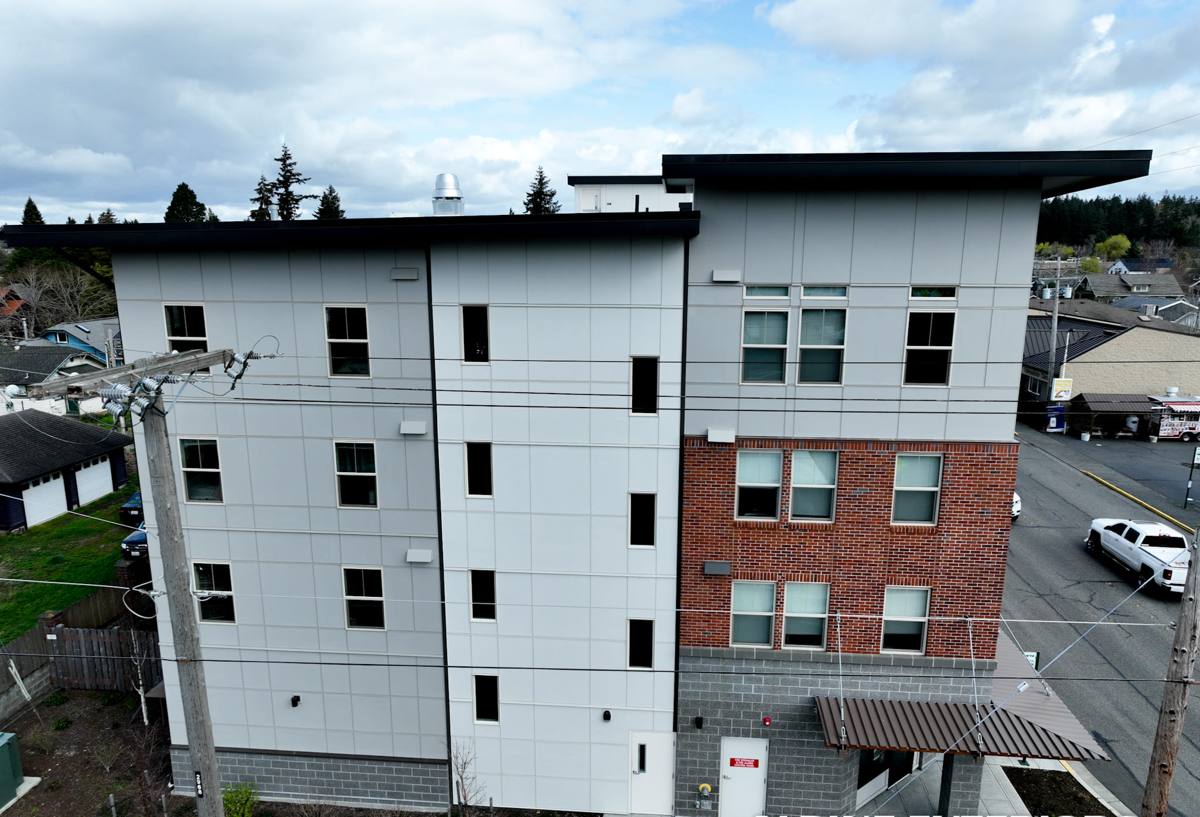
What Whatcom County's Weather Actually Does to Windows
Driving Rain
Wind-driven rain doesn't just run down glass — it gets pushed sideways and up under trim, sills, and poorly flashed frames. Over years, this is how water finds its way behind siding and into wall cavities, usually long before anyone notices a leak from inside. Correct flashing and sealant work at the window opening matters as much as the window itself.
Salt Air
Proximity to Puget Sound and the surrounding waterways means airborne salt reaches homes well inland, including up into South Hill's elevation. Salt accelerates corrosion on hardware, hinges, and metal window components, and it can degrade certain finishes and sealants faster than a purely inland climate would. Materials and hardware that hold up in a dry climate don't always hold up here.
Moss and Shade
Trees and terrain that make South Hill attractive also mean a lot of shaded wall area that stays damp for extended stretches, especially fall through spring. Moss and algae don't just grow on roofs — they colonize window sills, trim, and any horizontal or textured surface that holds moisture. Left alone, that growth traps water against wood trim and finishes, which shortens their life.
What "Energy-Efficient" Actually Means
The term gets used loosely in this industry, so it's worth being specific about what actually makes a window perform well in a Pacific Northwest climate.
- U-factor — measures how well the window resists heat loss. Lower is better for our mild but persistently cool, damp winters.
- Solar Heat Gain Coefficient (SHGC) — measures how much solar heat passes through the glass. In our cloudy climate this matters less than in sunnier regions, but it still affects comfort in south- and west-facing rooms.
- Low-E coatings — a microscopically thin coating that reflects heat while letting light through, improving both insulation and comfort near the glass.
- Gas fills (argon or krypton) — inert gas between panes that slows heat transfer better than plain air.
- Frame material and construction — the frame is often the weak point for both energy loss and moisture resistance, which is why we spend as much time discussing frames as glass.
A window can have excellent glass and still perform poorly if the frame conducts cold or the installation lets air leak around the perimeter. Efficiency is a system, not a single spec on a label.
Comparing Window Materials for This Climate
Every material has trade-offs. Here's how the common options actually perform in a wet, moss-prone, salt-influenced climate like South Hill's.
| Material | Moisture Resistance | Maintenance | Typical Lifespan | Notes for This Area |
|---|---|---|---|---|
| Vinyl | Good — won't rot | Low; occasional cleaning | 20-30 years | Solid, budget-friendly baseline; hardware quality varies by manufacturer |
| Fiberglass | Very good — dimensionally stable | Low | 30-40+ years | Handles temperature and moisture swings with minimal expansion/contraction |
| Wood-clad | Depends entirely on the cladding and joinery quality | Higher — exposed wood needs upkeep | 20-30 years, less if maintenance lapses | Attractive interior look, but the cladding seams are where moisture problems start if not detailed correctly |
| Aluminum | Poor thermal performance, corrosion risk near salt air | Moderate | 20-30 years | We generally steer South Hill homeowners away from bare aluminum frames for this reason — thermal bridging and salt exposure are a tough combination |
We don't push one brand or material on every job. The right call depends on your home's exposure — how shaded it is, which direction it faces prevailing weather, and what the existing wall assembly looks like once we open it up.
Signs Your Current Windows Are Working Against You
Homeowners in South Hill often live with underperforming windows for years before replacing them, mostly because the signs show up gradually. Worth checking for:
- Visible fog or moisture between panes on double- or triple-glazed units — the seal has failed
- Condensation forming on the inside of the glass regularly during cool months
- Drafts you can feel with a hand near the sash or frame on a windy day
- Soft or discolored wood trim around the window, especially on the sill
- Moss or dark staining building up in the corners of the frame or sill that keeps coming back after cleaning
- Windows that are difficult to open, close, or lock — a sign the frame has shifted or swollen
- A noticeable difference in room temperature near the window compared to the rest of the house
Any one of these on its own isn't necessarily urgent. Several together, especially moisture staining plus drafts, usually means the window and possibly the surrounding wall assembly need attention.
How We Approach a Window Replacement in South Hill
Assessment First
Before we talk products, we look at the actual opening — how it's currently flashed, whether there's existing moisture damage, which direction it faces, and how exposed it is to wind-driven rain. This tells us more about what the job needs than any product brochure does.
Correct Flashing and Sealing
This is the step that matters most in our climate and the one that gets rushed most often in cheaper installs. Proper window replacement means integrating the window flange with a weather-resistant barrier, using flashing tape and sill pans designed to shed water outward, and sealing the perimeter so any water that does get behind the trim has somewhere to drain rather than sitting against the framing. A great window installed with sloppy flashing will leak eventually. A modest window installed correctly usually won't.
Fit and Finish
We measure for the actual opening, not a catalog size, and we finish the interior and exterior trim so it sheds water and matches the rest of the home rather than looking like a patch job.
Cleanup and Walkthrough
We walk every completed window with the homeowner — operation, locks, and how to spot early signs of a problem down the road — before we consider the job done.
Why a Crew That Already Works South Hill Matters
Window replacement isn't just a product install — it's a judgment call about how a specific wall assembly, on a specific lot, with a specific amount of shade and wind exposure, needs to be detailed. A crew that has worked homes across Sudden Valley and South Hill has already seen how the local moss season affects sill maintenance, how driving rain off the lake hits certain elevations harder than others, and which details on older homes in this area tend to need extra attention when the old windows come out. That's not something a crew unfamiliar with the area picks up on the first pass. It also means faster, more accurate estimates, because we're not guessing at how the local climate will treat a given product — we've already seen it.
What Affects the Cost of a Window Replacement
| Factor | Why It Affects Price |
|---|---|
| Number and size of windows | More openings and larger glass area mean more material and labor |
| Frame material | Vinyl is typically the most affordable; fiberglass and wood-clad cost more upfront |
| Glass package | Double vs. triple pane, low-E coatings, and gas fills add cost but also add performance |
| Condition of the existing opening | Rot or moisture damage found once the old window is out adds repair work before the new one goes in |
| Trim and finish work | Matching existing interior or exterior trim, or upgrading it, adds labor |
| Access and home layout | Second-story windows, tight side yards, or unusual openings take more time to install correctly |
We give honest, itemized estimates rather than a single vague number, so you can see exactly what's driving the cost and where there's room to adjust the scope if needed.
Living With Windows in a Moss-Season Climate
Even a well-installed, high-quality window benefits from basic upkeep in this environment. A couple of habits go a long way:
- Clear moss and debris from sills and tracks a couple of times a year, especially on shaded elevations
- Check weep holes (the small drainage openings at the base of the frame) to make sure they're clear and draining, not blocked by debris or paint
- Look at exterior caulking annually and touch it up before gaps open into real leaks
- Wipe down hardware periodically if you're close to open water, since salt air accelerates corrosion on hinges and locks
None of this is complicated, but skipping it is how a good installation slowly turns into a problem one over several years.
Get a Straightforward Estimate
If your South Hill or Sudden Valley home has windows that are drafty, fogged, or showing moisture damage, it's worth having someone look at the actual openings before you decide what to do. We'll give you a clear, no-pressure assessment of what your windows and the surrounding trim actually need — use the form below to request a free estimate.