 Sudden Valley Siding
 Composite Decking Built for the Barkley Climate
Homeowners in Barkley and the wider Sudden Valley area deal with a specific combination of conditions: salt-laden marine air, long stretches of driving rain, and a moss season that can run most of the year. A deck out here doesn't just need to look good for a season — it needs to shed water fast, resist algae and moss growth, and hold its fasteners tight through freeze-thaw swings and constant damp. Composite decking, installed correctly, handles all of that better than most alternatives. Installed poorly, it fails in the same ways wood does — just more slowly and more expensively.
We install composite decking as part of our regular work in Barkley, alongside the siding and moisture-management work we do on the same homes. That matters more than most homeowners expect, and we'll explain why further down.
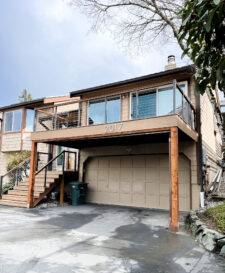
What Whatcom County's Climate Actually Does to a Deck
Constant Moisture
Whatcom County doesn't get one big rainy season — it gets a long, low-grade drip that keeps everything damp for months. Wood decking absorbs that moisture, swells, and eventually cups, splits, or rots at the joints. Composite boards don't absorb water the way wood does, but the substructure underneath still can, and that's where most deck failures out here actually start.
Moss and Algae
Shade, moisture, and mild temperatures are exactly what moss and algae need to thrive, and a deck surface that stays damp for days at a time is an easy target. Moss on a walking surface isn't just unsightly — it's a slip hazard, and left alone it holds moisture against the board surface longer than it would otherwise sit.
Salt Air
The marine air common to this part of Whatcom County accelerates corrosion on any exposed metal — fasteners, brackets, railing hardware. A deck built with the wrong hardware will show rust streaks and weakened connections years before the decking itself wears out.
What a Correct Composite Deck Installation Involves
A composite deck is only as good as what's underneath it. Most of the problems we get called out to fix on existing decks — soft spots, sagging, staining, boards that have pulled away from fasteners — trace back to shortcuts taken below the surface, not the decking material itself.
Framing and Joist Spacing
Composite boards need tighter joist spacing than solid wood decking, especially at angles or diagonal patterns. Manufacturer spec sheets set minimum spacing for a reason — going wider to save lumber leads to bounce, and over years, fastener fatigue.
Ledger Board Attachment and Flashing
Where the deck ties into the house is the single most common point of water intrusion on any deck, composite or otherwise. Proper flashing at the ledger board keeps water from tracking behind your siding and into the wall assembly — this is exactly the kind of detail that gets missed when decking and siding are treated as two unrelated jobs by two different crews.
Drainage and Airflow Underneath
Composite decking needs airflow beneath it to dry out properly after rain. Low-clearance decks, or decks built tight against grade, trap moisture underneath and create the exact damp, shaded conditions moss and mildew prefer — on both the underside of the boards and the framing.
Fasteners and Hardware
In a salt-air environment, hardware grade isn't optional. Stainless steel or coated fasteners rated for coastal/marine exposure cost more up front and save you a fastener-replacement job in five years.
Capped vs. Uncapped Composite: What Actually Matters Here
Composite decking comes in capped and uncapped versions, and in a climate like this the difference is worth understanding before you choose a board.
- Capped composite has a polymer shell around the wood-plastic core, which resists moisture absorption at the surface and generally sheds moss and mildew more easily during cleaning.
- Uncapped composite is more exposed at the surface, tends to stain more readily, and often needs more frequent cleaning to keep moss and algae from taking hold in a wet climate like ours.
- Both types still need a correctly built substructure — the cap protects the board surface, not the framing underneath.
Composite vs. Other Decking Materials for This Climate
| Material | Moisture Behavior | Moss/Algae Resistance | Maintenance | Notes for Barkley Conditions |
|---|---|---|---|---|
| Wood (cedar/pressure-treated) | Absorbs and releases moisture; prone to cupping/splitting | Low — porous surface holds moss well | Annual sealing/staining recommended | Needs the most upkeep in constant damp; lowest upfront cost |
| Uncapped composite | Low absorption, but surface can stain | Moderate — needs regular cleaning | Periodic washing, no sealing needed | Solid mid-range option if maintained |
| Capped composite | Very low surface absorption | Better — smoother cap sheds moss easier | Occasional washing | Best fit for long wet seasons and salt air |
| PVC decking | Essentially non-absorbent | Good, similar to capped composite | Low | Higher cost; can look less natural to some homeowners |
Cost Factors for a Barkley Composite Deck
Every deck is different, but the same handful of factors drive most of the cost swing on composite deck projects in this area. As a broad range, homeowners in Whatcom County typically see installed composite decking cost more than pressure-treated wood and less than PVC, with the final number depending heavily on the factors below.
| Factor | Why It Affects Cost |
|---|---|
| Deck size and shape | More linear footage, angles, and cuts mean more labor and material waste |
| Framing condition | Replacing rotted or undersized existing framing adds cost before decking even starts |
| Board tier (uncapped vs. capped vs. premium) | Material cost per square foot varies significantly by product line |
| Railing system | Composite, metal cable, and glass railing all price differently and affect labor time |
| Height and footings | Elevated decks need engineered footings and may trigger additional permit review |
| Ledger and flashing work | Correct flashing against existing siding takes more time than a shortcut installation, but protects the house |
How We Approach a Composite Deck Project in Barkley
1. On-Site Assessment
We look at existing framing (if any), grade and drainage around the deck footprint, the condition of the wall where the deck will tie in, and sun/shade exposure that affects moss growth.
2. Material Selection
We walk through board options with an honest comparison of upfront cost, maintenance expectations, and how each product performs in a wet, mossy, salt-air climate — not just which one looks best in a sample rack.
3. Framing and Waterproofing First
Before a single composite board goes down, framing gets built or reinforced to spec, and the ledger connection is properly flashed against the house. This is the step that determines whether the deck lasts.
4. Installation
Boards are installed with correct spacing for expansion, appropriate fastening (hidden fastener systems where the product supports it), and attention to drainage paths underneath.
5. Walkthrough
We go over basic care with you — cleaning frequency, what to watch for, and what's normal wear versus something to call us about.
Why a Crew That Already Works Barkley Matters
A deck built by a crew unfamiliar with this specific climate often looks fine for the first year or two and then starts showing problems — moss buildup in low-airflow spots, corrosion at hardware, water tracking in behind siding at the ledger. We do siding work throughout Sudden Valley and Barkley as a core part of our business, so we already understand how water moves around these homes, what local grading and drainage patterns tend to look like, and how to tie deck work into the rest of the home's water management rather than treating it as an isolated add-on. That connection between decking and siding know-how is exactly what prevents the ledger-board leaks and hidden rot that show up years later on decks built without it.
Maintenance Checklist for Composite Decks in a Wet Climate
Composite decking is lower-maintenance than wood, not maintenance-free. In Whatcom County's conditions, a little regular care goes a long way toward keeping moss and staining under control.
- Sweep debris and standing leaves off the deck regularly, especially under trees and in shaded corners
- Wash the surface at least once or twice a year with a composite-safe cleaner to remove early moss and algae growth before it takes hold
- Check gaps between boards periodically to make sure they're not clogged with debris that traps moisture
- Inspect the ledger board area and any visible flashing once a year for signs of staining or water tracking
- Confirm gutters and downspouts near the deck are directing water away, not onto the deck surface or framing below
- Look underneath the deck occasionally for adequate airflow — trapped vegetation or blocked skirting can create a moss-friendly environment out of sight
Get a Straight Answer on Your Deck
If you're planning a new composite deck in Barkley or elsewhere around Sudden Valley, or replacing one that's showing its age, we're happy to take a look and give you an honest read on what your home actually needs — framing, drainage, board selection, all of it. Use the form below to request a free, no-pressure estimate.