 Sudden Valley Siding
 Why Bellingham Siding Takes More Punishment Than People Expect
Homes in the Bellingham area sit at the intersection of a few conditions that are genuinely hard on exterior cladding: salt-laden air moving in off the water, long stretches of driving rain that don't just fall straight down but get pushed sideways into wall assemblies, and a wet season long enough that moss and algae get a real foothold on north-facing and shaded walls. Any one of those is manageable. Together, over years, they expose every weak point in a siding system — every seam that wasn't flashed right, every board that was hung too tight to the trim, every coat of paint that was never going to hold up on its own.
We install James Hardie fiber cement siding exclusively, and we bring that up early on every job we talk through in Bellingham, because the "why" behind that choice is really a climate conversation before it's a product conversation. What we're describing on this page is specific: what Bellingham homes need from their siding, what a correct Hardie installation actually involves here, and how our process is built around this particular stretch of Whatcom County.
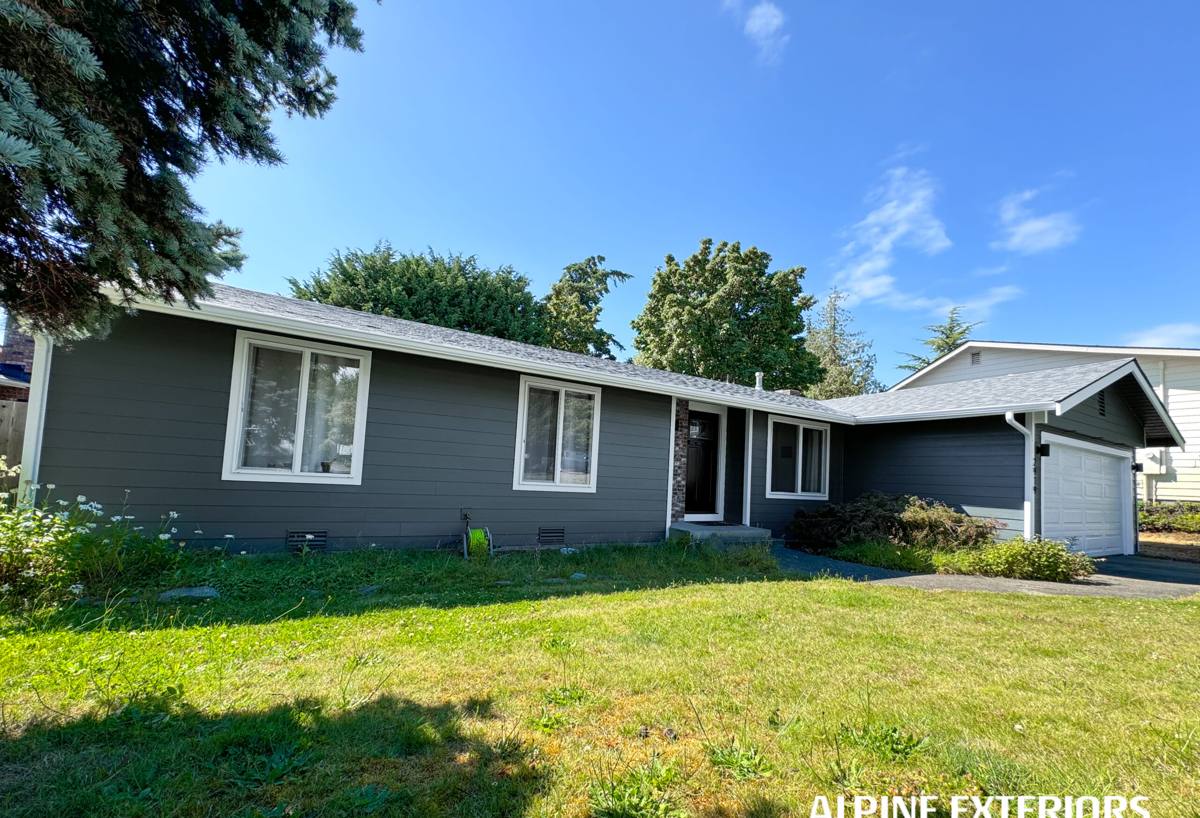
What Salt Air, Rain, and Moss Actually Do to a Wall
Salt Air
Airborne salt is corrosive to metal fasteners, flashing, and trim hardware, and it accelerates the breakdown of lower-grade coatings and caulks. It doesn't take a beachfront lot to be affected — moisture carries salt further inland than most homeowners assume, especially on exposed elevations.
Driving Rain
Wind-driven rain doesn't respect a siding product's face — it gets forced up under laps, into unsealed joints, and behind trim that wasn't properly flashed. A siding material that swells, delaminates, or wicks water when it gets wet at a seam will eventually show it, whether that's bubbling paint, soft spots, or staining.
Moss and Sustained Dampness
Shaded, north-facing, and tree-covered walls in this area stay damp for extended stretches. Any organic-based siding material is vulnerable to rot in those conditions if the moisture has anywhere to sit. Even non-organic materials need the right coating and enough of an air gap behind them to shed that moisture instead of trapping it.
Why We Standardized on James Hardie for This Climate
James Hardie fiber cement is engineered from cement, sand, and cellulose fiber — it does not have the same moisture-driven failure modes as wood-based products, and it doesn't corrode, warp, or become an insect target the way some alternatives do. It's also non-combustible, which matters increasingly to insurers and to homeowners thinking about wildfire-adjacent risk even in a wet climate like ours.
Two things make it specifically well-suited to Bellingham conditions:
- HZ climate-engineered formulations. James Hardie makes siding formulated for specific climate zones, including wetter, moisture-heavy regions like the Pacific Northwest. That's not marketing — the cement formulation is adjusted for the moisture exposure the product will actually see.
- ColorPlus factory-applied finish. Instead of relying on field-applied paint (which is only as good as the weather and prep conditions on install day), ColorPlus is baked on at the factory in a controlled environment, which gives it far more consistent, durable coverage and a much stronger track record against fading, peeling, and chipping than site-painted siding.
We won't install LP SmartSide, vinyl, Cemplank, Allura, primed spruce, or cedar, and we're upfront about why: each of those has a real trade-off in this climate — vinyl becomes brittle and can warp with temperature swings and impact; wood-based and engineered wood products need consistent maintenance to keep moisture out of cut edges and seams; cedar looks great initially but demands ongoing sealing, staining, and vigilance against exactly the rot and moss issues this climate creates. We'd rather install one product correctly and stand behind it than offer five options and hope the homeowner maintains the wrong one perfectly forever.
What a Correct James Hardie Installation Actually Involves
The material is only half the equation. Fiber cement siding installed poorly will still fail early — usually at the same points where any siding fails: flashing, fastening, and joints. A correct installation in this climate means:
- Proper weather-resistive barrier and flashing behind every window, door, and penetration, lapped correctly so water is directed out and down, not trapped behind the cladding.
- Manufacturer-specified fastening — the right fastener type, spacing, and depth so boards aren't over-driven (which cracks the material over time) or under-driven (which lets boards work loose in wind).
- Correct clearances at the ground, roofline, deck ledgers, and any hardscape — Hardie specifies minimum gaps for a reason: tight clearances hold moisture against the board's bottom edge and are one of the most common causes of early failure on any siding job, regardless of brand.
- Caulking only where James Hardie's installation instructions call for it — not as a blanket fix for gaps, since over-caulking can trap moisture rather than shed it.
- Field-cut edge sealing on any cut board ends, since factory-primed or ColorPlus edges lose their protection once cut and need to be treated before installation.
- Panel and joint layout planned to shed water, with butt joints positioned and flashed correctly rather than just caulked and hoped for.
None of this is unique to Bellingham, but a wet, salt-exposed, moss-prone climate is exactly where these details show up as problems within a few years if they're skipped — versus a drier region where a sloppy install might coast for a decade before anyone notices.
Our Process on a Bellingham Job
1. Assessment and Exposure Mapping
We walk the home and note which elevations take the most wind-driven rain, which stay shaded and damp longest, and where the current siding or trim is already showing moisture damage. That shapes flashing detail and product selection (plank, panel, or shingle profile) before we ever price the job.
2. Tear-Off and Substrate Check
Once old siding comes off, we check the sheathing and framing underneath for hidden rot or moisture damage — a step that matters more here than in drier climates, since long-term dampness behind failing siding is common and needs to be dealt with before new material goes up, not covered over.
3. Weather Barrier and Flashing
New house wrap or weather-resistive barrier goes on with correct lapping, and flashing is installed at every window, door, and penetration before the first piece of Hardie siding is hung.
4. Installation to Manufacturer Spec
Boards or panels go up with the fastening pattern, clearances, and joint treatment James Hardie specifies — not a generalized "siding install," but the specific method for this product.
5. Trim, Caulk, and Touch-Up
Trim is fitted, cut edges are sealed, and any ColorPlus touch-up is done with matched product, not generic exterior paint.
6. Final Walkthrough
We walk the finished job with the homeowner, checking joints, clearances, and finish before calling it done.
Hardie vs. the Alternatives in This Climate
| Material | Moisture Behavior Here | Maintenance Burden | Why We Don't Install It (where applicable) |
|---|---|---|---|
| James Hardie fiber cement | Non-organic, HZ-formulated for wet climates, sheds water when installed to spec | Low — occasional wash, no repainting for years with ColorPlus | N/A — our standard product |
| Vinyl | Doesn't rot, but can warp, crack, or gap with temperature swings and impact | Low, but limited repair options once damaged | Appearance and durability trade-offs don't match our standard |
| Cedar | Absorbs moisture, needs consistent sealing to resist the rot risk this climate creates | High — regular staining/sealing, edge and joint monitoring | Maintenance demand too high for most homeowners to sustain long-term |
| Engineered wood (e.g., LP-type products) | Vulnerable at cut edges and seams if moisture gets in | Moderate to high — edge sealing and moisture vigilance required | Long-term moisture sensitivity in a climate this wet |
Cost Factors on a Bellingham James Hardie Job
Every home is different, but the line items that actually move the price on a Hardie job here are consistent:
| Factor | Why It Matters |
|---|---|
| Tear-off and substrate repair | Hidden rot behind old siding is more common in long-term damp exposure and adds labor once uncovered |
| Home elevation count and complexity | Dormers, bump-outs, and multiple rooflines add cutting, flashing, and trim work |
| Product line and profile | Plank width, panel vs. lap style, and shingle accents price differently |
| ColorPlus color and trim package | Factory finish and matched trim add cost over field-painted options but remove future repainting |
| Access and site conditions | Slopes, landscaping, and staging affect labor time on many Bellingham lots |
Maintaining James Hardie Siding in a Moss-Prone Climate
Fiber cement is low-maintenance compared to wood, but "low-maintenance" isn't "no-maintenance" here. A simple annual routine keeps a correctly installed system performing for the long haul:
- Rinse siding annually (garden hose pressure, not a pressure washer aimed at joints or under laps) to clear salt residue, pollen, and early moss growth.
- Keep gutters clear so overflow doesn't run down the wall face repeatedly.
- Trim back vegetation and tree cover that keeps specific wall sections shaded and damp longer than the rest of the house.
- Inspect caulking at trim and penetrations every year or two and have gaps addressed before they become entry points.
- Watch ground-level clearance — mulch, soil, or hardscape that creeps up over time against the bottom of the siding should be pulled back.
Why Hiring a Crew That Already Works This Area Matters
A correct James Hardie install depends on judgment calls that a generic siding crew, or one unfamiliar with Whatcom County's specific exposure, can get wrong without it showing for a year or two — flashing details on a wall that takes heavy wind-driven rain, clearance decisions near a shaded foundation line, fastening choices that account for gusts common in the area. A crew that already does this work around Bellingham has already seen where the old siding failed on homes like yours, and builds the new system to not repeat it.
We also stand behind the installation itself, separate from James Hardie's own product warranty — because a warranty on the material doesn't help if the failure traces back to how it was hung, flashed, or fastened.
Get a Straight Answer for Your Home
If you're weighing a siding replacement in Bellingham, we'll walk your home, point out what your specific elevations and exposure actually need, and give you a clear, no-pressure estimate for a correct James Hardie installation — no upsell into products we don't stand behind. Use the form below to request your free estimate.