 Sudden Valley Siding
 Why Fiber Cement Makes Sense in the Bellingham Climate
Homes around Bellingham and out toward Sudden Valley deal with a specific combination of punishment: salt-laden air drifting in off Bellingham Bay and the Strait of Georgia, long stretches of driving rain off the water, and a moss and algae season that can run eight months or more thanks to shade, humidity, and mild temperatures. Add the freeze-thaw swings that show up most winters, and you have a climate that is genuinely hard on exterior materials — not in a dramatic, one-storm way, but in a slow, cumulative way that shows up as soft trim boards, peeling paint, and swollen siding seams five or ten years in.
Fiber cement holds up to that combination better than most alternatives because it doesn't rely on a surface coating alone to keep water out, and it doesn't swell, rot, or feed mold the way wood-based products can. It's dimensionally stable across the moisture swings that are constant in Whatcom County, and it doesn't give moss and algae the organic surface they need to really take hold. That's the whole reason this page exists: fiber cement isn't just "a siding option" for a house in this area, it's the material that matches the actual conditions the house will face for the next 30-plus years.
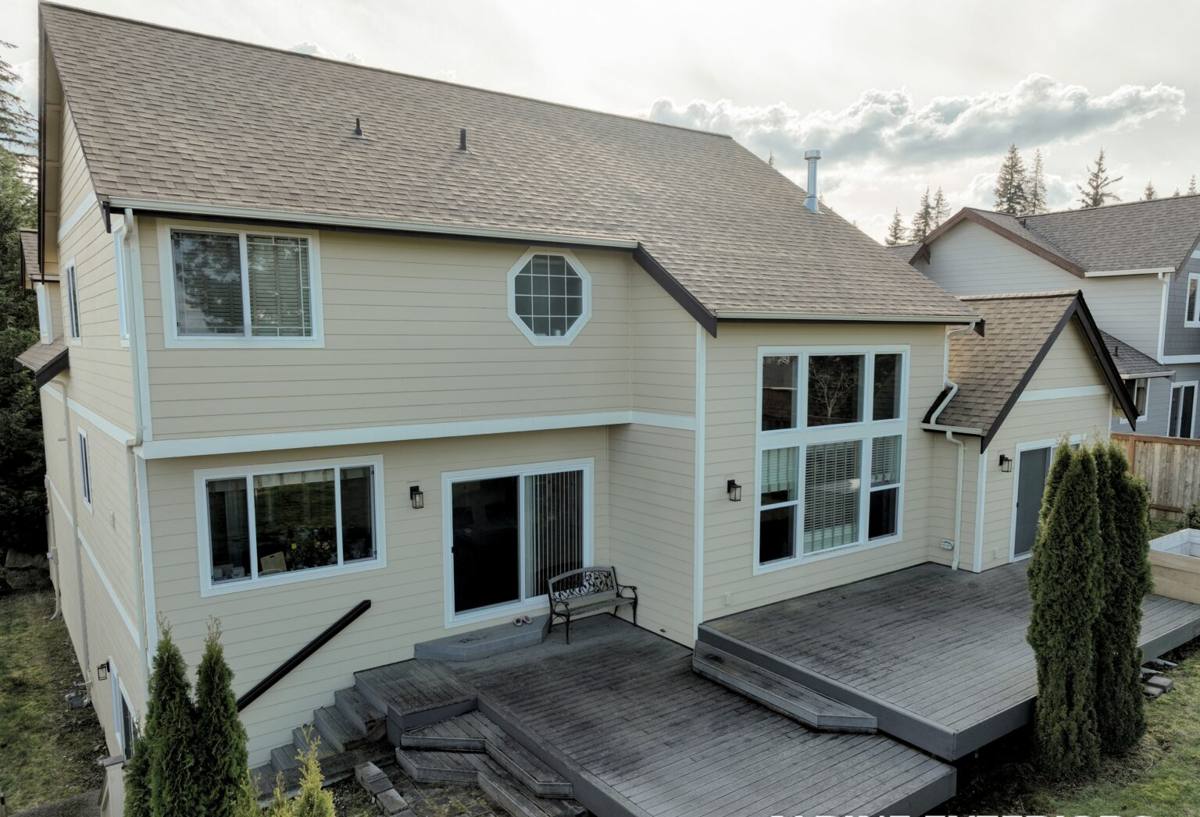
What Bellingham Homes Specifically Need From Their Siding
Salt Air Resistance
Proximity to saltwater accelerates corrosion on fasteners, flashing, and any metal trim components. It also degrades cheap coatings faster than inland exposure would. Fiber cement itself doesn't corrode, but the fasteners and flashing details around it matter just as much as the panel — stainless or hot-dip galvanized fasteners and properly lapped flashing are not optional extras on a home this close to the water.
Driving Rain and Wind-Driven Moisture
Rain in this area rarely falls straight down. Wind off the water pushes it sideways into wall assemblies, which means the water-resistive barrier behind the siding, the flashing at every penetration, and the lap and butt-joint details on the siding itself all have to be done correctly — not just "good enough for a dry climate." A siding job that would hold up fine in a low-rainfall region can fail here within a few years if these details are skipped.
Moss, Algae, and Prolonged Dampness
Shaded lots near tree lines, common around Sudden Valley and the wooded fringes of Bellingham, stay damp longer after a rain. Moss and algae need organic material and consistent moisture to establish themselves, and untreated wood or wood-composite siding gives them exactly that. Factory-finished fiber cement with a dense cementitious surface resists that growth far better, though it still needs occasional cleaning in heavily shaded spots.
What a Correct Fiber Cement Installation Involves
Fiber cement's reputation is only as good as the installation behind it. Most of the failures homeowners eventually notice — cracked caulk lines, buckled panels, streaking at the bottom edge — trace back to installation shortcuts, not the material itself. A correct job includes:
- Proper starter strip and clearance from grade, decks, and roof lines so the bottom edge of the siding never sits in standing water or gets buried under mulch or soil
- A code-compliant water-resistive barrier and correctly lapped flashing at every window, door, and penetration
- Fasteners sized and spaced to the manufacturer's specification, driven flush (not overdriven, which cracks the board and voids the warranty)
- Correct gaps at butt joints and trim, sealed with a high-quality, paintable sealant rated for exterior movement
- Field-cut edges primed or sealed before installation so raw cut edges aren't left exposed to moisture
- Ventilation gap or rainscreen detailing appropriate to the wall assembly, so incidental moisture behind the siding can actually dry out
Skip any one of these and you can still end up with premature failure even though the siding itself is a top-tier product. This is why we treat installation practice as seriously as the material choice.
Why We Install Only James Hardie
We standardized on James Hardie fiber cement specifically, not fiber cement in general. Hardie engineers its HardieZone products by climate region, and the Pacific Northwest falls under their HZ5 climate engineering — meaning the formulation is built around exactly the wet, moderate-temperature conditions this region sees, rather than a one-size-fits-all mix. The ColorPlus factory finish bakes the color onto the board through multiple coats and a baked-on process, which holds up to UV and moisture better than field-applied paint and reduces how often the house will need to be repainted.
Hardie also backs its products with a strong, transferable limited warranty, which matters to homeowners planning to sell within the warranty period. Between the climate-specific engineering, the factory finish, and the warranty structure, it's the fiber cement system we're comfortable standing behind on every job — not because other fiber cement products don't exist, but because we'd rather install one system extremely well than juggle several and dilute our expertise in any of them.
James Hardie Product Lines We Work With
| Product | Typical Use | Why It Fits This Area |
|---|---|---|
| HardiePlank lap siding | Primary wall cladding | Most common profile locally; wide color and texture range in ColorPlus finish |
| HardiePanel vertical siding | Accent walls, gables, modern facades | Clean lines for contemporary Whatcom County builds |
| HardieShingle siding | Accent/shingle-style sections | Matches the shingle-style look common on older Bellingham-area homes |
| HardieTrim boards | Corners, window and door surrounds, fascia | Won't rot the way wood trim does in this moisture load |
Our Process for a Bellingham Job
- On-site assessment — we look at the existing wall assembly, moisture damage if any, sun/shade exposure, and how close the home is to the water or tree cover, since that changes the detailing we plan for
- Tear-off and substrate check — removing the old siding lets us actually see sheathing condition instead of guessing; any soft or water-damaged sheathing gets addressed before new siding goes on, not covered up
- Weather barrier and flashing — installed or upgraded to current best practice regardless of what was there before
- Hardie installation to spec — fastener pattern, clearances, and joint treatment done to manufacturer requirements, which is also what keeps the warranty valid
- Final walkthrough — caulking, paint touch-up at cut edges, and a walk of the full exterior with the homeowner before we call it done
Why Local Experience Matters Here
A crew that has already worked houses around Bellingham and out toward Sudden Valley has already run into the site-specific issues that come with this area — homes on slopes with limited access, wooded lots where staging and drying time both take longer, and wall assemblies on older homes that need more prep than a straightforward re-side. That experience shows up in fewer surprises mid-project and in flashing and drainage details that are sized for what this climate actually delivers, not textbook averages. It also means we're not learning the region's quirks on your house.
Maintenance Expectations
Correctly installed Hardie siding is low-maintenance, not no-maintenance. In this climate, realistic upkeep looks like:
- An annual rinse-down, more often on shaded elevations prone to moss and algae buildup
- Periodic inspection of caulk lines at trim and penetrations, since sealant has a shorter service life than the siding itself
- Prompt attention to any gutter overflow or downspout misdirection, since concentrated water runoff is harder on any siding than general rainfall
- Repainting on a much longer cycle than raw wood, since ColorPlus finish is factory-baked rather than field-applied
Cost Factors to Expect
| Factor | Why It Moves the Price |
|---|---|
| Existing wall condition | Rotten sheathing or hidden moisture damage found at tear-off adds repair work before siding can go on |
| Home size and wall complexity | More corners, gables, and trim details mean more labor and cut waste |
| Product mix | Combining lap siding with shingle or panel accents costs more than a single product on flat walls |
| Access and site conditions | Steep lots, tree cover, and limited staging area (common around Sudden Valley) can add time |
| Trim scope | Full trim replacement versus reusing sound existing trim changes both material and labor cost |
We don't quote a number without seeing the house — anyone who does is guessing — but these are the variables that actually move the estimate up or down.
A Simple Checklist Before You Hire
- Ask whether the crew is James Hardie certified or trained, not just "familiar" with the product
- Ask what fastener type they use and whether it's rated for this area's exposure
- Ask how they handle flashing at windows and doors specifically — this is where most failures start
- Ask whether they inspect and repair sheathing before installing new siding, not just over it
- Ask for the warranty terms in writing, both manufacturer and workmanship
If a contractor can't answer these clearly, that's worth noting before you sign anything.
If your Bellingham or Sudden Valley home needs new siding, or you're just trying to figure out whether fiber cement is the right call for your specific house, we're happy to take a look and give you a straightforward, no-pressure estimate — fill out the form below and we'll get in touch.