 Sudden Valley Siding
 What Barkley's Climate Actually Does to Siding
Barkley sits inside the same weather pattern that shapes every home around Sudden Valley and the rest of Whatcom County: damp, mild, and rarely dry for long. That combination sounds harmless compared to a hurricane coast or a desert freeze-thaw cycle, but it's actually one of the harder climates on exterior siding, because the damage isn't dramatic — it's constant. Moisture-carrying air off the water, driving rain that comes in sideways during winter storms, and long stretches of shade from mature tree cover all work on a house year-round, not just during a few bad weeks a year.
Three specific factors matter most for siding decisions here:
Salt-laden, moisture-heavy air
Homes near Lake Whatcom and the surrounding lowlands sit in air that stays humid for much of the year. That moisture gets into anything porous or poorly sealed — wood fibers, cut edges, unpainted seams — and it doesn't fully dry out between rain events the way it would in a drier region. Over years, that slow moisture cycling is what causes swelling, delamination, and paint failure on siding that isn't built to handle it.
Driving rain, not just rainfall totals
It's not only how much rain falls, it's how it arrives. Wind-driven rain during fall and winter storms pushes water sideways into laps, corners, and trim intersections — the exact spots where a siding installation is easiest to get wrong. A product and installation method that only account for water falling straight down will leak here.
A long moss and algae season
Shaded, north-facing walls and roof lines around tree-covered lots in this area stay damp far longer after a rain than a wall in full sun. That extended dampness is exactly what moss, algae, and mildew need to establish themselves on a siding surface, and once organic growth takes hold it holds moisture against the wall even longer — a cycle that accelerates whatever the siding material is already struggling with.
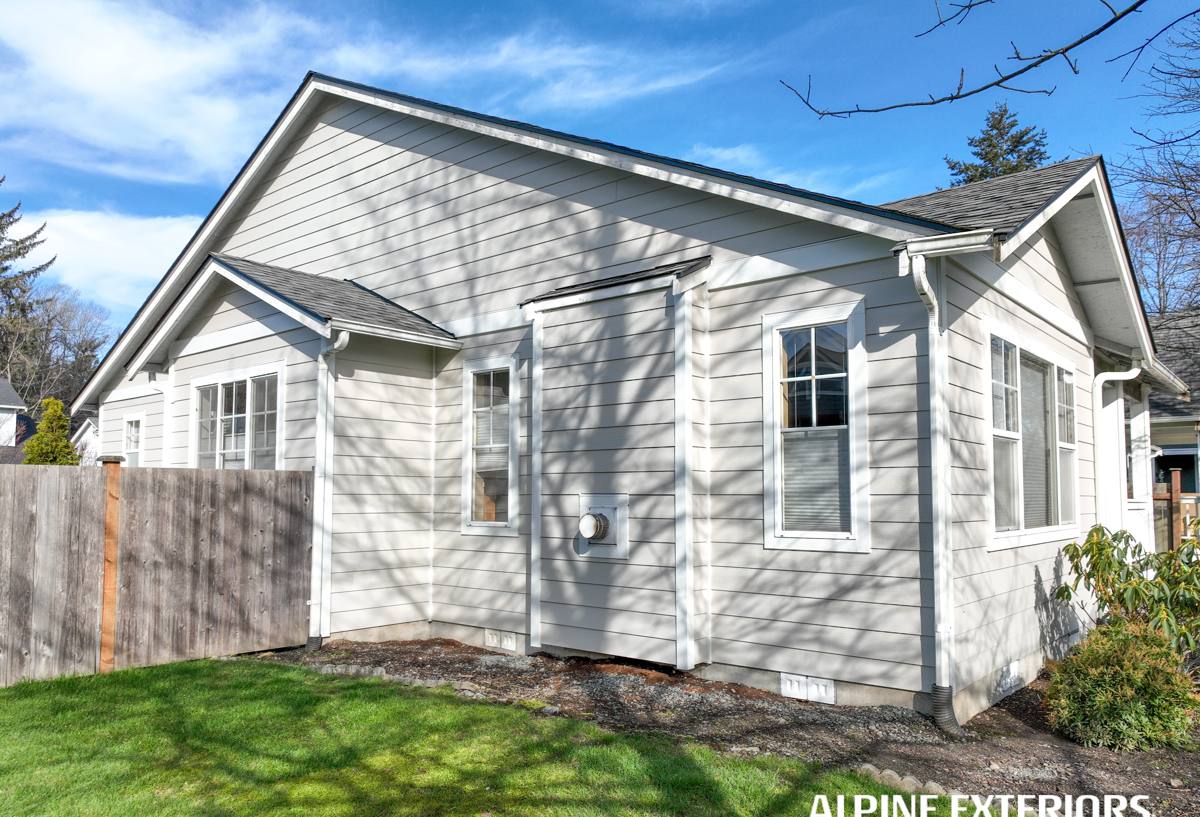
Why We Install James Hardie Here Specifically
We don't install James Hardie because it's the only option on the market — we install it because it's the one fiber cement system engineered with regions like this in mind, and because it's the product we can stand behind with a straight face after years of watching how different materials age in Whatcom County weather.
The HZ5 climate-engineered formulation
James Hardie makes region-specific formulations of its siding, and the HZ5 line is built for climate zones with more moisture exposure and freeze-thaw cycling — which describes the Pacific Northwest well. It's engineered to resist moisture absorption and hold up to that year-round dampness better than a generic, one-size-fits-all fiber cement board. That's a meaningful difference in a climate where the siding almost never gets a long dry stretch to fully recover.
ColorPlus factory finish vs. job-site paint
A huge amount of long-term siding failure in wet climates isn't the substrate — it's the paint. Field-applied paint on any siding material is only as good as the weather conditions on the day it was applied and the maintenance schedule after that. James Hardie's ColorPlus finish is baked on at the factory in a controlled environment, cures fully, and comes with a finish warranty separate from the substrate warranty. In an area with a long wet season, that factory cure matters — it's not fighting humidity to bond in the first place.
Non-combustible and dimensionally stable
Fiber cement doesn't expand and contract with moisture the way wood-based products do, and it won't support the kind of rot that starts most siding failures in wet climates. It's also non-combustible, which matters increasingly to insurers and homeowners even in a maritime climate like this one, where wildfire smoke and regional fire risk have become a bigger part of the conversation than they used to be.
What a Correct James Hardie Installation Actually Involves
The siding board is only part of the system. Most premature siding failures we see in this region — on any brand — trace back to installation shortcuts, not the material itself. A correct Hardie job includes:
Water management behind the cladding
A proper weather-resistive barrier, correctly lapped and taped, with a drainage plane behind the siding so any water that does get past the surface has somewhere to go besides your sheathing. Given how much wind-driven rain this area sees, this layer is not optional — it's the difference between a wall that sheds an occasional leak and one that quietly rots from the inside.
Manufacturer-spec fastening and clearances
James Hardie publishes exact fastener spacing, nailing patterns, and minimum clearances from grade, roof lines, and decks. Those clearances exist specifically to keep splash-back and standing moisture away from the bottom edge of the siding. Skipping them voids warranty coverage and is one of the most common shortcuts we see corrected on older installs.
Properly sealed joints and butt seams
Every horizontal seam and vertical joint is a potential entry point for driving rain. Factory-primed or ColorPlus'd cut edges need to be sealed per spec, and butt joints need to be flashed or caulked correctly — not just butted together and painted over.
Trim and flashing integration
Windows, doors, and roof-to-wall intersections are where siding jobs fail first in a wet climate. Correct integration with head flashing and kick-out flashing at rooflines is what keeps water from Barkley's rain events out of the wall assembly at these transition points.
| Installation Element | Why It Matters in This Climate |
|---|---|
| Weather-resistive barrier + drainage plane | Gives wind-driven rain that gets past the siding a way out instead of soaking sheathing |
| Manufacturer clearances from grade/decks | Keeps splash-back and standing moisture off the bottom courses |
| Sealed cut edges and butt joints | Prevents moisture wicking into the board core during the long wet season |
| Flashing at windows, doors, rooflines | Closes the most common leak points during driving rain |
| HZ5 formulation + ColorPlus finish | Matched to regional moisture exposure instead of a generic national spec |
Our Process for a Barkley Project
- On-site assessment — we look at sun/shade exposure, existing siding condition, moisture staining, and any moss or algae buildup on your specific lot, since orientation and tree cover vary block to block in this area.
- Substrate check — before any new siding goes up, we check sheathing and framing for existing moisture damage. Covering up a wet wall with new siding just delays a bigger repair.
- Water barrier and drainage plane installation — done to spec, not shortcut, because this layer is doing real work in this climate.
- Hardie board installation — correct fastening pattern, clearances, and joint treatment, matched to the HZ5 formulation and the specific Hardie profile chosen for the home.
- Trim, flashing, and detail work — the transitions where most leaks actually start.
- Final walkthrough — we go over the finished job and what maintenance (if any) it will need going forward.
Cost Factors for a Barkley Hardie Project
Every home is different, but the line items that actually move the price on a James Hardie job in this area are consistent:
| Factor | How It Affects the Job |
|---|---|
| Existing siding removal | Tear-off and disposal of old material adds labor before installation even starts |
| Sheathing/framing repair | Moisture damage found during removal has to be fixed before new siding goes up |
| Home size and wall complexity | Dormers, multiple gables, and cut-up wall lines mean more trim and flashing detail |
| Siding profile and finish | Lap, shingle, and panel profiles, plus ColorPlus color selection, affect material cost |
| Access and site conditions | Sloped lots and tree-heavy properties common around Sudden Valley can affect staging and labor |
We give a written, itemized estimate after seeing the actual house — not a phone-quote guess — because the difference between a straightforward wall and one with moisture damage or difficult access is real money, and you deserve to know which one you're dealing with before work starts.
Maintenance in a Wet, Shaded Climate
James Hardie siding, installed correctly, is a low-maintenance product — but "low" isn't "none," especially with the moss and algae pressure common on shaded Barkley lots. A simple annual routine keeps it looking and performing the way it should:
- Rinse the siding annually with a garden hose and soft brush — avoid high-pressure washing, which can force water behind laps and joints
- Check caulked joints and seams each fall before the wet season sets in, and re-caulk any that have cracked or pulled away
- Trim back vegetation and tree limbs that keep a wall shaded and damp longer than necessary
- Clear debris from behind gutters and at roof-to-wall intersections so water isn't funneled into a wall section
- Watch for early moss or algae growth on north-facing and shaded walls and address it before it spreads
- Repaint is rarely needed with ColorPlus finish, but if a board is ever cut or damaged, seal the exposed edge promptly
Why a Crew That Already Works This Area Matters
Correct installation detail — clearances, flashing, drainage planes — isn't theoretical here; it's the difference between a wall that handles a Whatcom County winter and one that doesn't. A crew that already works in and around Sudden Valley has seen how the specific exposure on lakeside and tree-covered lots plays out over time, which houses tend to hold moisture longer, and where the shortcuts on older installations tend to show up first. That local pattern recognition is worth more than a generic install checklist, because it tells you where to pay extra attention before a problem exists, not after.
Why We Only Install James Hardie
We made a decision to install one siding system and do it right, rather than offer every product on the market and let quality vary by job. Vinyl, LP SmartSide, and other fiber cement alternatives each have real trade-offs in a climate with this much sustained moisture and driving rain — from wood-based products that need more diligent joint and cut-edge sealing, to systems without a regionally formulated version or a factory-cured finish. James Hardie's HZ5 formulation, ColorPlus finish, and transferable warranty give us a system we can install to spec and stand behind for the life of the product, in the exact climate Barkley homes actually deal with.
If you're weighing a siding project for a Barkley home, we're happy to take a look and walk you through what your specific house needs — no pressure, no obligation. A free estimate is a good way to find out exactly where your project stands before you commit to anything.