 Sudden Valley Siding
 Window Installation Built for Yew Street's Weather, Not Just Its Openings
Homes around Yew Street in Sudden Valley take a steady beating from weather that most window manufacturers only test for in a lab. Whatcom County sits in a marine-influenced climate belt — driving rain that comes in sideways during fall and winter storms, salt-laden air moving in off the regional waterways, and a moss season that can stretch six months or more on shaded, north-facing walls. None of that is dramatic on its own. What it does is slow and cumulative: it finds the weak point in a window installation and works on it, year after year, until a seal fails or a sill starts to soften.
That's the real difference between a window that looks fine going in and one that actually performs for fifteen or twenty years. The window unit itself matters, but in this climate the installation — flashing, sealing, drainage, and fit — is what decides whether water stays out. We've worked enough homes in and around Sudden Valley to know which details get skipped by crews who aren't used to this weather, and which ones can't be skipped here.
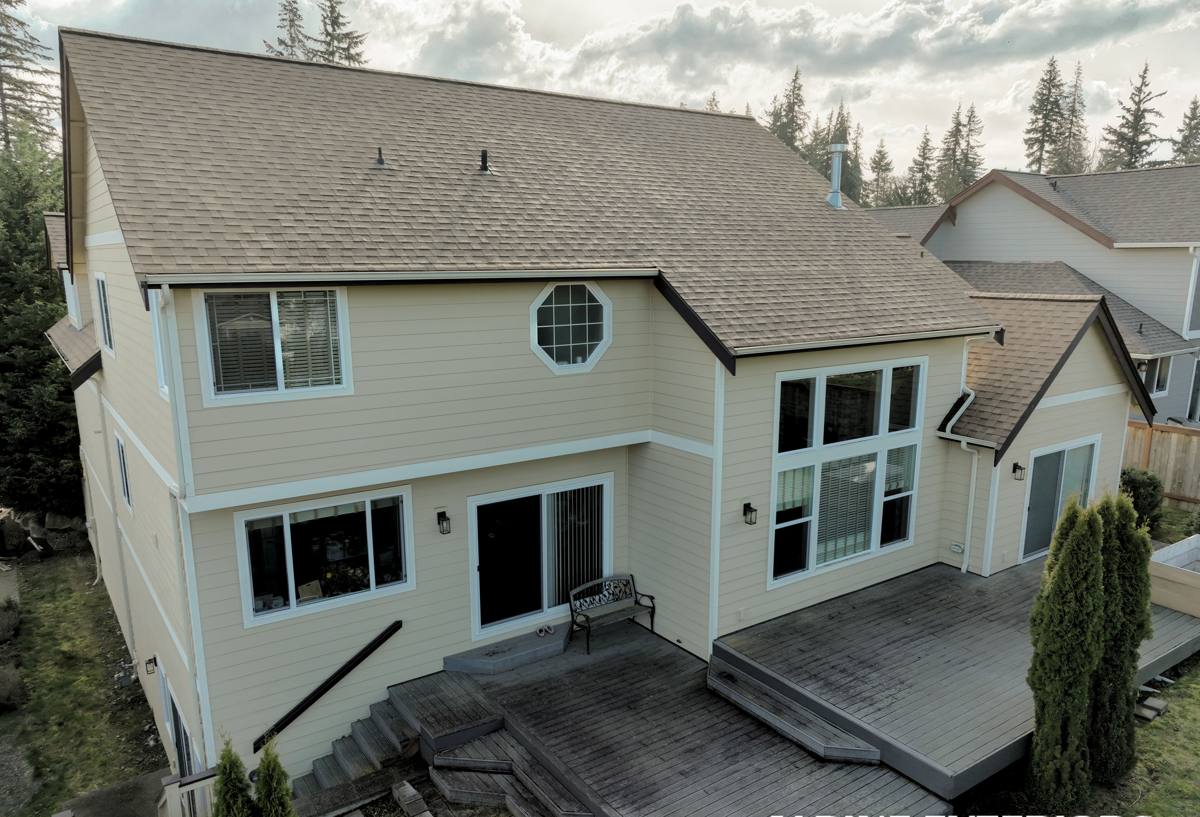
What Yew Street Homes Are Up Against
Every region has its own failure pattern for windows, and this one is fairly consistent:
- Driving rain intrusion — wind-driven rain pushes water sideways and upward under trim and sills, not just straight down, which standard installation methods don't always account for.
- Salt-air corrosion — airborne salt accelerates corrosion on hardware, fasteners, and lower-grade metal components, especially on windows facing open exposure.
- Moss and algae growth — persistent moisture on shaded siding and trim feeds moss and algae that hold water against wood surfaces longer than they'd otherwise sit wet.
- Condensation from humidity swings — damp Pacific Northwest air combined with heated interiors in winter can fog glass or, worse, sweat inside the wall cavity if a window isn't sealed correctly.
Individually, these are manageable. Together, over a decade or two, they're the reason older single-pane and poorly-flashed windows in this area tend to show rot at the sill and corners years before the glass itself gives out.
Signs a Yew Street Home Needs Window Attention
Most window failures give warning signs long before a pane cracks or a frame collapses. Worth checking for:
- Soft or spongy wood at the sill or bottom corners of the frame
- Fogging or a milky haze between panes of double-glazed glass (a sign the seal has failed)
- Visible moss, algae, or black staining building up on the exterior trim or sill
- Drafts you can feel near the frame even with the window fully closed
- Difficulty opening, closing, or locking a window that used to operate smoothly
- Peeling or bubbling paint on interior trim near the window — often a sign of trapped moisture
- Noticeably higher heating bills without any other explanation
Any one of these on its own isn't an emergency. Several at once, especially on windows facing the prevailing weather, usually means the installation — not just the glass — has started to let go.
What a Correct Window Installation Actually Involves
Removal and Opening Prep
Old windows come out carefully so we can inspect the rough opening underneath — this is where problems usually hide. Soft sheathing, old rot, or missing/degraded house wrap gets addressed before a new window ever goes in. Installing a new window over a compromised opening just resets the clock on the same failure.
Flashing and Weatherproofing
This is the step that matters most in a climate with driving rain. Proper flashing is layered so water is shed downward and outward at every seam — sill pan flashing, side flashing, and head flashing integrated with the house wrap in the correct shingle-lap order. Skipping or shortcutting this sequence is the single most common reason a window installation fails early in wet climates, regardless of how good the window itself is.
Sealing and Insulation
Low-expansion foam or backer rod and sealant fill the gap between the window frame and rough opening — enough to stop air and moisture infiltration without bowing the frame out of square, which affects how smoothly the window operates for years afterward. Exterior sealant beads get tooled properly so they shed water instead of holding it against the trim.
Finish and Cleanup
Trim, caulking lines, and interior finish work get completed to match the existing house, and the work area is cleaned up daily — not just at the end of the job. We also walk the finished opening with the homeowner before calling it done.
Choosing Materials for This Climate
There's no single "best" window material — there's a best fit for the exposure, budget, and maintenance appetite of a given home. Here's how the common options actually compare for a damp, moss-prone, salt-air-influenced area like this:
| Frame Material | Moisture Behavior | Maintenance | Typical Fit |
|---|---|---|---|
| Vinyl | Won't rot; expands/contracts with temperature swings | Low — occasional cleaning | Best value for most Sudden Valley homes |
| Fiberglass | Very stable; minimal expansion, holds paint well | Low to moderate | Good for high-exposure walls facing prevailing weather |
| Wood-clad | Attractive interior wood, but cladding seams are a moisture entry point if not detailed correctly | Higher — cladding joints and sills need periodic inspection | Homes prioritizing a traditional wood interior look |
| Aluminum | Conducts cold and can condensate heavily in this humidity | Moderate — watch for corrosion near salt-influenced exposure | Limited use; mainly commercial or specific architectural needs |
We don't push one brand or material as a blanket answer. We look at which wall the window sits on, how much weather it takes directly, and what the homeowner wants to maintain — then match the frame material and glass package to that. What we won't do is install a product whose warranty structure or moisture behavior sets a homeowner up for a callback in five years; that's a standard we hold regardless of what's cheapest to source.
Glass and Performance Options Worth Understanding
Beyond frame material, the glass package affects both comfort and long-term durability:
- Double-pane with Low-E coating — the standard baseline for this climate; reduces heat loss and cuts UV fading on interior floors and furniture
- Argon or krypton gas fill — improves insulation value between panes at a modest cost premium
- Warm-edge spacers — reduce condensation risk at the edge of the glass, which matters given how humid it gets here for stretches of the year
- Impact-resistant or laminated glass — worth considering for exposed elevations that take the brunt of storm-driven debris
None of these are upgrades for their own sake — each one solves a specific problem this climate creates.
Our Process, Start to Finish
- On-site assessment — we look at the existing windows, the wall assembly where visible, and the specific exposure of each opening before quoting anything.
- Written estimate — clear pricing by window, material and glass options explained, and a realistic timeline.
- Scheduling around weather — in a region with this much rain, we plan installation days around forecasts so openings aren't left exposed longer than necessary.
- Removal and opening inspection — old units come out, and we address any rot or wrap issues found before the new window goes in.
- Installation with full flashing sequence — sill pan, side, and head flashing integrated correctly, window set plumb and square, sealed and insulated.
- Finish work and walkthrough — trim and caulking completed, and we walk every opening with the homeowner to confirm smooth operation and a clean finish.
Why a Crew That Already Works Yew Street Matters
Window installation isn't just a product install — it's a judgment call about how much flashing overlap a given wall needs, whether an opening's rough sill has already started to soften, and how a particular exposure in Sudden Valley behaves compared to a more sheltered lot a few streets over. A crew that's already worked homes in this specific area has usually seen the recurring issues before — the shaded walls where moss builds up fastest, the corners that take driving rain hardest, the older construction details common to homes built in a given era locally. That's not something a crew unfamiliar with the area picks up on the first visit.
Local presence also means straightforward accountability. If a question comes up six months after installation, we're not a company that has to be tracked down from out of the area — we're already working in the neighborhood.
What Affects the Cost of a Window Installation
| Factor | Why It Matters |
|---|---|
| Number of windows | Per-window cost typically drops on larger jobs due to shared setup and labor efficiency |
| Frame material and glass package | Vinyl is generally the most affordable; fiberglass and wood-clad cost more upfront |
| Opening condition | Rot repair or rough opening rebuild adds labor and material beyond the window itself |
| Wall exposure | High-exposure walls may warrant upgraded flashing detail or impact-resistant glass |
| Access and window size | Second-story, oversized, or hard-to-access windows take more labor and equipment |
| Trim and finish scope | Full trim replacement costs more than reusing sound existing trim |
We'd rather walk a homeowner through these factors honestly during the estimate than quote a flat number that doesn't reflect what a specific home actually needs.
Keeping New Windows Performing Through Moss Season
A correctly installed window is low-maintenance, but "low" isn't "none" in this climate. A few habits go a long way:
- Rinse pollen, moss spores, and grime off sills and tracks a couple of times a year, especially on shaded walls
- Check exterior caulking annually for cracking or separation, particularly after a hard winter
- Keep gutters and downspouts clear so water isn't sheeting down over window heads
- Trim back vegetation or overhanging branches that keep a wall shaded and damp longer than it needs to be
- Open weep holes on vinyl and fiberglass frames if debris builds up, so water can drain as designed
None of this takes much time, but skipping it is how a well-installed window ends up with the same moisture problems the old one had.
If you're weighing whether it's time to replace windows on a Yew Street home, or you just want an honest read on what condition your current ones are in, we're happy to take a look. The estimate is free, there's no pressure attached to it, and you'll get a straight answer about what your home actually needs — use the form below to get started.