 Sudden Valley Siding
 Composite Decking Built for South Hill's Wet, Mossy Climate
South Hill sits in one of the wetter, greener pockets of Sudden Valley, and that's exactly why so many homeowners here are moving away from wood decking. Between the driving rain that blows in off the lake basin, the marine air that moves through Whatcom County most of the year, and a moss season that can stretch from October well into spring, a deck in this neighborhood works harder than a deck almost anywhere else in the state. Composite decking was built for conditions like these. It doesn't mean "install it and forget it," but it does mean fewer of the recurring problems that wood decks develop here year after year.
This page is specifically about composite decking for South Hill homes — what the climate demands, what a correct installation actually involves, and how we approach these projects when we're already familiar with the neighborhood.
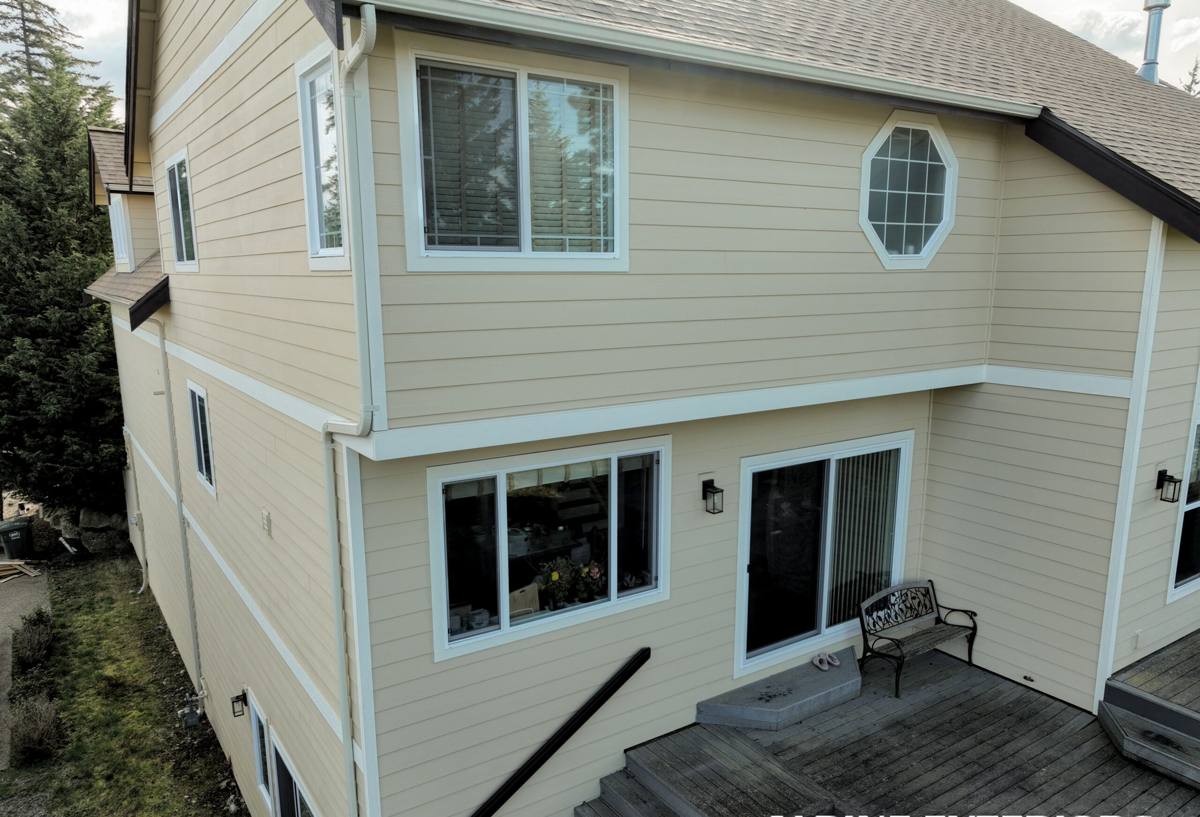
What South Hill's Weather Does to a Deck
Driving Rain and Standing Water
Rain in this part of Whatcom County doesn't just fall straight down — wind-driven rain gets pushed sideways into railings, against house walls, and into any gap where a deck board meets a ledger or post. On a wood deck, that moisture works its way into end grain and fastener holes, which is where rot almost always starts. Composite boards don't absorb water the way wood does, but the deck still needs to be built to shed water fast, because standing water on top of any decking material — composite included — is what feeds the next problem.
The Long Moss Season
South Hill's tree cover and shade patterns mean a moss season that runs longer than in more open parts of Sudden Valley. Moss and algae need moisture and shade to establish, and a deck that stays damp under a heavy canopy is a perfect host. On wood, moss holds moisture against the surface and accelerates decay. On composite, moss is mostly a surface and slip-hazard issue rather than a structural one — but it still needs airflow and drainage underneath to keep from becoming a recurring cleaning chore.
Marine Air and Slow Drying
The humid, marine-influenced air common across Whatcom County means decks here simply take longer to dry out between storms than decks in drier climates. That slower drying cycle is the real driver behind most of the maintenance headaches we see — fastener corrosion, warped boards, mildew staining. A deck design that accounts for that slow-drying reality holds up; one that doesn't will show problems within a few wet seasons no matter what decking material sits on top.
Why Composite Decking Fits This Neighborhood
We install both wood and composite decking, and we're upfront with South Hill homeowners about the trade-offs rather than pushing one product. For a shaded, moisture-heavy lot, composite generally holds up with less ongoing work. Here's the honest comparison we walk clients through:
| Factor | Wood Decking | Composite Decking |
|---|---|---|
| Moisture absorption | Absorbs water through end grain and surface; drives rot over time | Resists absorption; core doesn't swell or rot the way wood does |
| Moss and algae | Moisture trapped in grain feeds decay underneath the growth | Growth stays mostly surface-level and cleans off without damaging the board |
| Annual upkeep | Sanding, staining, or sealing every 1-3 years in this climate | Periodic washing; no staining or sealing required |
| Upfront cost | Lower material cost | Higher material cost, often offset by lower long-term maintenance |
| Appearance over time | Graying, cupping, and splintering without regular maintenance | Color and surface stay consistent for the life of the warranty |
| Warranty structure | Typically none beyond installation workmanship | Manufacturer material warranties, often 25-50 years, plus our install warranty |
Composite isn't the right call for every budget or every homeowner's preference — some people genuinely like the look and feel of real wood and are willing to keep up with it. That's a legitimate choice. What matters is going in with clear expectations for South Hill's climate rather than finding out the hard way after one wet winter.
What a Correct Composite Deck Installation Involves
Substructure and Framing
Composite decking is only as good as what's underneath it. We use pressure-treated or naturally decay-resistant framing lumber, and in a climate like this we treat joist protection as non-negotiable — a self-adhering joist tape over every top edge keeps water from soaking into the framing through screw penetrations, which is one of the most common hidden failure points on decks we've been called to repair.
Ventilation and Drainage
A deck built low to the ground or tight against a foundation traps humid air underneath, which is exactly the environment moss and mildew need. We build in enough clearance and slope for water to drain away from the house rather than pool under the deck, and we won't box in a substructure in a way that blocks airflow just because it looks tidier.
Fastening, Spacing, and Board Layout
Composite boards expand and contract with temperature more than most homeowners expect, so gapping and hidden fastener systems have to be installed to the manufacturer's spec, not eyeballed. Boards run the wrong direction relative to drainage, or fastened too tight, are a common source of buckling and squeaking down the road.
Railings, Fascia, and Stairs
The trim details are where a lot of the weather protection actually happens. Fascia boards, post wraps, and stair stringers all need the same attention to water shedding as the deck surface itself — a well-built deck surface with a poorly flashed fascia board will still develop rot behind the trim.
Our Process for South Hill Composite Decking Projects
Site Visit and Assessment
We walk the site, check drainage patterns, tree cover, and sun exposure, and look at how the existing structure (if there is one) has held up to the local climate. This tells us where moss, moisture, and shade are going to be the biggest factors for your specific yard.
Design and Material Selection
We talk through composite board options, color, railing style, and layout, and give you a straightforward rundown of cost differences between product lines rather than steering you toward whatever has the best margin.
Installation
Framing and joist protection go in first, inspected before a single deck board is placed. Boards are laid with proper spacing and fastened per manufacturer spec, with attention to how water will move off the surface and away from the house.
Final Walkthrough
We walk the finished deck with you, cover basic care, and explain what the manufacturer warranty covers versus what our workmanship warranty covers, so there's no confusion later about who to call if something needs attention.
Composite Decking Options and Cost Factors
Composite decking isn't a single product — it spans a range of price points and construction types, and the right choice depends on your budget, sun exposure, and how the deck will be used. Rough cost drivers we walk through with South Hill homeowners:
| Cost Factor | What It Affects |
|---|---|
| Board type (capped composite vs. capped polymer/PVC) | Material price per square foot and long-term moisture and stain resistance |
| Deck size and layout complexity | Labor hours, waste factor, and number of custom cuts around posts or angles |
| Substructure condition | Whether existing framing can be reused or needs to be rebuilt to code and to handle moisture correctly |
| Railing style | Composite, aluminum, and cable railing systems vary widely in material cost |
| Height and stairs | Elevated decks need additional structural work, footings, and stair framing |
| Site access | Difficult access on sloped South Hill lots can add labor time for material handling |
We give real numbers during the estimate once we've seen the site — broad online price ranges rarely account for slope, tree removal needs, or substructure condition, and we'd rather quote accurately than lowball and revise later.
Maintenance in a Moss-Prone Climate
Composite decking cuts down on maintenance significantly, but "low-maintenance" isn't "no-maintenance," especially under South Hill's tree cover. A simple seasonal routine keeps a composite deck looking and draining the way it should:
- Sweep leaves and debris off the surface regularly through fall — trapped organic matter is what feeds moss and mildew growth
- Wash the deck surface with soap and water (or a manufacturer-approved cleaner) once or twice a year to remove pollen film and early moss growth before it takes hold
- Keep gutters and downspouts near the deck clear so runoff isn't dumping extra water onto or under the deck structure
- Trim back overhanging branches where practical to reduce shade and speed up drying time on the deck surface
- Check the gap between boards periodically for trapped debris, which can hold moisture against the board edges
- Inspect railings, post bases, and stair connections annually for movement, even though the decking itself needs little attention
Why Hire a Crew That Already Works in Sudden Valley and South Hill
A composite deck installed to a generic national spec will hold up fine in a dry climate and struggle in this one. Building for South Hill means designing drainage and ventilation around driving rain and a long moss season from the start, not treating them as an afterthought. Working regularly in Sudden Valley also means we already understand the shade patterns, slope challenges, and moisture behavior that are typical on lots in this part of Whatcom County, so there's less guesswork and fewer surprises once framing is open.
If you're weighing composite decking for a South Hill property, we're happy to come look at your specific site, talk through honest material and cost options, and give you a straightforward estimate — no pressure, no upsell script. Reach out using the form below to get started.