 Sudden Valley Siding
 Why Sehome Homes Wear Out Siding Faster Than You'd Expect
Homes in and around Sehome sit inside one of the more punishing microclimates for exterior materials in Whatcom County. It isn't any single event that does the damage — it's the combination, repeated season after season. Salt-tinged marine air off the Sound corrodes fasteners and softens paint film. Driving rain, pushed sideways by wind off the water, finds every gap in flashing and trim. And because the region rarely gets the hard freeze-and-dry cycles that keep moss in check elsewhere, moss and algae get months at a time to colonize north-facing walls, shaded siding, and anything under tree cover.
Individually, none of that is unusual for the Pacific Northwest. Together, on a home that's had the same siding for fifteen or twenty years, it adds up to soft spots at the bottom courses, discoloration that pressure washing can't fully remove, and trim that's started to separate from the wall. If you're looking at your siding and wondering whether it's cosmetic or structural, the honest answer is usually both — cosmetic damage is often the first visible sign of moisture that's already working on the material underneath.
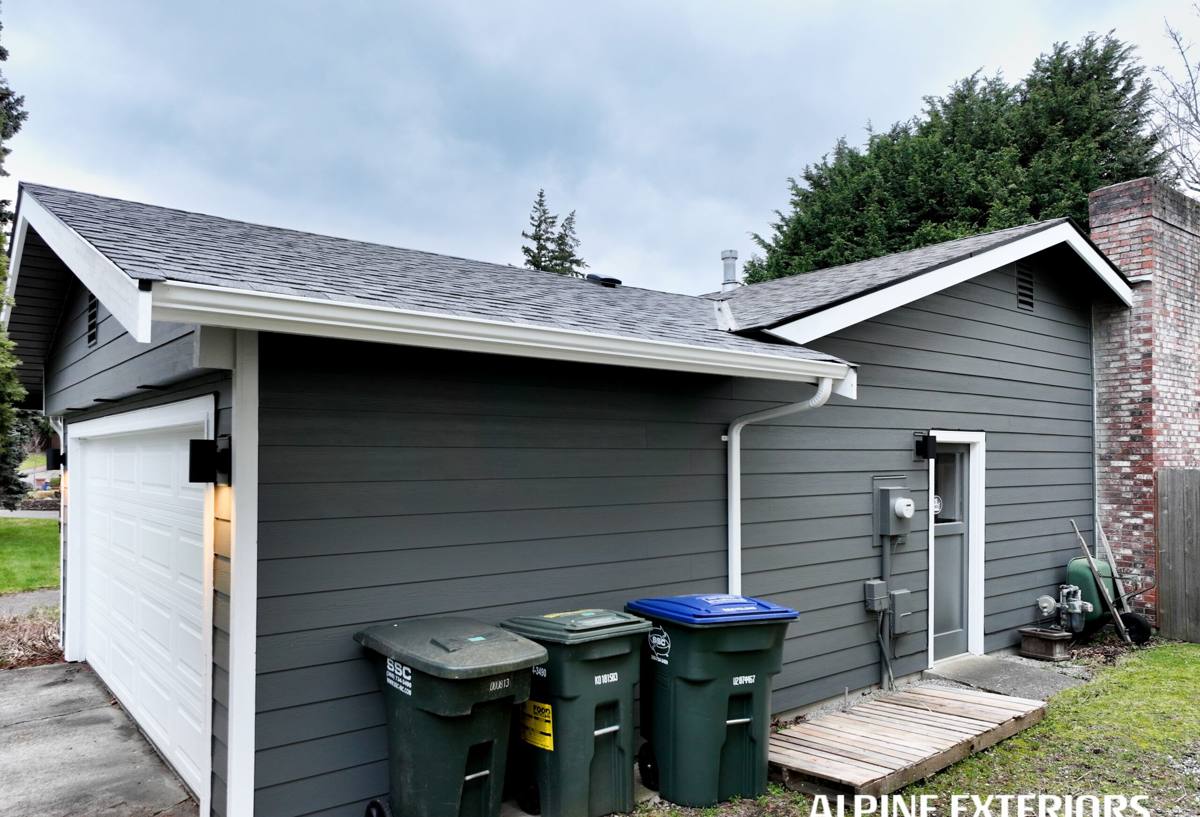
What This Climate Does to Different Siding Materials
Not all siding fails the same way here. Understanding the failure pattern for your current material helps explain why replacement — not another round of patching — is often the right call.
- Wood and primed spruce: absorbs moisture at end grain and behind trim, swells, and eventually rots from the inside out — often before the surface looks bad.
- Vinyl: doesn't rot, but it's not a water barrier by design — it relies entirely on the underlying weather-resistant barrier. UV and temperature swings make it brittle over time, and it can't be spot-repaired without a visible patch.
- Uncoated or budget fiber cement: performs reasonably if the factory finish is thin or absent, moss and mildew stain the surface faster and repainting becomes a recurring maintenance cycle rather than a one-time job.
- Properly finished fiber cement: holds its factory coating, resists moisture intrusion at the board itself, and gives moss and algae a harder surface to grip.
Signs a Sehome Home Needs Siding Replacement, Not Just Repair
Some damage can be repaired in place. Some can't, and treating it as a repair job just delays a bigger bill. Here's a practical checklist to walk your own home through before you call anyone:
- Soft or spongy siding when you press on it, especially near the bottom few feet of the wall
- Paint that's bubbling, peeling, or that needs repainting more often than every 7-8 years
- Persistent moss or black streaking that returns within a season of cleaning
- Visible gaps, warping, or boards pulling away from the wall at seams and corners
- Rising interior humidity, musty smells near exterior walls, or peeling interior paint on the same wall
- Siding that's original to a home 20+ years old and has never been fully replaced
If you're seeing two or more of these, it's worth a full assessment rather than another spot repair — moisture problems in siding rarely stay contained to the area you can see.
Why We Install Only James Hardie Fiber Cement
We don't install vinyl, LP SmartSide, Cemplank, Allura, primed spruce, or cedar — not because those products have no place in the market, but because we've made a professional call about what holds up on homes in this specific climate, and we stand behind that call by only offering one system. Wood needs consistent maintenance to resist moisture, and driving rain off the water doesn't give it much of a break. Vinyl is a fine budget option in drier climates but isn't engineered for the moisture load Whatcom County sees, and it can't take a factory-baked finish the way fiber cement can. Other fiber cement brands vary in formulation and finish quality, and we'd rather stand behind one system we know inside and out than install several we're less sure of.
James Hardie's HardieZone system includes an HZ5 product line specifically engineered for regions with the moisture and temperature range the Pacific Northwest gets, including freeze-thaw resistance and moisture management built into the board itself. The ColorPlus factory finish is baked on under controlled conditions, not brushed or sprayed on-site, which is a meaningful difference in a climate where DIY-grade paint jobs fail early. It's also non-combustible, which matters more each year as wildfire smoke seasons extend across western Washington.
What ColorPlus Actually Buys You Here
The factory finish resists fading, chipping, and the kind of chalky breakdown that field-applied paint shows after a few wet winters. It also gives mold and algae a smoother, harder surface to colonize, which means less staining between cleanings — not none, since nothing eliminates moss growth entirely in this climate, but noticeably less than a porous or field-painted surface.
What a Correct Installation Actually Involves
The material is only half the job. A correctly installed Hardie siding system is what actually keeps water out, and most of the failures we see on "new-ish" siding trace back to installation shortcuts, not the product itself.
- Full tear-off and inspection: removing old siding to check sheathing, framing, and existing water damage before anything new goes up — covering rot instead of finding it is how small problems become expensive ones.
- Weather-resistant barrier: a correctly lapped and sealed barrier behind the siding, since the siding itself is the second line of defense, not the only one.
- Flashing at every penetration: windows, doors, and any wall penetration get proper flashing detail — this is where driving rain finds its way in if it's skipped or rushed.
- Correct fastening and clearances: Hardie specifies fastener type, spacing, and minimum clearance from grade, roofing, and decks — deviating from spec is one of the more common ways warranty coverage gets voided.
- Factory-finish-compatible caulking and touch-up: using products matched to the ColorPlus system so seams don't become the first place discoloration shows up.
Our Process for Sehome Homeowners
| Step | What Happens |
|---|---|
| Assessment | On-site walk of the whole exterior, checking siding, trim, and any signs of moisture intrusion already present |
| Estimate | Written scope and cost based on square footage, trim complexity, and condition of the sheathing underneath |
| Tear-off | Old siding removed and substrate inspected before any new material is ordered or installed |
| Installation | HardieZone HZ5 panels or lap siding installed to manufacturer spec, with flashing and fastening done to code |
| Final walkthrough | Site cleanup and a walk-through so you can see the finished work and ask questions before we consider the job done |
Cost Factors to Understand Before You Get Quotes
Siding replacement pricing varies a lot by home size, trim detail, and current condition, so we won't put a number here that doesn't apply to your project. What we can tell you is what actually drives the range between quotes:
| Factor | Why It Matters |
|---|---|
| Sheathing condition | Rotted sheathing found during tear-off adds cost that a surface-only estimate can't predict |
| Trim and architectural detail | Homes with more corners, gables, and window trim take more labor per square foot than a simple rectangular footprint |
| Siding profile | Lap siding, panel systems, and shingle-style Hardie products differ in material and labor cost |
| Access and site conditions | Multi-story sections, tight lot lines, and landscaping can add scaffolding or staging time |
| Color and finish | Factory ColorPlus finishes come in a range of standard colors; custom field-painting after install adds cost and gives up the factory warranty on the finish |
Why a Crew That Already Works This Area Matters
A siding crew that regularly works Sudden Valley and the surrounding Whatcom County communities has already seen how this climate behaves on real homes — which walls take the worst of the driving rain, where moss establishes fastest, and which older installation habits are causing the callbacks we get asked to fix. That's not something you can fully substitute with a generic estimate from a crew that mostly works drier inland areas. It shows up in small decisions: where extra flashing attention matters, which trim details need a different sealing approach, and what's realistic to expect from a factory finish here versus a home three counties east.
It also means someone is local if a question comes up after the job is done — not a call center, not a subcontractor who's moved on to another region.
Ready to Talk About Your Siding?
If your Sehome-area home is showing any of the signs above, or you just want an honest read on whether it's a repair situation or a replacement one, we're happy to take a look. The estimate is free, there's no pressure attached to it, and you'll get a straight answer about what your home actually needs.