 Sudden Valley Siding
 Why Decks in Happy Valley Take a Different Kind of Beating
Happy Valley sits in the part of Whatcom County where three things happen at once for a good chunk of the year: rain comes in sideways off the water, humidity stays high under heavy tree cover, and moss finds every shaded, damp surface it can grab onto. A deck out here isn't just outdoor furniture — it's a structure that has to shed water fast, dry out between storms, and resist organic growth that never really stops trying to take hold. Add in the salt-tinged air that drifts through this part of Whatcom County, and you've got a combination that's harder on fasteners, framing, and finish than most manufacturers' warranty language assumes.
We've built and repaired enough decks in this area to know that the decks that fail early almost never fail because of bad wood or bad composite. They fail because of decisions made at the framing and flashing stage — decisions that don't show up as a problem until year three or four, when it's a much bigger job to fix.
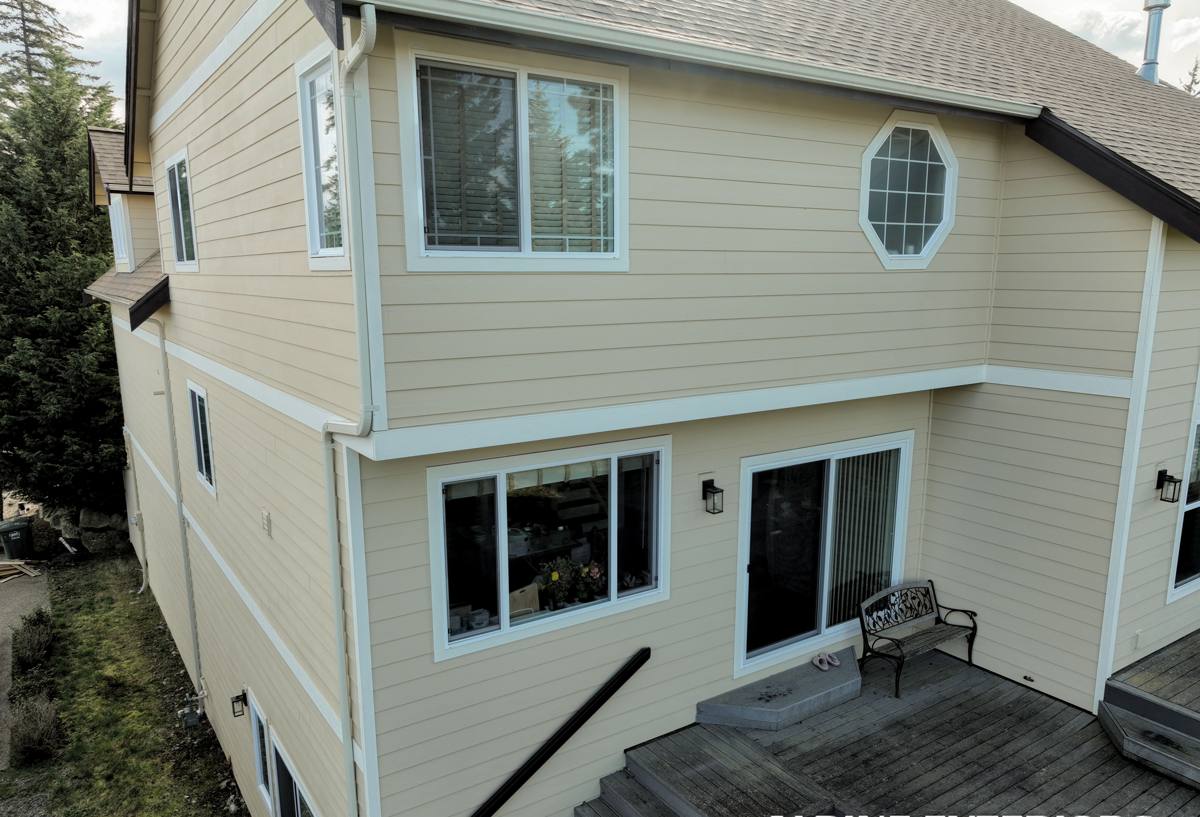
What a Deck Built for This Climate Actually Needs
A deck that's going to hold up in Happy Valley's rain-and-moss cycle needs a few things that a deck built somewhere drier can sometimes skip:
- Real drainage under the boards. Standing moisture between joists and decking is where rot and moss both start. Spacing, slope, and airflow matter as much as the decking material itself.
- Ledger board flashing that actually sheds water away from the house. This is the single most common failure point we see on older decks — water tracking behind the ledger and into the rim joist or wall sheathing.
- Corrosion-resistant fasteners and hardware. Coastal and near-lake air carries enough moisture and mineral content to accelerate corrosion on lower-grade screws, joist hangers, and post bases faster than most homeowners expect.
- A finish or material that doesn't need constant babying. Whatever decking you choose, it needs to handle repeated wet-dry cycles and shaded, slow-drying conditions without cupping, splitting, or hosting moss within a season or two.
Decking Material Options for This Area
Weighing your choices honestly
There's no single "right" decking material for Happy Valley — there's a right material for your budget, your maintenance appetite, and how shaded your particular lot is. Here's how the common options actually compare once you factor in this climate, not a national average.
| Material | Upfront Cost | Moss / Mold Resistance | Maintenance | Realistic Lifespan Here |
|---|---|---|---|---|
| Pressure-treated fir/hem-fir | Lowest | Fair — needs sealing to hold up | Annual cleaning + resealing every 2-3 years | 10-15 years with upkeep |
| Cedar | Moderate | Good — naturally rot-resistant | Periodic cleaning + oil/stain every 2-3 years | 15-20 years with upkeep |
| Composite (capped) | Higher | Very good — doesn't absorb moisture like wood | Periodic washing, no sealing/staining | 25+ years |
| PVC | Highest | Excellent — non-organic surface | Occasional washing | 25-30+ years |
The trade-off is straightforward: wood costs less up front but asks for regular attention to keep moss and rot from getting a foothold in a damp, shaded yard. Composite and PVC cost more initially but largely take that maintenance burden off the table, which matters a lot in a climate where a skipped season of sealing can mean visible moss growth by spring. We'll walk you through which makes sense for your specific site — a fully shaded lot under mature trees has different needs than a more open, sun-exposed yard even a few hundred feet away.
What we generally steer clients away from, and why
We're cautious about uncapped composite decking on heavily shaded Whatcom County lots — early-generation composite products without a full polymer cap can absorb moisture at the surface, and in a spot that doesn't get much direct sun to dry out, that's exactly the condition that encourages mold and moss staining. It's not that the product is bad everywhere; it's that our standard is picking materials that match the specific site conditions, and a shaded, damp lot calls for either a fully capped composite/PVC product or a wood species that's genuinely rated for ground-contact-level moisture exposure.
Framing and Structure: Where Deck Failures Actually Start
Decking gets all the attention because it's what you see and walk on, but the framing underneath is what determines whether the deck is safe and long-lasting. For Happy Valley conditions, our framing standards include:
- Footings sized and set to local frost depth and soil conditions, not just the minimum a permit will accept.
- Structural screws or hot-dipped galvanized/stainless hardware at every connection point — no bargain-bin fasteners that'll show rust streaks within a year or two.
- Proper ledger flashing with a water-resistant barrier behind it, so moisture is directed away from the house rather than trapped against the rim joist.
- Joist tape or an equivalent moisture barrier on top of framing members, which meaningfully slows rot at the number-one failure point on older decks: the top of the joist where fasteners penetrate.
- Post bases that hold posts above grade and off standing water, rather than buried or set directly on damp soil.
Our Process, Start to Finish
What to expect when you call us
- On-site assessment. We look at your yard's sun exposure, drainage patterns, and how close the deck will sit to grade or existing structures — all of which change the right approach.
- Honest material walkthrough. We'll lay out the real cost and maintenance trade-offs for your site specifically, not a generic sales pitch toward the most expensive option.
- Permit handling. Whatcom County requires permits for most new deck construction and many significant rebuilds; we handle that paperwork and inspection scheduling as part of the job.
- Build. Footings and framing first, with every connection point built to hold up to repeated wet-dry cycles, then decking, railing, and any finishing details.
- Final walkthrough. We go over basic care for whatever material you chose, so you know what upkeep (if any) is expected in year one versus year five.
Maintenance in a Moss-Prone, Salt-Air Environment
Even the best-built deck needs some seasonal attention out here. What that attention looks like depends heavily on material, but the underlying issues — moss, moisture trapping, and fastener corrosion — are the same regardless of what's on top. A simple seasonal checklist:
- Clear leaves, needles, and debris from between boards and along the ledger board before fall rains set in — trapped organic matter is moss's favorite starting point.
- Check that gutters and downspouts near the deck aren't dumping extra water onto or under it.
- Look for early moss or algae staining on shaded boards and treat it before it spreads, rather than waiting for a heavier buildup.
- Inspect fasteners and hardware for rust streaks or loosening, especially on railings and stair connections.
- For wood decks, reapply sealant or stain on the schedule the product calls for — skipping a cycle in this climate shows up fast.
- Confirm the deck still drains and doesn't pool water after a heavy rain; standing water is the clearest sign something under the surface needs attention.
Permits and Code Considerations
Most new decks and many deck rebuilds in Whatcom County require a building permit, with inspections at the framing stage and again at completion. Requirements can vary depending on deck height, size, and proximity to property lines, so this isn't something to guess at or skip — an unpermitted deck can complicate things later if you sell the home or need insurance to cover storm or structural damage. We handle the permit application and inspection scheduling as a standard part of the job, so it's one less thing you have to track down yourself.
Why Hire a Crew That Already Works This Area
A deck built the way it would be built in a drier, sunnier part of the country doesn't hold up the same way in a Whatcom County lakeside or coastal-adjacent neighborhood. The framing choices, fastener grade, flashing details, and even the material recommendation should reflect what actually happens to a structure that sits through a long wet season with limited sun exposure. Working with a crew that already builds and repairs decks in this specific area means those decisions aren't guesswork — they're based on what we've seen hold up here and what hasn't.
If you're planning a new deck or replacing one that's showing its age, we're happy to come take a look and give you a straightforward, no-pressure estimate — just fill out the form below.