 Sudden Valley Siding
 Board & Batten in a Marine Climate: What Fairhaven Homes Are Actually Up Against
Board and batten has a specific look — tall, clean vertical lines with crisp shadow lines at each batten — and it's a style that shows up a lot on homes near Fairhaven and around the broader Sudden Valley area of Whatcom County. It's also a style that punishes cheap execution faster than almost any other siding profile. The vertical joints, the batten-to-panel seams, and the exposed fastener lines all create more edges where water can get in if the assembly underneath isn't right.
In this part of Whatcom County, that matters more than most places. Homes here deal with salt-laden air off the water, long stretches of driving rain that comes in sideways during fall and winter storms, and a moss and algae season that can run most of the year on north-facing and shaded walls. None of that is unusual for a home in this region — but it means board and batten siding either needs to be built to handle it, or it becomes a maintenance headache within a few years.
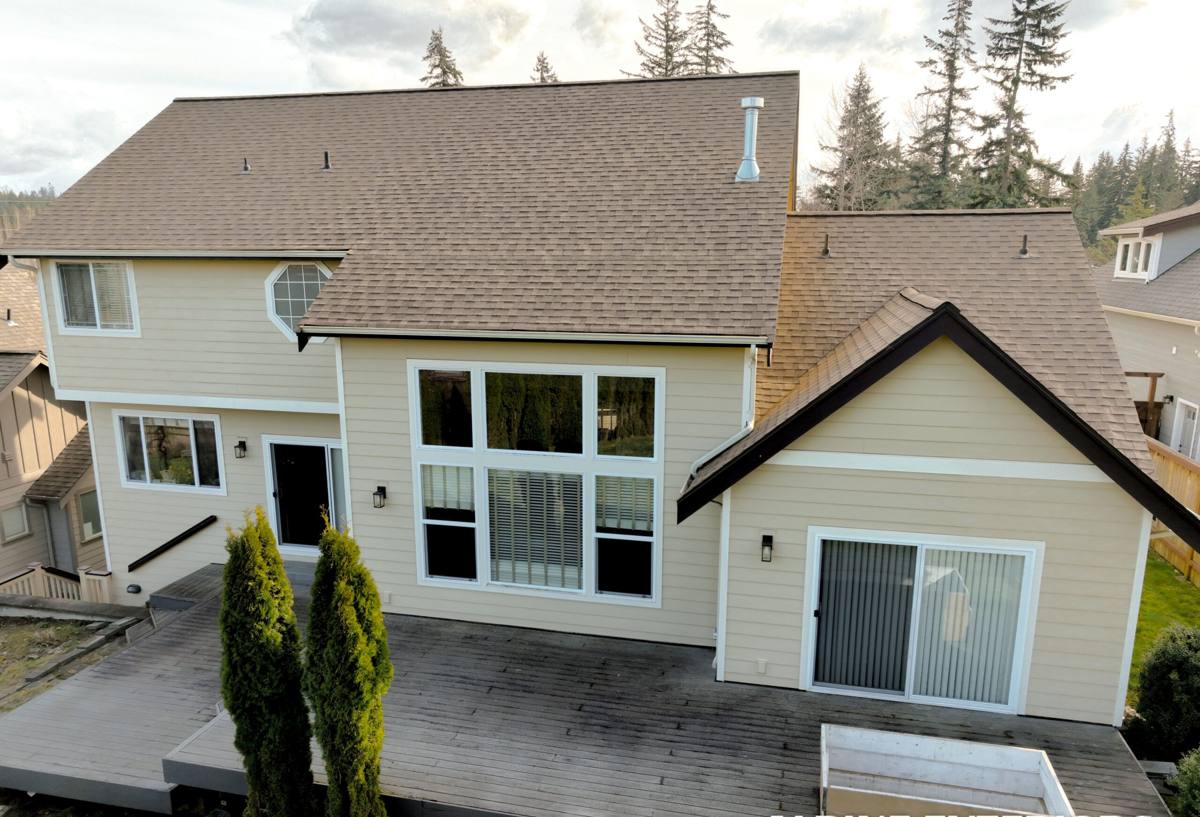
Why the Substrate Matters More Than the Style
Board and batten is a look, not a material. You can build it out of vinyl, engineered wood, primed spruce, cedar, or fiber cement, and from the street a lot of these will look similar for the first year or two. The difference shows up later — in how the material handles the moisture cycle that's constant in this climate, and in how the fasteners and seams hold up to salt air over time.
We install board and batten using James Hardie fiber cement exclusively — specifically HardiePanel vertical siding paired with HardieTrim battens. We don't install vinyl board and batten, engineered wood panel systems, or cedar board and batten, and we don't keep those materials in our lineup for this style or any other. That's a standard we apply across every job, not just in Fairhaven, but it's especially relevant here because the vertical-panel style leans hard on the material's ability to resist moisture intrusion at every seam.
What Actually Happens at the Seams
Every board and batten wall has two kinds of seams: the horizontal joints between panels (if the wall height requires more than one panel) and the vertical batten lines that cover the panel edges. Water finds both. A correctly built assembly manages that water with a drainage plane and rain screen behind the panels, proper flashing at every horizontal joint, and battens fastened in a way that doesn't trap moisture against the substrate. A poorly built one just relies on caulk to keep water out — and caulk is a maintenance item, not a moisture barrier, especially in a climate that sees this much sustained rain.
Comparing Board & Batten Materials for This Climate
Homeowners comparing quotes for board and batten siding in this area are usually comparing more than price — they're comparing how each material will actually perform against salt air, standing moisture, and moss growth over a 20-30 year window.
| Material | Moisture Behavior | Salt Air / Fastener Corrosion | Moss & Algae Resistance | Typical Maintenance |
|---|---|---|---|---|
| James Hardie fiber cement | Dimensionally stable; doesn't swell or rot when wet | Installed with corrosion-resistant fasteners; panel itself doesn't corrode | Factory ColorPlus finish resists moss staining better than bare wood surfaces | Occasional wash-down; repaint not needed for years |
| Vinyl board and batten | Doesn't rot, but panels expand/contract and can warp or bow | Fasteners can corrode over time; panel itself is inert | Moss and algae grow on the surface film; regular cleaning needed | Cleaning to prevent green staining; replacement of cracked panels |
| Engineered wood panel | Wood-based core is vulnerable to swelling and edge failure if water gets past the finish | Coated fasteners recommended; more sensitive install | Prone to moss/algae at seams if coating wears | Recoating and seam inspection on a schedule |
| Cedar board and batten | Natural wood; absorbs and releases moisture constantly | Needs corrosion-resistant fasteners; wood movement stresses seams | Moss and algae are common on cedar in shaded, wet walls | Staining/sealing on a recurring cycle; board replacement over time |
This isn't a claim that the other materials fail outright — it's that they each ask something of the homeowner (recoating, sealing, cleaning, watching for warping) that fiber cement doesn't. We standardized on James Hardie because it holds its shape, its finish, and its seams with the least ongoing intervention in a climate that doesn't give siding much of a break.
What Correct Installation Involves
The panel and batten material is only part of the equation. A board and batten job that's going to hold up near the water in Whatcom County needs a specific set of details done right, every time:
- Drainage plane and rain screen: a code-compliant weather-resistive barrier with a gap behind the panel so any water that gets past the surface has somewhere to go besides the wall sheathing.
- Flashing at every horizontal joint and penetration: window and door openings, hose bibs, light fixtures, and any panel-to-panel horizontal seam need proper flashing, not just caulk.
- Corrosion-resistant fasteners: stainless steel or hot-dip galvanized fasteners set to Hardie's specification, because salt-laden air accelerates corrosion on lesser hardware faster than most homeowners expect.
- Correct batten spacing and fastening: battens installed per manufacturer spec so they cover the panel seam fully without trapping water against it.
- Proper clearance at grade and roofline: siding held off decks, patios, and roof lines by the specified gap so splashback and runoff don't sit against the bottom edge.
- Factory-finished ColorPlus panels where possible: a factory-applied finish resists fading and moisture better than field-applied paint on cut edges, which we seal separately.
Which Hardie Product Line We Use Here
James Hardie engineers its siding by climate zone, and homes in this part of Washington fall into the HZ5 zone — built for regions with sustained moisture and freeze-thaw cycles rather than extreme heat. We spec HZ5 HardiePanel and matching HardieTrim battens for Fairhaven and Sudden Valley jobs specifically because that's the formulation designed for what this climate actually does to a wall, not a generic national product.
Our Process for a Fairhaven Board & Batten Job
- On-site walkthrough: we look at wall exposure, existing moisture damage, roofline clearances, and how much shade and salt exposure each elevation gets — a north wall near tree cover and a south wall facing open water don't need identical treatment.
- Scope and product plan: we spec panel texture, batten spacing, and ColorPlus color, and identify any sheathing or flashing repairs needed before siding goes on — covering rot or soft sheathing with new siding just hides the problem.
- Tear-off and substrate check: old siding comes off, sheathing gets inspected and repaired as needed, and the drainage plane goes on correctly the first time.
- Installation to spec: panels, flashing, and battens go on following Hardie's fastening and clearance requirements, not shortcuts that save a day but cost the homeowner in five years.
- Final walkthrough and warranty registration: we walk the job with the homeowner, and register the installation for James Hardie's manufacturer warranty coverage.
Moss, Algae, and the Long Wet Season
Moss and algae aren't a defect — they're what happens on any exterior surface in Whatcom County that stays damp and shaded for months at a time. The question is how much the siding itself contributes to the problem. Rough or porous surfaces, and materials that hold moisture in their structure, give moss more to grip and more time to establish. A dense fiber cement panel with a factory finish sheds water and gives moss less to hold onto, but it still needs the same basic care every siding material does in this climate: keeping vegetation and gutters clear of the wall, rinsing shaded elevations periodically, and not letting sprinklers hit the siding directly for hours at a time.
Homeowner Checklist Before Hiring for This Job
- Ask what's happening behind the panels — drainage plane, rain screen gap, and flashing details, not just the finish material.
- Confirm the fastener type and whether it's rated for coastal/salt-air exposure.
- Ask which Hardie climate zone product (HZ5 vs. HZ10) is being specified for your home.
- Get the batten spacing and attachment method in writing, not just "board and batten style."
- Check that sheathing and moisture damage get inspected and addressed before new siding goes on, not covered over.
- Ask how the manufacturer warranty gets registered and what voids it.
Why a Crew That Already Works This Area Matters
Board and batten installed to spec in a dry inland climate and board and batten installed to spec near Bellingham Bay aren't quite the same job. The flashing details, fastener selection, and even which Hardie climate line to spec change based on how much salt air and sustained moisture a wall sees. A crew that works Fairhaven and Sudden Valley regularly has already seen what happens when those details get skipped — soft sheathing behind panels installed without a drainage gap, corroded fasteners on jobs that used the wrong hardware, moss buildup on walls that never got proper clearance at grade. That's the kind of thing you learn from doing the work in this specific climate repeatedly, not from a spec sheet.
Cost Factors to Expect
Board and batten costs more than standard lap siding to install correctly — there are more linear feet of trim and fastening involved per square foot of wall, and the vertical panel-and-batten assembly takes more labor time than a straightforward horizontal lap job. Exact numbers depend on wall square footage, how much of the existing siding and sheathing needs to come off and be repaired, roofline and window trim complexity, and color selection. We give homeowners a real number after walking the property, not a phone estimate — but broadly, expect board and batten in Hardie fiber cement to run above vinyl and engineered wood options and closer to, or above, quality cedar, with the advantage that the ongoing maintenance cost over the life of the siding runs meaningfully lower.
| Cost Factor | Why It Matters |
|---|---|
| Wall square footage and elevation count | More cuts and corners mean more labor and material |
| Existing sheathing condition | Rot or moisture damage found during tear-off adds repair cost before siding goes on |
| Batten spacing and trim detail | Tighter spacing and more trim at windows/rooflines add labor time |
| ColorPlus color and panel texture | Factory-finished options vary slightly in cost by color and texture selection |
| Access and site conditions | Steep grades, limited access, or multi-story walls affect labor time |
If you're weighing board and batten siding for a home in Fairhaven or elsewhere around Sudden Valley, we're glad to walk the property, look at what your walls are actually dealing with, and put together a straightforward, no-pressure estimate — just fill out the form below.